Expired Electric Contract: What to Verify in Texas
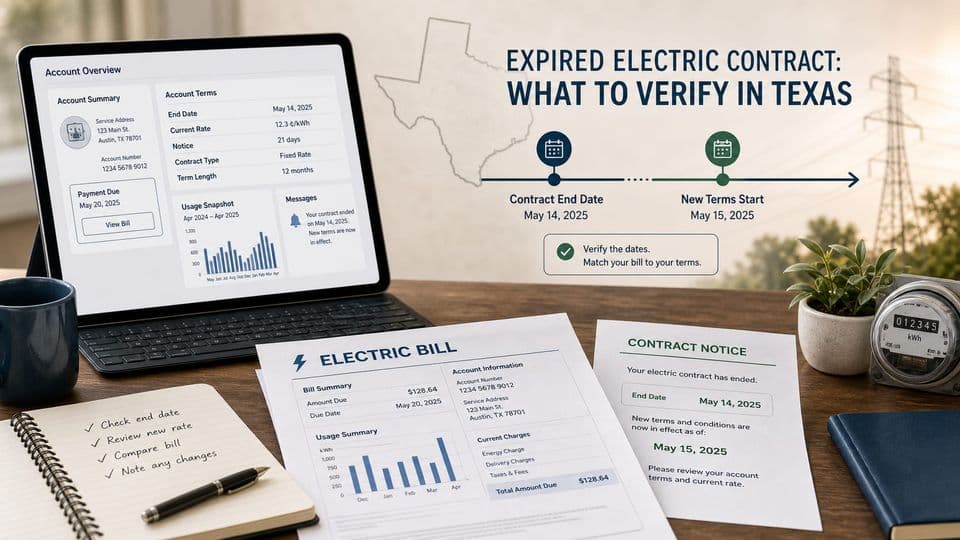
If your electric contract expired and your bill changed, start with the contract end date, provider notice, current account terms, and any separate fee or disconnection notice. The answer depends on your documents, not a single statewide shortcut.
Key Takeaways
- 1An expired electric contract means the contract term reached its end date, but the next account terms must be verified in provider notices and contract records.
- 2A bill can change after the end date. Customers are typically rolled over to a higher-rate month-to-month plan if the contract is not renewed on time.
- 3Early termination fees are a separate from expiration.
- 4Shutoff should be handled through provider disconnection notices and official disconnection rules.
If your electric contract expired and your bill changed, it is natural to wonder whether the expiration itself caused the difference. You may be asking whether a Texas electricity contract expired notice triggered a new rate, or whether you missed a renewal window that left you on a more expensive option.
The answer depends on a few specific documents and dates tied to your account. There is no single statewide shortcut. This article walks through what to verify so you can tell whether the contract end date is actually the factor behind the change.
Confirm the Contract End Date First
Before blaming an expired contract, you need to be sure the contract term has actually ended. The end date is the specific day stated in your contract agreement. It is not the same as the date you started service, the date you received a renewal offer, or the date your next bill covers.
Find the end date in the provider notice
Your retail electric provider should have sent you a contract expiration notice that states the end date. If you have an online account, the same date should appear in your account record or contract summary.
Check that notice first. If you cannot find it, look at the terms of service or the original contract document for the stated term length and start date. The actual expiration date determines everything that follows.
Documents That Control What Happens Next
The terms that apply after the contract end date come from a small set of documents. General internet advice about what usually happens does not apply to every Texas customer. Your provider notice, contract agreement, and current account status are the only reliable sources for your situation.
Check the contract, terms, and notice together
Start with the original contract agreement. It may include a section about what happens after the term ends. Then look at the expiration notice the provider sent before the end date. That notice should explain what options or terms apply next.
Finally, look at your current account record, which shows the rate or pricing that is already in effect. If all three documents say the same thing, you have a clear answer.
If they differ, the most recent written notice from the provider is usually the controlling document, but you may need to check official Texas rules for specific requirements.
Post-Term Labels Such as Month-to-Month, Variable, Holdover, or Default
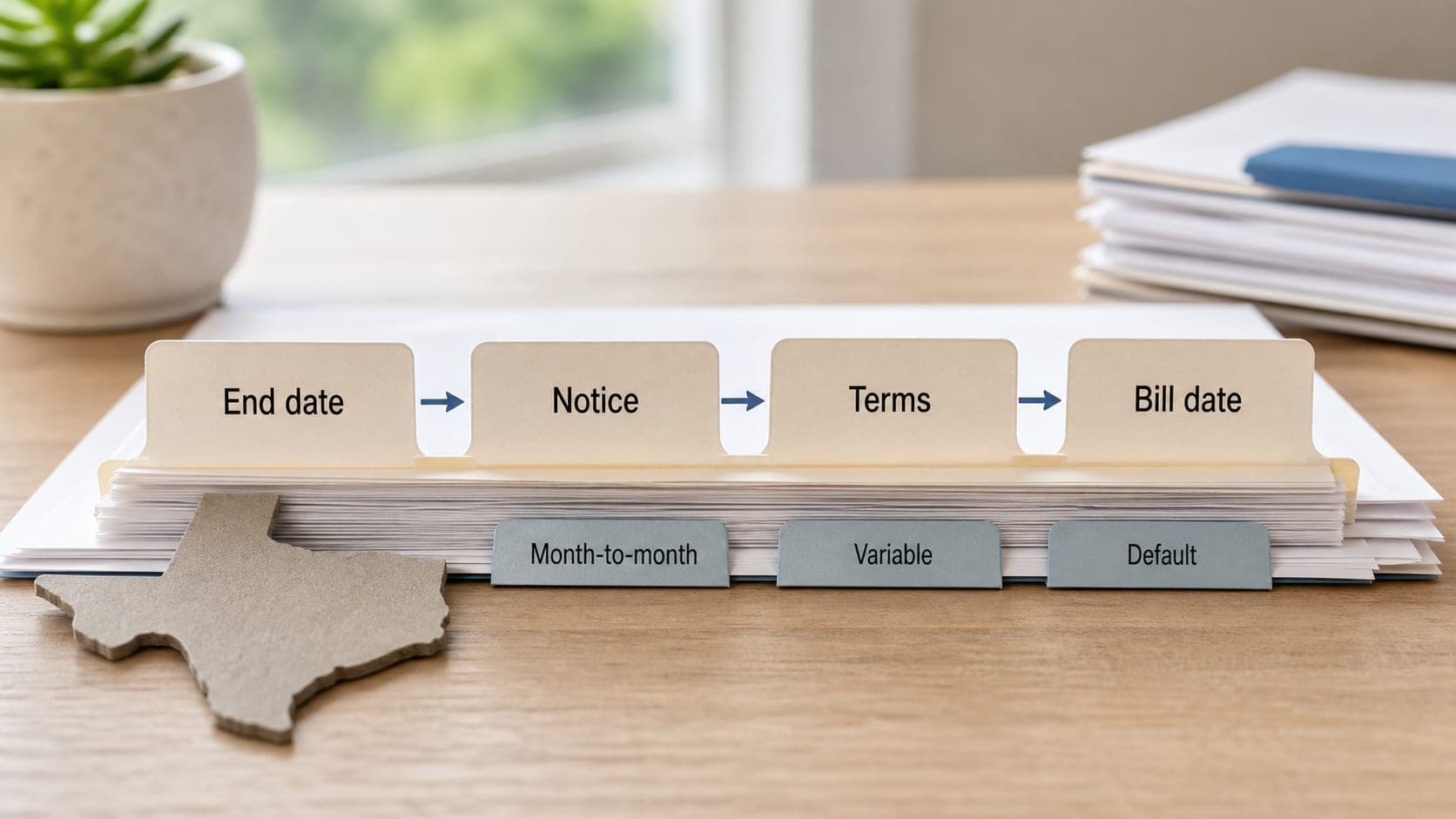
You may see terms like month-to-month, variable rate, holdover rate, or default pricing. These describe possible outcomes, but they are not guaranteed for every Texas account. The only way to know which one applies to your account is to read the provider notice or contract language that follows the end date.
Treat post-contract pricing as document-specific
If your provider uses the term holdover rate or default pricing, that term should appear in writing somewhere in the notice or contract terms. Do not assume that every provider uses the same language. Some accounts move to a month-to-month arrangement with a variable rate, others may shift to a default price that is different from the previous fixed rate.
The important step is to find the phrase in your actual documents. Without that confirmation, you are guessing at the terms.
Bill Changes After the Contract Term Ends
A bill can change after a contract ends if the terms that apply next are different from the terms in the prior fixed-term agreement. That is a pretty straightforward, but it does not mean every expired contract automatically leads to a higher bill. The change depends on what the provider offers after the end date and on your usage during the new period.
Match the bill date to the contract timeline
Compare the date on your higher bill to the contract end date. If the bill covers days after the end date, the new terms may have caused the difference. If the bill covers days before the end date, something else may be at play. Also check the provider notice for any mention of a new rate that took effect immediately after the expiration. That notice is the clearest clue about whether the bill change is related to the contract term.
Early Termination Fees Are Different
Expiration and early termination are not the same thing. Expiration means the contract term reached its stated end date. Early termination means the customer canceled a fixed-term agreement before that end date.
Mixing these two situations leads to confusion about what fees apply and when.
Check whether the fee question is before or after the end date
If your contract already expired, an early termination fee no longer applies to that contract. The fee only applies if you canceled before the end date. If you are unsure whether you canceled early or let the contract run to its end, check the cancellation date against the end date in your contract.
The rule about early termination fees is governed by the Texas Public Utility Commission and the specific language in your contract. Do not assume that every provider charges the same fee or follows the same exceptions.
Renewal and Expiration Notices
Provider notices are the most valuable records you can keep around a contract end date. They tell you when the current term ends, what options or terms may apply next, and in some cases how to accept or decline a renewal offer.
Exact notice timing can change based on Texas rules, so the key is to save every notice you receive.
Verify exact notice timing in current Texas rules
The Texas rule that governs contract expiration notices is part of the Public Utility Commission rules for retail electric providers. The exact number of days before the end date that a provider must send a notice can vary depending on the account type and the current rule version.
Does Service Stop When the Contract Ends?
A common fear is that electricity service will stop the day the contract expires. That fear usually comes from confusing a contract end date with a disconnection notice. The two are separate events with separate rules.
Use disconnection notices for shutoff questions
If you received a disconnection notice, that notice is tied to your payment status, provider communications, and official Texas disconnection rules.
It is not automatically triggered by the contract end date. To understand whether your service is at risk, read the disconnection notice carefully and refer to the PUCT disconnection rules. The contract expiration notice itself rarely includes disconnection information.
Keep the two categories separate: contract expiration tells you about your pricing terms, disconnection notices tell you about service interruption.
Multiple Addresses, Meters, or Accounts Can Create Date Confusion
If you have more than one service address, meter, or account, each one has its own contract end date. A provider notice for one account does not necessarily apply to another. This is a common source of confusion for customers with a home and a rental property, or for small businesses with multiple meters.
Confirm each contract end date separately
Check the start date and term length for each account individually. Keep separate records for each contract and each expiration notice. A renewal or price change on one account may be entirely unrelated to another. Treating them as the same can lead to missed deadlines or incorrect assumptions about what terms apply where.
Common Mistakes When Reading an Expiration Notice
Even when you have the right document, it is easy to misread it. Some common mistakes lead to unnecessary concern or missed opportunities to confirm current terms.
Do not assume one statewide rollover rule
Texas does not have a single rule that tells every provider how to handle post-expiration terms. Each provider writes its own contract language and sends its own notices. Reading the word expired and assuming a specific outcome is the most common mistake.
Instead, treat the notice as a starting point and then look at the actual terms that apply after the end date. Also, do not confuse an expiration notice with a renewal offer or a disconnection notice. Each document answers a different question.
Records to Keep Before the Next End Date
The best way to avoid confusion with future contract end dates is to build a simple recordkeeping habit now.
You do not need a spreadsheet, just a folder and a calendar reminder.
Save the contract agreement, the expiration notice, any renewal communication, and the current account terms that show what applies after the end date.
When you receive a new notice, compare it to the previous one to see if the terms have changed.
Set a calendar reminder for a few weeks before each end date so you have time to read the notice and confirm the next terms before the bill changes. The goal is to check the date, read the notice, confirm the terms, and keep the record.
That habit alone prevents most of the confusion that comes from an expired electric contract.
FAQs About Expired Electric Contracts in Texas
Editorial standards
SlashPlan publishes independent guidance to help Texans compare electricity plans. Our editorial team reviews each article without advertiser influence. See our editorial guidelines and monetization disclosure.
About the author
Roi CahanaEnergy advisor helping Texans better understand their electricity options and make more confident decisions. Focused on simplifying electricity plans, explaining confusing terms, and sharing practical guidance to help readers avoid common mistakes when comparing rates, contracts, and renewals.
Ready to compare plans?
Enter your ZIP code to see electricity plans available at your address.