How to Switch Electricity Providers in Texas
Learn how to switch electricity providers in Texas, compare plans by usage, read EFLs, avoid fees, and keep service uninterrupted.
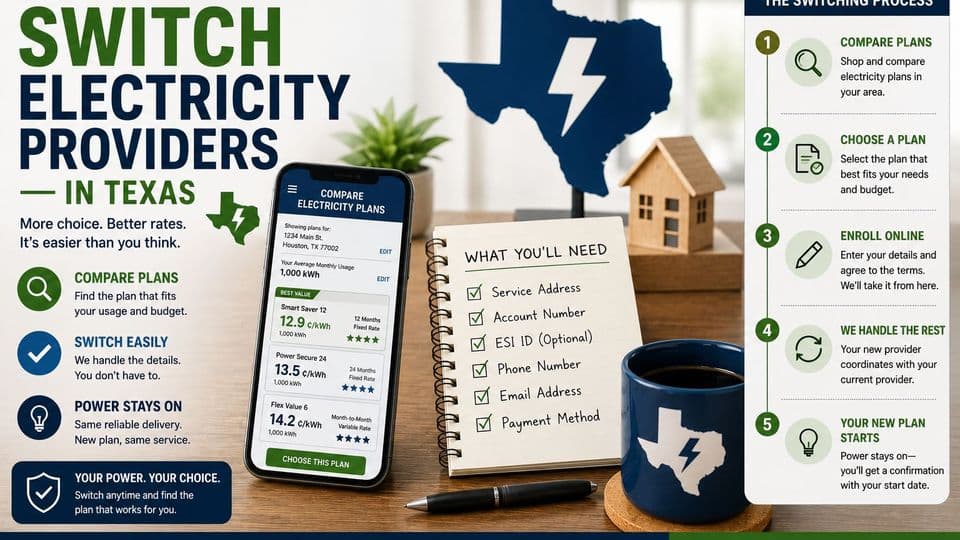
Key Takeaways
- 1Texas shoppers should confirm address-level eligibility before comparing providers because municipal utilities and electric cooperatives may not offer retail choice.
- 2Switching providers usually changes the retail plan and billing relationship, not the local delivery utility that maintains poles, wires, meters, and outage response.
- 3The best plan comparison uses the household's real kWh history, not only the advertised rate at a single usage level.
- 4The Electricity Facts Label, Terms of Service, and Your Rights as a Customer disclosure should be reviewed before enrollment.
- 5Early termination fees, switch holds, unpaid balances, deposits, and payment rules can change whether switching is worth it.
- 6Account numbers should be protected because they can be misused for unauthorized enrollment.
Can you switch electricity providers in Texas?
Many Texans can select a retail electric provider, but eligibility begins with the exact service address. The answer is not the same everywhere in the state.
Address-level eligibility comes first
Retail choice exists only in areas served by competitive transmission and distribution utilities. Verify the address on the Public Utility Commission of Texas website or ask the current provider before shopping new offers.
Municipal utilities and electric cooperatives may be different
Customers inside city-owned utilities or member-owned cooperatives usually cannot switch retail suppliers. Those utilities set their own rates and rules.
Why national switching advice can mislead Texas shoppers
Guides written for other states often assume every address has choice. In Texas the distinction between deregulated and non-competitive territories matters.
What changes when you switch, and what stays the same
Switching replaces the retail electric provider and the plan terms that govern the energy charge. The physical delivery of electricity remains unchanged.
Your REP handles the plan and retail account
The new retail electric provider sets the rate, issues the monthly bill, and manages customer service for that account.
Your TDU keeps delivering power
The local transmission and distribution utility continues to own the poles, wires, and meters. It restores service after storms and reads the meter regardless of which retail provider you choose.
Why the lights should stay on during the switch
A normal provider switch is an administrative change. No technician visits the home, the meter stays in place, and service continues without interruption.
Check your current plan before you shop
Review the contract end date and any early termination fee first. Starting a new enrollment too soon can cost more than the advertised savings.
Find the contract end date
The end date appears on the current bill or in the Terms of Service. Note it before comparing new plans.
Check the early termination fee
Calculate the fee against the expected savings of the new rate. A high fee can erase any advantage for several months.
Watch renewal and auto-renewal language
Some contracts convert to a variable rate or a higher fixed rate if no action is taken. Confirm the exact renewal terms before the end date.
Gather the account details you will need
A recent electric bill supplies most of the information required for enrollment.
Service address, account number, and ESI ID
The new provider asks for the service address, ESI ID, and account number to locate the meter and complete the switch.
Usage history from recent bills
Twelve months of usage helps match the household to the right rate structure and bill-credit threshold.
Keep the account number private until you are ready to enroll
Treat the account number as sensitive data. Do not share it with door-to-door or phone solicitors unless enrollment is intentional.
Compare plans using your real kWh usage
Plans that rank lowest at one usage level can rank higher at another. Use the home's actual monthly kilowatt-hour history.
Why 500, 1000, and 2000 kWh prices can rank plans differently
Tiered rates, bill credits, and minimum-usage rules shift the effective price as consumption rises or falls.
How bill credits and usage tiers change the bill
A credit that appears only above 1,000 kWh changes the comparison for a low- or high-usage household. Check the conditions that trigger or remove the credit.
Seasonal usage matters in Texas homes
Summer air-conditioning and winter heating can double usage in peak months. Compare plans against the highest month to avoid surprises.
Read the Electricity Facts Label before you enroll
The Electricity Facts Label lists the energy charge, base charge, contract length, and early termination fee in one place. Read it before submitting any enrollment.
Energy charge, base charge, and delivery charges
Confirm whether the quoted rate includes or excludes the transmission and distribution utility delivery charge. Delivery charges appear on every bill regardless of provider.
Contract length and cancellation terms
Note the exact term length and the fee that applies if service ends early. Some plans allow a one-time move without a fee; verify the exception.
Renewable content and special pricing conditions
Renewable plans list the renewable percentage on the EFL. Review any usage requirements or seasonal adjustments that accompany the renewable claim.
Choose the rate type that fits your risk tolerance
Fixed-rate plans lock the energy charge for the contract term. Variable-rate plans move with wholesale market conditions.
Fixed-rate plans for price stability
A fixed-rate contract protects against summer price spikes but does not freeze regulated delivery charges or taxes.
Variable-rate plans and bill volatility
Variable plans can drop quickly when wholesale prices fall, yet they can rise sharply during extreme weather events.
Renewable plans without rooftop solar
Renewable content can be purchased through the retail provider. The power delivered to the home still travels over the same wires.
Fees that can erase the savings
Several charges appear only after enrollment or after leaving the old plan.
Early termination fee on the old plan
Include the remaining early termination fee in any savings estimate before switching.
Minimum usage fees, bill credits, and base charges
Plans that require a minimum monthly usage or award a credit only at higher tiers can increase the bill for smaller homes.
Deposits, late fees, and payment options
New providers may require a deposit based on credit score. Budget billing and autopay discounts should be compared when bill stability matters more than the lowest rate.
The best time to switch
The lowest-risk window occurs near the current contract expiration.
Near the end of the current contract
Waiting until the final weeks reduces exposure to an early termination fee.
When moving to a new Texas address
A move can change the available providers and the utility territory. Compare plans at the new address before transferring service.
After your household usage changes
Adding an EV charger or increasing the number of occupants can make the existing plan a poor fit. Re-evaluate when usage patterns shift.
How to enroll with the new provider
After selecting a plan, confirm every detail before authorization.
Confirm the service address and start date
Verify that the enrollment start date aligns with the contract end date of the current provider.
Review the authorization before submitting
Read the final confirmation screen that lists the plan name, rate, term length, and cancellation fee.
Save the confirmation and plan documents
Store the confirmation number, Electricity Facts Label, Terms of Service, and Your Rights as a Customer disclosure for future reference.
What happens after enrollment
The new provider submits the switch request to the Electric Reliability Council of Texas.
The new provider submits the switch
The transfer occurs on the date listed in the enrollment confirmation unless a hold exists on the account.
The old provider sends a final bill
Any remaining balance or credit appears on the closing bill. Resolve the balance promptly to avoid a switch hold.
Watch for confirmation and first-bill details
Expect a confirmation letter or email from the new provider. Compare the first full bill against the enrolled plan documents.
If you owe money or have a switch hold
An unpaid balance often blocks a new enrollment.
How a switch hold can block enrollment
A utility or previous provider can place a switch hold until the balance is paid. Resolve the hold before attempting another enrollment.
Final bills, credits, and unpaid balances
Any credit on the old account should appear on the final bill. Contact the previous provider if the refund does not arrive within the stated timeframe.
What to resolve before trying again
Clear the balance or arrange a payment plan before shopping new providers.
How your bill may look after the switch
The first bill from the new provider may separate supply and delivery charges differently than the previous format.
Supply charges and delivery charges
Supply charges reflect the new plan rate. Delivery charges remain the transmission and distribution utility tariff.
Combined billing or separate billing
Most providers consolidate charges on one bill. Confirm whether the new provider uses combined or separate billing.
Payment setup after the switch
Re-enter autopay and budget-billing preferences. Previous settings do not transfer automatically.
Sales pitches, savings claims, and account-number safety
Protect account information during any sales contact.
Treat savings claims as something to verify
Compare the advertised rate against the Electricity Facts Label at the household's actual usage before enrolling.
Watch for utility impersonation
Confirm whether a salesperson represents a retail electric provider or merely markets on behalf of one. The local utility does not sell retail plans.
Protect your account number
Share the account number only after reviewing the full plan documents and deciding to enroll.
A final pre-switch checklist for Texas shoppers
Confirm address eligibility and current contract status before comparing offers.
Compare the selected Electricity Facts Label at the household's real usage level.
Enroll only after verifying the start date, cancellation terms, renewal rules, and required authorizations.
Switching Electricity Providers FAQ
Sources & References
Editorial standards
SlashPlan publishes independent guidance to help Texans compare electricity plans. Our editorial team reviews each article without advertiser influence. See our editorial guidelines and monetization disclosure.
About the author
Roi CahanaEnergy advisor helping Texans better understand their electricity options and make more confident decisions. Focused on simplifying electricity plans, explaining confusing terms, and sharing practical guidance to help readers avoid common mistakes when comparing rates, contracts, and renewals.
Ready to compare plans?
Enter your ZIP code to see electricity plans available at your address.