Texas Electricity Deposit Rules and Waiver Options
A practical guide for Texas electricity shoppers who want to know why a deposit was requested, whether it can be waived, when it comes back, and when prepaid or no-deposit service makes sense.
Key Takeaways
- 1A Texas electricity deposit is usually refundable, but it can raise the upfront cost of starting service.
- 2A deposit request can come from limited utility history, late payments, unpaid balances, identity verification issues, or other enrollment factors.
- 3Some shoppers may qualify for a deposit waiver, including eligible older customers, family violence survivors, and customers with strong recent utility payment history.
- 4Deposits may earn interest and may be refunded after a qualifying on-time payment period or applied to the final bill when service ends.
- 5No-deposit and prepaid plans can help with upfront cash, but shoppers should compare the total bill, fees, and service rules before choosing one.
The signup decision: deposit, waiver, or no-deposit plan
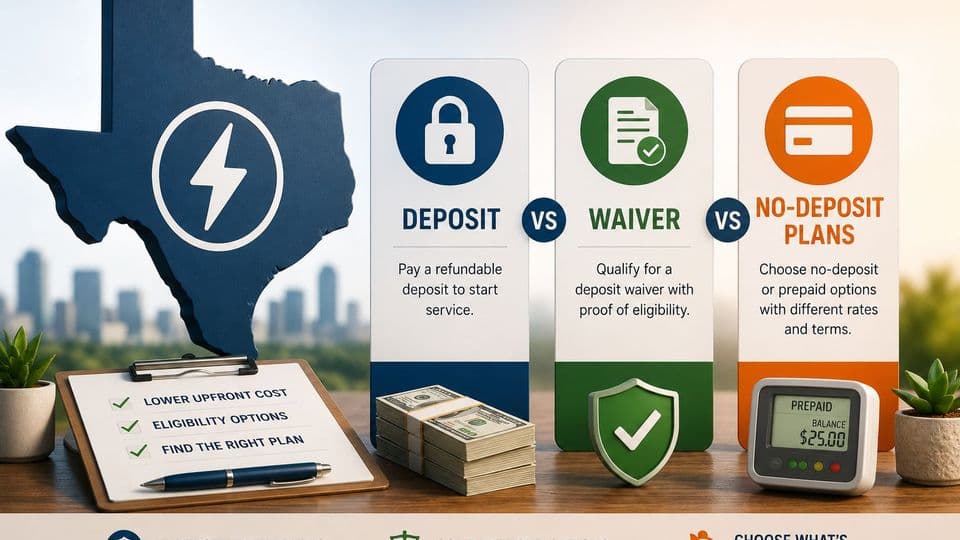
Texas shoppers who compare plans often face three choices at enrollment. They can pay a refundable deposit, request a waiver when eligible, or look at no-deposit and prepaid plans. Each path changes the upfront cost and the rules that govern service.
A deposit adds cash needed to start power, but it often returns later. A waiver removes the payment for qualifying customers who provide proof. No-deposit or prepaid plans lower the entry barrier yet usually carry different rates and usage rules.
Shoppers should weigh the full bill, not just the first amount due. Deposit rules, screening steps, and plan terms together determine the better route for each household.
What a deposit changes at enrollment
A deposit raises the total paid on day one. Providers calculate the amount from expected usage and account details. The refund arrives only after the account meets the provider's on-time payment requirement or when service ends.
Why a Texas provider may ask for a deposit
Electricity is used before the bill arrives, so a deposit protects the provider against unpaid usage. Limited utility history, late payments, unpaid balances, identity verification issues, or expected high usage can all trigger the request. Requirements also differ by provider and situation.
Payment history and outstanding balances
Past due amounts or missed payments on prior utility accounts often lead to a deposit request. Providers check records to estimate risk before new service begins.
Identity checks, credit freezes, and limited history
New residents, recent movers, or customers with thin utility records may see a deposit because the provider lacks enough payment history to judge risk. A credit freeze or mismatched identity documents can produce the same outcome.
How much a Texas electricity deposit can be
Texas rules tie the deposit amount to either one-fifth of the estimated annual bill or the sum of the first two estimated monthly bills. The final figure depends on the provider's usage projection, home size, plan type, and account details.
Shoppers should not pick a plan by the advertised rate alone when one option requires a large deposit and another does not.
The two common cap calculations
One formula uses annual usage estimates. The other uses the first two months of projected usage. Providers apply the calculation that fits their internal model for the address and meter type.
Why home size and usage estimates matter
Larger homes or accounts with summer cooling or electric heat can raise the deposit because the provider forecasts higher kWh use. Smaller apartments or efficient homes usually receive a lower figure.
Credit checks during electricity enrollment
Many retail electric providers run a soft credit check or utility account screen at signup. The request for a deposit can stem from thin history, mismatched identity data, prior utility problems, or other risk factors rather than a single score.
Soft checks and what they do not tell you
A soft check leaves the credit score unchanged. It does not guarantee no deposit, because payment history and identity verification still influence the final decision.
Deposit waiver paths to ask about
Some Texas customers can avoid the deposit with proper documentation. Eligible groups include customers age 65 or older, family violence survivors, and those who can show consistent recent utility payments. Proof must usually be submitted before the provider waves the fee.
Age 65 or older
Customers who meet the age threshold can request the waiver and supply identification that confirms eligibility.
Family violence survivor documentation
Survivors may qualify with the required verification letter or court document. The provider sets the exact submission method during enrollment.
Strong recent utility payment history
A record of on-time payments for the prior 12 months can support a waiver request. The outgoing utility or provider must supply the payment history letter.
How deposit interest and refunds work
Texas electricity deposits can earn interest under current PUCT rules. The deposit is typically returned with interest after 12 consecutive on-time payments or applied to the final bill when service ends.
After 12 consecutive on-time payments
Once the account meets the payment record, the provider issues a refund that includes any accrued interest. The exact timing follows the provider's billing cycle.
At move-out or final billing
When service stops, the provider applies the deposit and interest to any remaining balance. Any excess amount returns to the customer.
No-deposit and prepaid electricity options
No-deposit electricity often takes the form of prepaid service that requires payment before power flows. These plans remove the traditional deposit but introduce balance monitoring and different disconnection timing.
No credit check does not automatically equal the lowest total cost. Rates, fees, and usage rules still affect the monthly bill.
How prepaid service works
Customers add funds to an account and receive power until the balance reaches zero. Alerts notify the user before disconnection occurs.
No credit check is not the same as cheapest
Prepaid plans can carry higher per-kWh rates or extra fees. Shoppers who compare total estimated monthly cost often find that a refundable deposit plus a lower traditional rate ends up lower over several months.
Prepaid vs. traditional plans: compare the total bill
The choice between prepaid and traditional service involves more than the upfront deposit. Energy rates, delivery charges, monthly fees, usage tiers, balance alerts, and disconnection rules all differ.
Prepaid service can suit urgent move-ins, short-term stays, or cases where a waiver is not available. Traditional postpaid service with a refundable deposit can produce a lower ongoing bill when the deposit returns after the qualifying period.
Energy rate, delivery charges, and monthly fees
Prepaid plans sometimes list a higher energy charge or add daily fees. Traditional plans include the same delivery charges from the utility but may avoid extra prepaid account fees.
When prepaid can still be the right short-term move
Short stays, immediate move-in needs, or credit issues that block traditional service without a large deposit can make prepaid the practical option for a month or two.
Getting connected when timing matters
Shoppers who need power on a specific date should gather service address details, identification, preferred start date, and any waiver documents before enrollment. Prepaid or no-deposit plans can speed connection in some cases, yet old balances or switch holds can still delay activation.
What to have ready before signup
Service address, driver's license or state ID, payment method, and recent utility statements help the enrollment process move faster. Waiver documentation should be scanned and ready to upload.
Documents to check before you choose a plan
Before enrolling, review the Electricity Facts Label, Terms of Service, and Your Rights as a Customer disclosure. These documents show deposit amounts, refund rules, monthly fees, and cancellation terms that the advertised rate does not capture.
A low energy rate can still produce a higher bill once fees and delivery charges are added. Comparing deposit size, refund conditions, and total estimated monthly cost together gives a clearer picture.
Electricity Facts Label and Terms of Service
The Electricity Facts Label lists the energy charge, delivery charges, and any recurring fees. The Terms of Service spell out deposit handling and early termination charges.
Your Rights as a Customer disclosure
This document explains how the provider handles deposits, interest, and refunds under Texas rules. It also covers disconnection procedures that vary between prepaid and traditional plans.
Texas electricity deposit FAQ
The structured FAQ block for this page will be rendered by the CMS from the approved answers.
Texas Electricity Deposit FAQ
Sources & References
Topics
Editorial standards
SlashPlan publishes independent guidance to help Texans compare electricity plans. Our editorial team reviews each article without advertiser influence. See our editorial guidelines and monetization disclosure.
About the author
Roi CahanaEnergy advisor helping Texans better understand their electricity options and make more confident decisions. Focused on simplifying electricity plans, explaining confusing terms, and sharing practical guidance to help readers avoid common mistakes when comparing rates, contracts, and renewals.
Ready to compare plans?
Enter your ZIP code to see electricity plans available at your address.