How to Read an Electricity Facts Label in Texas
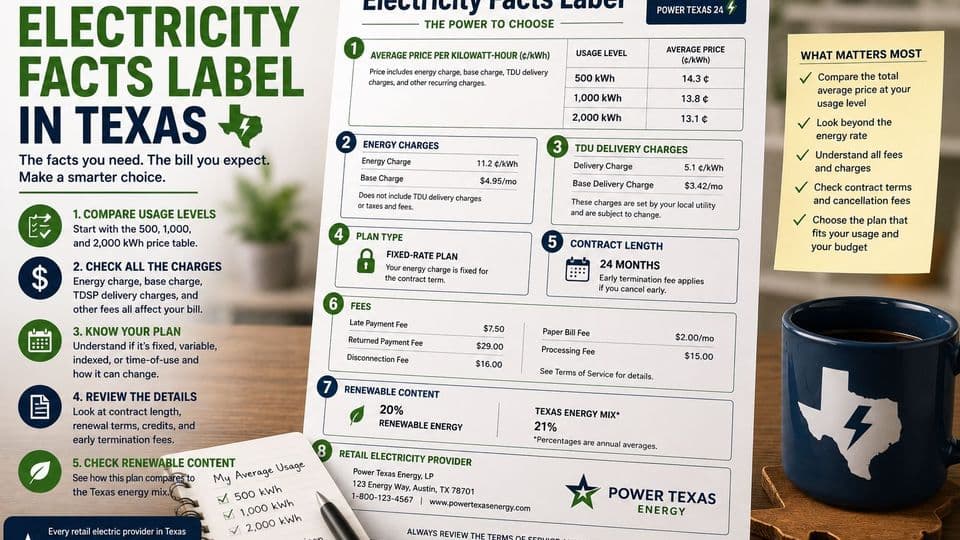
An EFL shows the details that matter most when a shopper compares Texas electricity plans. It lists the plan type, contract length, average prices, fees, renewable content, and provider information.
Key Takeaways
- 1The Electricity Facts Label is the Texas plan document to read before enrolling because it shows pricing, plan type, fees, contract terms, and renewable content.
- 2The average price at 500, 1,000, and 2,000 kWh only helps if you compare it with your own household usage.
- 3TDSP or TDU delivery charges come from the local utility and apply no matter which retail electric provider you choose in that service area.
- 4Usage credits, base charges, and minimum usage rules can make a plan look cheap at one usage level and costly at another.
- 5A fixed-rate plan can make the energy charge more predictable, but contract length, renewal timing, and early termination fees still matter.
- 6The Terms of Service and Your Rights as a Customer disclosure can reveal fee details that the EFL only summarizes.
An Electricity Facts Label shows the details that matter most when a shopper compares Texas electricity plans. The document lists the plan type, contract length, average prices at set usage levels, fees, renewable content, and provider information. Every retail electric provider must issue this standardized form, and reviewing it before enrollment helps avoid surprises on the first bill.
What the EFL Tells You Before Signup
The Electricity Facts Label is a required disclosure, not a marketing summary. It covers pricing structure, plan type, contract term, fees, renewable content, and basic provider details. Shoppers should read the full label before signing up and keep a copy for reference after enrollment. The document sets clear expectations about what the plan includes and what it does not cover.
Where to Find the EFL Before Enrolling
Look for an EFL link or PDF on the plan detail page while comparing offers. If the link does not appear, ask the provider directly for the document before entering personal information. Providers are also required to supply the EFL after signup. Relying on an advertised rate without seeing the full label increases the chance of unexpected charges.
Start With the 500, 1,000, and 2,000 kWh Price Table

Most EFLs list average prices at three monthly usage levels. Compare the row that comes closest to a household's actual history. The lowest average price on the table may not match a home with very different consumption patterns. Homes with strong summer cooling loads often see higher totals in June through September, so seasonal variation matters when selecting the most relevant row.
Separate the Energy Charge From the Average Price
The energy charge reflects the provider's supply rate per kWh. The average price per kWh on the label usually folds in delivery charges, fixed fees, and any credits at the stated usage level. Comparing only the energy charge can understate the total bill. Taxes and certain government fees may sit outside the average price calculation entirely.
Where TDSP or TDU Delivery Charges Enter the Bill
TDSP and TDU charges cover the utility's cost to deliver electricity to the meter. These per-kWh and fixed monthly components apply in the local service area no matter which retail provider is chosen. Delivery charges can change even when a plan locks the energy charge. Because they vary by utility territory, shoppers must factor them into every bill estimate.
Base Charges, Minimum Usage Rules, and Bill Credits
Fixed base charges add the same amount each month regardless of usage. Usage credits appear only when consumption meets the plan's stated threshold. Missing that threshold raises the effective price per kWh for that month. Review whether a plan's credits or minimums align with normal household patterns instead of matching only one advertised usage point.
Fixed, Variable, Indexed, and Time-of-Use Language
Fixed-rate plans hold the energy charge steady for the stated contract term, though delivery charges can still shift. Variable-rate plans adjust more often. Indexed or time-of-use structures tie the price to external factors or the time of day. Match the plan type to the level of bill predictability desired for the coming months.
Contract Length, Renewal Timing, and Cancellation Risk
Contract length appears in the terms section of the EFL. Shorter terms require more frequent monitoring before renewal. Longer terms can lock rates but often carry early termination fees.
Fees the Terms of Service May Reveal
The EFL may summarize fees while the Terms of Service supplies more detail. Review both the Terms of Service and the Your Rights as a Customer disclosure for late payment, returned payment, disconnection, paper billing, and processing fees. Treat these potential costs as part of the plan comparison rather than an afterthought.
Renewable Content and the Texas Mix
The EFL states the plan's renewable energy percentage. Some labels also note how that percentage compares with the overall Texas generation mix. Shoppers who prioritize energy sourcing can use this field to differentiate otherwise similar plans. Cost, fees, and contract fit remain the primary decision factors.
Estimate a Bill From the EFL Without Guessing
Multiply expected monthly kWh by the relevant per-kWh charges, add any fixed monthly fees, and subtract credits only if the usage requirement is met. Fixed charges affect low-usage homes more than high-usage homes. Run the same method at low, typical, and high seasonal usage levels to see how the bill changes. Avoid reusing sample rates from other sites without verifying them on the current publication date.
A Final Check Before Choosing the Plan
Compare the same usage level across every EFL under review. Confirm usage credits, base charges, delivery charges, plan type, contract length, early termination rules, and renewable content. Choose the option that produces the more realistic bill with fewer restrictions rather than the lowest single advertised number. A missing or incomplete EFL is enough reason to pause before enrolling.
Electricity Facts Label FAQs
Sources & References
Editorial standards
SlashPlan publishes independent guidance to help Texans compare electricity plans. Our editorial team reviews each article without advertiser influence. See our editorial guidelines and monetization disclosure.
About the author
Roi CahanaEnergy advisor helping Texans better understand their electricity options and make more confident decisions. Focused on simplifying electricity plans, explaining confusing terms, and sharing practical guidance to help readers avoid common mistakes when comparing rates, contracts, and renewals.
Ready to compare plans?
Enter your ZIP code to see electricity plans available at your address.