How to Get Electricity Turned Back On in Texas
A practical Texas guide for figuring out why the power is off, reaching the right utility or provider, handling a shutoff notice, and tracking the next step.
Key Takeaways
- 1Start by checking for safety hazards. Downed lines, sparking equipment, smoke, or water near electrical equipment call for emergency help, not troubleshooting.
- 2If nearby homes or businesses are also dark, report the outage to the local wires utility.
- 3If only your address is affected and you received a shutoff notice, call your retail electric provider and ask what must happen before a reconnect order is sent.
- 4Save notices, payment confirmations, assistance pledges, outage reports, and call details until service is restored.
- 5Call 211 Texas or a local assistance agency as early as possible if you need help with a past-due electric bill.
Losing power at your home or business is stressful, especially when you aren't sure if the problem is a neighborhood-wide outage or a specific issue with your account. In Texas, the path to getting the lights back on depends entirely on why they went off in the first place.
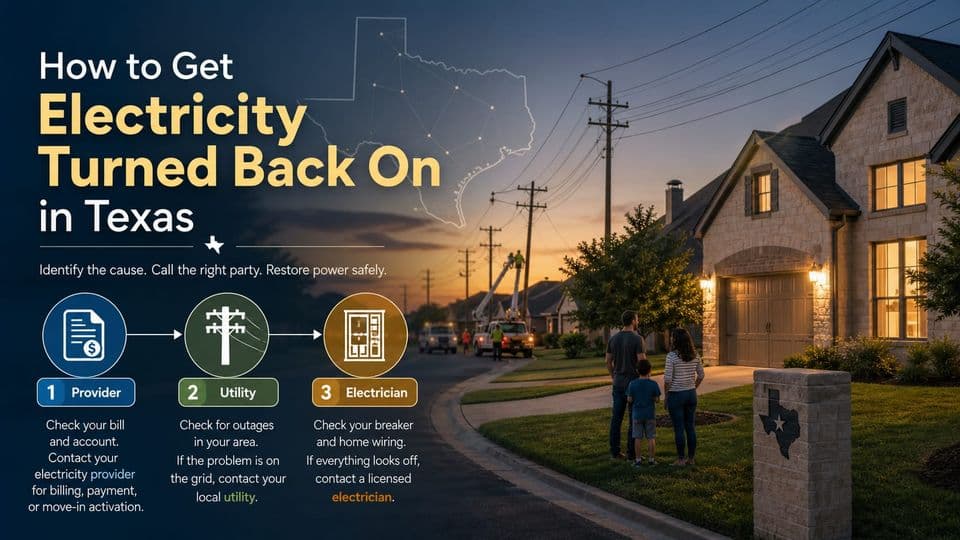
To restore your electric service, you must first identify the cause. If a storm took down lines, you need to report a power outage in Texas to your local wires company.
If you have a past-due bill or a disconnection notice, you need to work with your retail electric provider to clear the account and request a reconnect order.
This guide walks through the practical steps to take, who to call for different situations, and what to expect during the reconnection process.
Make the safety call before troubleshooting
Before you try to figure out why the power is off, check for immediate dangers. If you see a downed power line, sparking equipment, smoke, or a burning smell, stay far away and call 911 or your utility's emergency line immediately. Do not touch the meter, the service drop wires, or any damaged electrical equipment.
If it is safe to be inside, you can check your breaker panel. Only do this if the panel is dry and you can reach it without standing in water.
Flip any tripped breakers to see if that restores power. If the breakers are fine and the problem persists, stop and evaluate the situation from a safe distance.
Hazard signs that mean stop and call
- Downed power lines in the street or yard
- Loud humming or buzzing near the transformer
- Burning plastic or rubber smells
- Water leaking onto electrical panels or fixtures
- Exposed wires or damaged meter equipment
Identify the reason your power is off
Knowing why your power is off determines exactly who you need to contact. In Texas, the electric system is split between the "wires" company (the Transmission and Distribution Utility or TDU) and the "billing" company (your Retail Electric Provider or REP).
If your neighbors have power but you do not, the issue is likely with your account or your home's internal equipment. If the whole block is dark, it is probably an area outage handled by the TDU.
Clues that point to an outage
- Multiple homes or businesses on your street are without power.
- Your TDU's outage map shows active reports in your area.
- You recently experienced high winds, ice, or lightning in your area.
- Your circuit breakers are all in the "on" position, but there is no power.
Clues that point to disconnection
- You received a Texas electricity disconnection notice in the mail or email.
- Your online account with your provider shows a past-due balance.
- Only your home is dark while adjacent homes have power.
- Your meter display is off or showing an error code, but the rest of the grid appears active.
Report an area outage to the wires utility
If you have determined that the power loss is an area outage, you must contact your TDU. Your retail electric provider does not fix poles or wires; they only handle your bill and account.
Every part of Texas has a specific TDU assigned to it based on location. Common Texas TDUs include Oncor, CenterPoint Energy, AEP Texas, and TNMP. You can report an outage by phone or through the utility's website or mobile app.
Finding the right TDU for your address
If you aren't sure which company maintains the lines in your area, check a recent electric bill. The TDU name is usually listed separately from your provider's name. You can also look up your address on your city's municipal utility page or the PUCT website.
Always report the outage even if you think your neighbor already has. More reports help the utility prioritize which transformers and poles to fix first. Keep in mind that restoration estimates provided by the utility can change as crews discover more damage.
Contact your electric provider for an account shutoff
If your power is off because of a billing issue or a disconnect order, call your retail electric provider. This is the company you send your monthly payment to. Explain that your power is off and ask for the status of your account.
Be very specific when you speak to the representative. You need to know if the service was already disconnected or if it is scheduled to be disconnected. You also need to know exactly what you must do to get a reconnect order sent to the utility.
Questions to ask before you hang up
- Is my service currently disconnected, or is it scheduled to be?
- What is the total amount required to clear the account?
- Will I need to pay a deposit or a reconnect fee?
- How long after payment is the reconnect order sent?
- Can I get a payment arrangement to avoid a full disconnection?
Write down the name of the person you spoke with and any confirmation numbers they provide. This information is vital if there is a delay or a mistake later.
Read the disconnection notice like a checklist
A Texas electricity disconnection notice is a legal document that tells you when your service will be cut. Do not ignore it or assume it is a generic reminder. In Texas, providers must follow specific PUCT rules regarding how and when they notify you.
Look at the notice as a checklist of items you need to resolve the issue. The most important part of the notice is the "Proposed Disconnection Date." This is the day the utility is authorized to physically shut off your meter.

Dates and amounts to save from the notice
- Disconnection Date: The last day you have to act before the power goes out.
- Total Amount Due: The specific amount needed to stop the disconnection.
- Account Number: You will need this for any payment or assistance application.
- Dispute Instructions: Information on how to challenge a bill you believe is wrong.
Save a photo or a scan of this notice. You may need to show it to an assistance agency or to the PUCT if you file a complaint.
Resolve nonpayment without losing the paper trail
If your electricity was disconnected for nonpayment, paying the bill is only the first step. You must also ensure the provider processes your payment and sends a "reconnect order" to the TDU.
After you make a payment, call the provider back to confirm they received it and that the reconnect order has been submitted. Do not assume that because you paid online, the technician will automatically show up. There is often a delay between when a payment clears and when the administrative order is sent to the field crew.
Keep all payment confirmations. If the power does not come back on within the timeframe the provider gave you, you will need those confirmations to prove the account is current.
Use 211 and local assistance before the deadline
If you cannot afford to pay your electric bill in full, reach out for help before the disconnection date. Utility assistance for electric bill payments is available through several state and local programs.
What 211 can help you find
Dialing 2-1-1 connects you to a community resource specialist. They can help you locate agencies that offer utility assistance, including the Comprehensive Energy Assistance Program (CEAP). CEAP is an official Texas program that helps low-income households with energy costs.
Because these programs often have application processes and funding limits, you should call 211 as soon as you receive a disconnection notice. Do not wait until the day before the shutoff. If an agency agrees to help you, tell your electric provider immediately so they can pause the disconnection process while the payment is being processed.
Check Texas weather protections before a shutoff
Texas law provides certain protections for customers during extreme weather. Under PUCT rules, electric providers are generally restricted from disconnecting service for nonpayment during specific periods, such as when the National Weather Service issues a heat advisory or when temperatures are expected to drop below freezing.
However, these rules have specific start and end dates. A single hot day in early spring might not qualify. If you receive a disconnection notice during a period of extreme cold or heat, ask your provider if the weather protection rules apply to your account.
Save any weather alerts from the National Weather Service for your area. If you believe your provider is violating a weather-related disconnection ban, you can report that to the PUCT.
Handle medical equipment needs as an urgent case
If you or someone in your home relies on electric-powered medical equipment, you need to take extra steps. Texas rules allow for "Critical Care" or "Chronic Condition" designations, but you must apply for these through your provider before an emergency happens.
If you are facing a disconnection and have medical equipment, call your provider and explain the situation immediately. They may require a form signed by your physician.
Even with a medical designation, power can still be lost due to storms or unpaid bills if the proper paperwork is not on file. Always have a backup plan, such as a fully charged battery backup or a location where you can stay if the power goes out.
Track the reconnect order after the account is cleared
Once you have paid your bill or resolved your account issue, the process moves to the technical stage. Your provider must send an order to the TDU to physically turn the power back on.
Even after the order is sent, you might not have power instantly. The TDU technicians must often physically visit the meter or send a signal to a smart meter. If the technician cannot access your meter (for example, if a dog is in the yard or the meter is behind a locked gate), the reconnection will be delayed.
Remote meters, field work, and access issues
Many Texas homes now have smart meters that can be reconnected remotely. However, if the disconnection was for a long period or if there is a technical issue with the meter, a crew might need to visit your property.
If it has been several hours since your account was cleared and you still do not have power, call your provider again. Ask for an update on the "reconnect order status." Specifically, ask if the order was sent and whether a field visit is required.
Sort out new-address or move-in power problems
Sometimes the power is off because you have moved into a new home and didn't realize service was inactive. In Texas, you must specifically request to start service in your name. It does not happen automatically just because you signed a lease.
If you have just moved in and the power is off, check your lease to see who is responsible for the electricity-you or the landlord. If it is your responsibility, contact a provider and ask to start service. In some cases, the previous tenant's account might still be active, which can cause a "block" on the meter. Your provider can help sort out these move-in issues.
Escalate if the steps stall or the shutoff seems wrong
If you have followed all the steps and your power is still off, or if you believe your provider made a mistake, you have the right to escalate.
The first step is to keep a detailed log. Note the date and time of every call, the name of the representative, and any confirmation numbers. If you have a dispute about a bill or a disconnection that violates PUCT rules, you can file a complaint with the Texas Public Utility Commission (PUCT).
The PUCT handles complaints against retail electric providers and TDUs in most of Texas. If you live in a municipal utility or electric cooperative area, you may need to contact that organization directly, as the PUCT might not have jurisdiction over them.
Questions Texans ask when the lights are off
Editorial standards
SlashPlan publishes independent guidance to help Texans compare electricity plans. Our editorial team reviews each article without advertiser influence. See our editorial guidelines and monetization disclosure.
About the author
Roi CahanaEnergy advisor helping Texans better understand their electricity options and make more confident decisions. Focused on simplifying electricity plans, explaining confusing terms, and sharing practical guidance to help readers avoid common mistakes when comparing rates, contracts, and renewals.
Ready to compare plans?
Enter your ZIP code to see electricity plans available at your address.