How to Start New Electricity Service in Texas
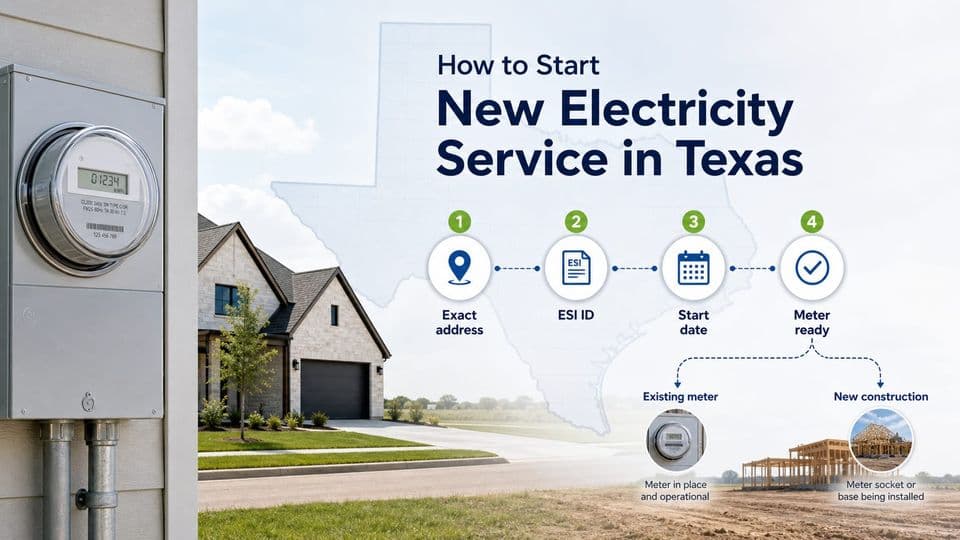
Starting electricity service depends on the exact address and the type of request. A home with an existing meter follows a different path than a new build, a transfer request, or a physical service change.
Key Takeaways
- 1Starting electricity service is not always the same as transferring service, stopping service, or requesting new construction service.
- 2The exact service address determines whether you should follow a competitive-choice, municipal utility, cooperative, delivery-utility, or construction-related path.
- 3Gather the service address, requested start date, contact information, identity information, payment details, and ESI ID if available before starting the request.
- 4A property without an existing meter or usable connection may need utility construction, meter work, inspection, or load review before service can begin.
- 5If power is not on after the expected start date, confirm account status and then use the local utility outage, service-status, or construction support.
How to Start New Electricity Service in Texas
Starting electricity service in Texas isn't one standard process. Whether you are moving into an apartment, buying a house, or finishing a new build, the steps depend on the exact location and whether the property already has a working electric meter.
Some addresses are in areas where you can choose a retail electric provider. Others are served by a municipal utility or a cooperative.
This guide walks through the main paths and helps you gather the information you will need before you make your request.
Choose the Right Service Path Before You Start
The first thing to figure out is what kind of service you actually need. Most people moving into a finished home or rental are starting service at an existing address. That usually means the property already has a meter and the wiring is in place. You just need to open an account and set a start date.
If you are buying or leasing a new construction house, the property might not have a meter yet. The utility may need to install a meter, run a service line, or complete an inspection before normal service can begin. That is a different process than a standard move-in. Similarly, if a property has been vacant for a long time or had the meter removed, it may fall into a construction or reconnection path.
Existing meter or new construction
Check whether the address has an active meter before you start. If the home has been lived in recently, it likely has one. If you are unsure, ask the property owner, real estate agent, or builder. For existing meters, you can usually request a start date online or over the phone in a few minutes.
For new construction or missing meters, you will need to work through a construction or installation request, which can take longer and may require site visits.
A transfer request is a different case. If you are moving from one address to another and both are served by the same municipal utility or co-op, a transfer may combine the stop and start into one step. If the old and new addresses are in different service territories or one is in a competitive-choice area and the other is not, you will need to stop service at the old address and start a new account at the new address separately.
Use the Exact Address to Find the Service Route
Texas does not have one single electric service path for every address. The same ZIP code can include competitive-choice areas, municipal utilities, cooperatives, and delivery-utility service territories. The exact location determines which organization handles your account and which process you follow.
Start with the full street address, including apartment or unit number if applicable. A house number alone may not be enough near service territory boundaries, in large apartment complexes, or in new subdivisions.
If the address is in a competitive-choice area, you will select a retail electric provider to open the account. If the address is inside a city that runs its own electric utility, like Austin or San Antonio, you will work directly with that utility.
If the address is in a cooperative service territory, like Pedernales Electric Cooperative, you follow the co-op's own start-service process.
ESI ID and service territory
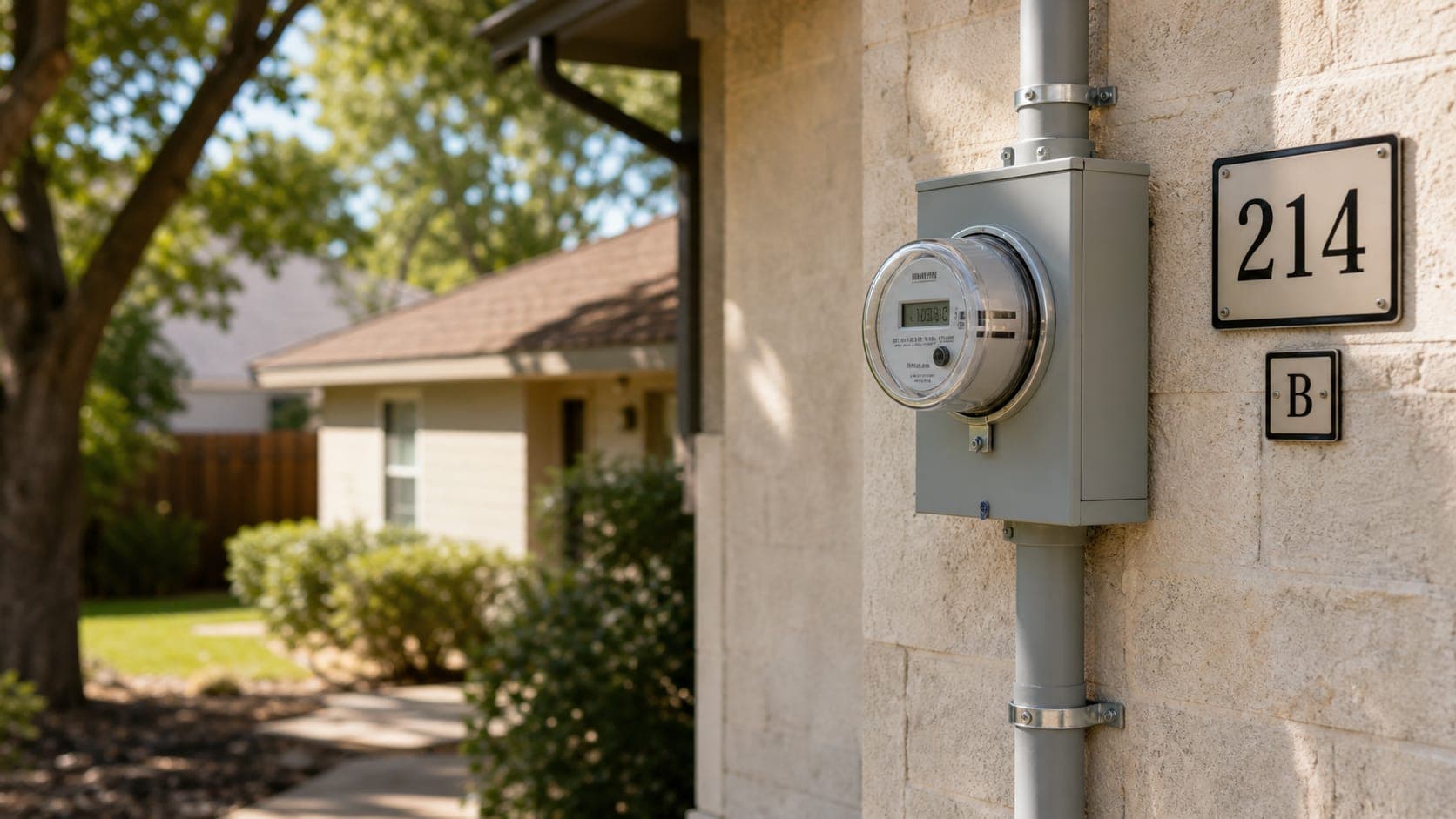
An ESI ID is a Texas electric service identifier tied to a specific service location. If the address has an existing meter, the ESI ID can help confirm the correct location when you are starting service. You can often look up the ESI ID on the local delivery utility's website or use SlashPlan's ESI ID search tool to find up-to-date information about all meters in Texas' deregulated territories.
Having it ready can speed up the request and help avoid mistakes, especially if the address is new or the lot number is similar to another property.
If you do not have the ESI ID, do not worry. Many providers and utilities can look it up using the service address. But if you can find it ahead of time, it is one less step during the request.
Gather the Details the Request May Ask For
Whether you are starting service online, over the phone, or in person, you will need certain information ready. Collecting it before you start makes the process smoother and reduces the chance of a delay.
- Exact service address: Street number, street name, apartment or suite number, and city. Double-check that the address matches the official property records, not a mailing address.
- Requested start date: The date you want electricity to be active. For a move-in, choose the day you plan to arrive or the day before. For a new build, work with the builder or utility to set a realistic date.
- Contact information: Your phone number, email address, and sometimes a secondary contact.
- Identity information: Most providers and utilities require your full legal name, date of birth, and the last four digits of your Social Security number or a government-issued ID. This is used for credit check and account verification.
- Billing and payment details: A valid payment method, such as a bank account for automatic payments or a credit card. Some providers may require a deposit depending on credit history.
- ESI ID: If you have it, include it. If not, the provider can look it up.
Service address, start date, and ESI ID
If you are renting, confirm the move-in date with your landlord before you set the service start date. If you are buying a home, coordinate with the closing date. For new construction, ask the builder whether the meter has been installed and whether an inspection has passed before you request a start date.
Starting the request too early could result in a failed activation, and starting too late could leave you without power on move-in day.
Request a Start Date Before Move-In
As a general rule, request service a few days before you plan to move in. That gives time for the request to be processed and for any issues to be caught. In competitive-choice areas, the retail electric provider often handles the account setup quickly, sometimes within one business day. But if the property requires a meter installation or a construction-related step, the timeline can be longer.
There is no single Texas-wide processing window. Some providers process same-day requests if submitted before a cutoff time. Others need advance notice, especially for new construction. The best approach is to submit the request as soon as you have a confirmed move-in date and then confirm the activation status a day or two before you plan to arrive.
Keep the confirmation number, account number, and any order reference from your request. If anything goes wrong, that information helps you track the issue. Store the confirmation email or screenshot on your phone so you have it handy when you check in on move-in day.
Know Which Company Handles Meter and Delivery Issues
In competitive-choice areas, the company you pay for electricity is your retail electric provider. But that provider does not own the power lines or the meter. A separate delivery utility, sometimes called the transmission and distribution utility, owns and maintains the physical equipment. Common Texas delivery utilities include Oncor, CenterPoint Energy, and AEP Texas.
If you have a problem with the meter, a power outage, or a damaged service line, the delivery utility is the one to call. Your retail electric provider may help you route the issue, but the physical work falls on the delivery utility. If you are served by a municipal utility or a cooperative, that single organization handles both the account and the delivery equipment, so you only have one point of contact.
Account setup and delivery work
Understanding this split helps you avoid wasted time. If your account is active and the power is still off, do not call your provider to fix a meter issue. Instead, check the online outage map for your delivery utility or use their outage reporting system.
If you need help finding the right contact, review how to report a power outage in Texas. If the property is new construction, meter installation and connection require the delivery utility's construction or service request process.
Starting Electricity Service FAQs
Sources & References
Editorial standards
SlashPlan publishes independent guidance to help Texans compare electricity plans. Our editorial team reviews each article without advertiser influence. See our editorial guidelines and monetization disclosure.
About the author
Roi CahanaEnergy advisor helping Texans better understand their electricity options and make more confident decisions. Focused on simplifying electricity plans, explaining confusing terms, and sharing practical guidance to help readers avoid common mistakes when comparing rates, contracts, and renewals.
Ready to compare plans?
Enter your ZIP code to see electricity plans available at your address.