How a Late Payment Increases Your Electric Bill in Texas
How A Late Payment Increases Your Electric Bill
Key Takeaways
- 1A late Texas electric payment can increase the bill directly through a late fee on the delinquent balance.
- 2The bigger bill often comes from the old balance rolling into the next cycle with new monthly usage and account charges.
- 3If the balance stays unpaid, disconnection can add reconnection costs and possible deposit requirements.
- 4One late electric bill usually is not the main credit risk; collections or court action are the bigger concern.
- 5Calling the REP early can open options such as payment arrangements, deferred payment plans, or assistance referrals.
- 6Before switching plans, resolve or understand the past-due account because a cheaper rate will not erase an old balance.
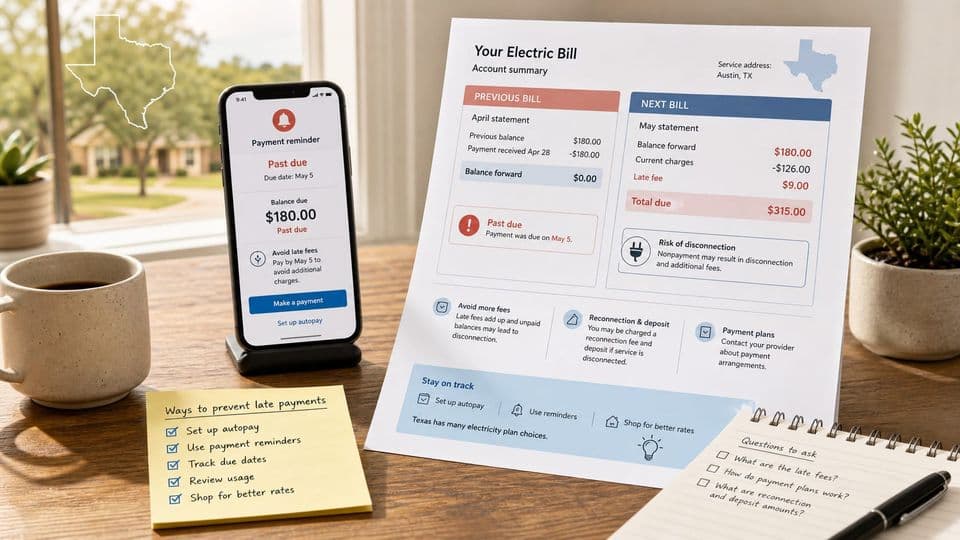
A missed due date on a Texas electric bill adds a late fee to the unpaid balance. The larger impact often appears on the next bill when the past-due amount carries forward alongside new usage and account charges.
The bill increase starts with the past-due balance
An unpaid electric bill becomes late after the due date listed on the statement. Retail Electricity Providers may apply a one-time late penalty of up to 5 percent on the delinquent balance under current Texas rules. Check the bill, the Terms of Service, and the Your Rights as a Customer disclosure to confirm the exact percentage and timing that applies to your account.
What counts as late on an electric bill
The due date on the current bill marks the line. Any balance remaining after that date counts as late.
How the late fee is calculated
Providers calculate the fee on the past-due amount shown on the statement. The fee appears as a separate line item on the following bill.
Where to find the fee in your plan documents
Review the Terms of Service for the late-penalty section and the Electricity Facts Label for any mention of account charges.
Why the next bill can look worse than the late fee
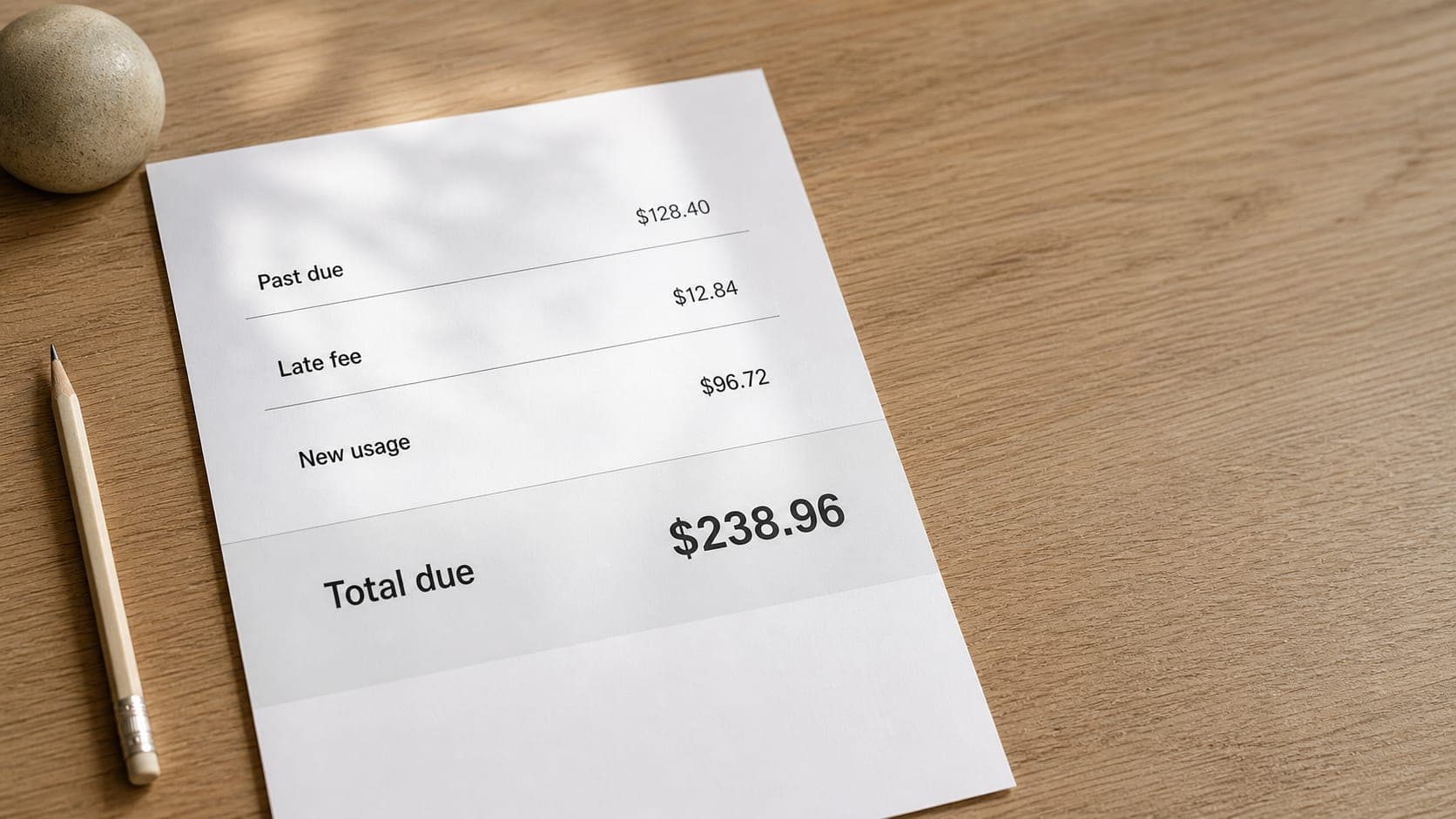
The unpaid balance does not vanish at the start of the next billing cycle. It stays on the account and appears with the new month's charges.
Past-due balance plus current charges
The next statement can combine the old balance, the late fee, the current month's electricity use, and any additional fees disclosed in the agreement. Fixed-rate plans keep the energy rate stable but leave late fees and account charges unaffected.
A simple Texas bill example
A $180 past-due balance with a 5 percent late fee adds $9 before new usage is added. The next bill then shows that total plus the current month's charges.
What Texas REPs usually do before disconnection
A late payment does not trigger immediate shutoff. Retail Electricity Providers follow a sequence of notices before service is disconnected.
Late notice, delinquency notice, and disconnection notice
The regular bill serves as the first notice. Later, a separate delinquency notice or disconnection notice may arrive by mail or email if electronic delivery was chosen.
The Texas notice window to verify before publishing
Written notice generally must be issued, and the disconnection date should not fall less than ten days after the notice. Confirm the current Public Utility Commission of Texas rules before relying on any timeline.
Why ignoring the notice is the expensive part
Once a disconnection notice is sent, the account moves closer to added charges for reconnection and possible deposits.
Costs that can show up after the lights are shut off
Restoring service after disconnection requires paying the full past-due balance first.
Overdue balance before reconnection
The provider will not reconnect until the delinquent amount is cleared.
Reconnection fees and timing
A reconnection charge may apply depending on the provider and the time needed to restore service.
Deposits after nonpayment
An additional deposit may be required if service was disconnected or if late payments have occurred repeatedly.
When a late electric bill can affect credit
Routine utility payments are not reported as positive history to major credit bureaus in most cases. One late electric bill is therefore different from a credit-card late payment.
One late bill versus collections
The larger risk appears when the unpaid balance reaches collections or leads to court action.
Why on-time utility payments usually do not build credit
Most Retail Electricity Providers do not report timely payments to the major credit bureaus unless the customer has enrolled in an optional credit-reporting tool.
What happens if an electric bill goes to collections
A collections entry can appear on a credit report and affect future applications for credit or housing.
Payment plans and assistance can stop the balance from growing

Contact the Retail Electricity Provider before the account reaches disconnection status. Many providers can offer a payment arrangement or a deferred payment plan when circumstances qualify.
What to ask your REP before the due date passes
Explain the situation and ask whether a payment plan or hardship arrangement is available. Keep written records of any agreement reached.
Deferred payment plans and assistance programs
Texas rules may require deferred payment plans in certain situations. Energy assistance programs such as LIHEAP may also help cover part of the balance.
When to contact the Public Utility Commission of Texas
Reach the commission if the provider will not address a disputed charge, failed to send required notices, or cannot resolve a valid issue.
Weather, medical, and energy-assistance protections to verify
Texas rules include protections during extreme weather emergencies. Verify the current definition with the Public Utility Commission of Texas before assuming a shutoff will be postponed.
Extreme weather disconnection rules
Emergency declarations can affect disconnection timing, but the exact conditions change and must be checked for the current event.
Medical need and critical-care accounts
Customers with documented medical equipment needs can request critical-care status, which usually requires forms and ongoing communication with the provider.
Pending energy assistance payments
Notification from an assistance agency may delay disconnection while payment is processed.
Renters, homeowners, and shared utility accounts
Homeowners typically hold the account directly with the Retail Electricity Provider. Renters may hold the account themselves, or the landlord may handle the utility through the lease.
If the electric account is in your name
Work directly with the provider to arrange payment or request a plan.
If utilities are handled through rent or a landlord
Identify who is listed on the account before requesting assistance or disputing a charge. Lease terms and local rules govern landlord actions.
How to avoid the next late fee without creating a new problem
Set calendar reminders or enable account notifications from the provider. Autopay prevents missed dates when the account balance is sufficient, but it can create overdraft risk if cash flow is tight.
Autopay works only if the account can cover it
Review the bank balance a few days before the scheduled draw.
Due-date reminders that actually help
Use the provider's text or email alerts and set a calendar entry one day before the due date.
Budgeting for high-usage Texas months
Summer air-conditioning use can double a bill. Broader energy-market conditions can also affect household budgets, and the U.S. Energy Information Administration publishes regular energy updates.
Before switching plans, deal with the past-due account
Switching providers does not erase an existing balance. Compare rates only after confirming the amount owed and any reconnection or deposit requirements.
A cheaper plan will not remove an old balance
The new provider starts fresh, but the prior account remains responsible for the debt until paid.
Documents to check before enrolling
Review the Electricity Facts Label, Terms of Service, and Your Rights as a Customer disclosure to understand how late fees and deposits would apply under a new plan. If the bill itself is hard to decode, use this guide to read your electricity bill in Texas before comparing plans.
Late Electric Bill FAQ
Editorial standards
SlashPlan publishes independent guidance to help Texans compare electricity plans. Our editorial team reviews each article without advertiser influence. See our editorial guidelines and monetization disclosure.
About the author
Roi CahanaEnergy advisor helping Texans better understand their electricity options and make more confident decisions. Focused on simplifying electricity plans, explaining confusing terms, and sharing practical guidance to help readers avoid common mistakes when comparing rates, contracts, and renewals.
Ready to compare plans?
Enter your ZIP code to see electricity plans available at your address.