What to Do When Your Texas Electricity Contract Expires
When your Texas electricity contract expires, your rate can skyrocket. This guide explains the switching process, the PUC 14-day rule, and how to transition to a new provider without fees or outages.
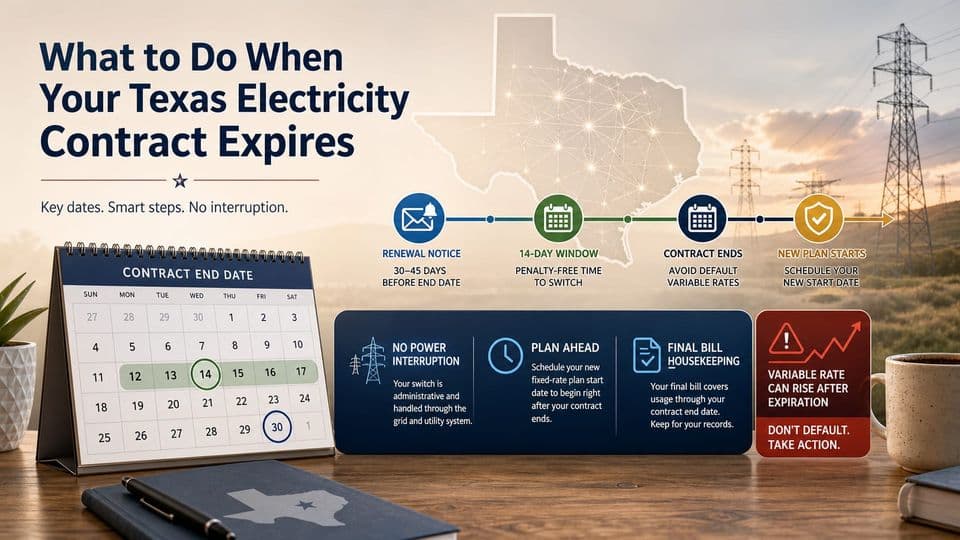
Key Takeaways
- 1Texas law requires providers to send a renewal notice at least 30 days before your contract expires.
- 2The PUC 14-day rule allows you to switch to a new provider without an early termination fee within 14 days of your contract end date.
- 3Failing to switch or renew usually results in being moved to a variable "default" rate, which can be significantly higher than fixed plans.
- 4Switching electricity providers in Texas does not require a technician visit or cause a power interruption.
- 5You will need your ESI ID, found on your bill, to complete a switch with a new company.
Your Texas electricity contract has an expiration date written into the fine print. When that date arrives, your rate can change overnight, and not in a good way. If you take no action, your provider will move you to a month-to-month plan with rates that can spike well above what you were paying.
The good news is that switching electricity companies in Texas when your contract ends is straightforward. You do not need a service visit, your power will not go out, and in most cases you can avoid early termination fees entirely.
This guide covers the timeline, the paperwork, and the steps to keep your rate under control.
The 14-Day Switching Window
How the PUC Rule Protects Consumers
The Public Utility Commission of Texas (PUCT) requires providers to allow customers to switch to a new company without paying an early termination fee during the final 14 days of their contract. This rule applies to most residential plans in deregulated areas of Texas.
What this means in practice is that you can shop for a new plan, sign up with a different provider, and set your start date to align with the end of your current contract, all without owing a penalty to your existing company.
Calculating Your Penalty-Free Date
To find your 14-day window, take your contract end date and count backward 14 days. Any switch you initiate during that period is fee-free. If you sign up for a new plan on day 15 or earlier before the end date, your current provider can charge you an early termination fee based on the terms in your original contract.
Mark your calendar for the start of this window. That is the earliest date you can lock in a new plan without financial penalty.
Reading Your Renewal Notice
Every Texas electricity provider must send you a notice before your contract ends. This document is your early warning system and contains the information you need to make a decision.
Required Timeline for Provider Notices
Your provider must send a renewal notice 30 to 45 days before your contract expires. This is a regulatory requirement, so if you have not received anything and your contract is approaching the end date, check your online account portal or contact customer service. The notice may arrive by mail, email, or both, depending on your communication preferences.
Critical Details to Locate in the Letter
Compare the proposed rate with other plans available in your area. The notice gives you a chance to shop around before your contract expires.
Identifying Your Contract End Date
If you want to skip the guesswork, find your exact contract end date directly. This date is the starting point for everything else.
Where to Look on Your Monthly Bill
Your monthly electricity bill lists the contract end date in the account details section. Look for a line labeled "Contract End Date," "Plan Expiration," or something similar. If you have paper bills, check the most recent one. If you receive bills online, log in and pull up your statement.
Verifying Dates via Online Account Portals
Most provider websites and mobile apps show your current plan details including the expiration date. Navigate to the account overview or plan details section. If you cannot find the date there, customer service can confirm it over the phone. Keep a note of the date on your calendar so you know when your 14-day window opens.
Risks of Default Variable Rates
Doing nothing when your contract expires is the most expensive option. Your provider will automatically move you to a default plan, and the terms are rarely in your favor.
How Month-to-Month Billing Works
Once your fixed-rate contract ends, you default to a month-to-month arrangement with no set end date. You are no longer locked in, which sounds flexible, but the tradeoff is that your rate can change from one billing cycle to the next. The provider does not need your permission to raise the rate, and they usually do.
The Cost Difference Between Fixed and Variable Rates
Default variable rates can be significantly higher than the fixed rate you were paying. In many cases, customers see their per-kilowatt-hour charge jump by 50 percent or more. During periods of high wholesale electricity prices, the gap can widen further.

The chart above shows how a stable fixed rate compares to a variable rate after a contract expires. The variable rate spikes at the default transition point and can remain elevated indefinitely. If you stay on a default plan for several months, the extra cost can easily exceed the savings you might find from a competitive fixed-rate plan.
Documentation Needed for a Switch
Switching to a new provider requires a few pieces of information. Having them ready speeds up the process.
Locating Your ESI ID
Write this number down or save a digital copy. Your new provider will ask for it when you sign up.
How the Switch Process Works Behind the Scenes
Switching electricity providers in Texas is an administrative process, not a physical one. Understanding what happens can remove any hesitation about making the change.
Why No Power Interruption Occurs
Because the switch is only a change in the billing and customer relationship, your lights never flicker, and your appliances never shut off. The electricity flows through the same wires from the same grid. Your TDU does not need to send a technician or reconnect service. The entire transition is handled through the ERCOT system, which updates its registry to show your new provider.
This is a common point of confusion. Many customers worry that switching will cause an outage. It will not. Your service continues without interruption.
Timing the New Contract Start Date
You can schedule your new plan to begin exactly when your current contract ends. This prevents any gap in coverage and avoids landing on a default variable rate.
Scheduling Your New Plan in Advance
Most providers allow you to set a start date up to 60 days in the future. When you sign up for a new plan, you can choose the date you want service to begin. Align this date with the day after your current contract expires. The new provider will coordinate the switch in the ERCOT system so that the change happens on that date.
Aligning Dates to Prevent Rate Gaps
If your new plan starts before your current contract expires, you may trigger an early termination fee. If it starts after expiration, you will spend at least a day or two on the default variable rate. Setting the start date to match your contract end date avoids both problems.
Some providers default to the next available meter read date rather than a specific calendar date. Ask the new provider how they determine the start date and whether you can request a specific date.
Avoiding Early Termination Fees
Switching too early or missing the 14-day window can trigger an early termination fee. Knowing how these fees work helps you avoid them.
Exceptions to the Termination Penalty
Early termination fees are not universal, and not every switch triggers one. If you are within the 14-day window before your contract end date, no fee applies. If you move out of your provider's service area, many contracts allow you to terminate without penalty. Some providers also waive the fee for active military members with deployment orders.

Managing the Final Bill from Your Old Provider
After the switch goes through, your old provider will issue a final bill. A little housekeeping ensures everything ends cleanly.
What to Expect on Your Final Statement
The final bill covers electricity usage up to the switch date. It may also include any outstanding balance from previous months. If you paid a deposit when you started service, the old provider should credit that amount to your final bill or issue a refund. Depending on the provider, the refund may come as a check or a credit to your payment method.
Resolving Credits and Deposits
If you have auto-pay set up with your old provider, update or cancel those settings after you receive the final bill. You do not want future automatic payments hitting a closed account. If the final bill shows a credit balance, contact the provider to confirm how and when you will receive the refund. Some providers send refunds automatically, while others require a request.
Steps to Verify Your New Plan Details
Once the switch is complete, take a few minutes to confirm everything is set up correctly.
Reviewing Your New Welcome Kit
Also take note of your new contract end date so you are ready when this plan approaches expiration. The cycle repeats, and knowing your future end date lets you plan ahead for the next switch.
Frequently Asked Questions About Expiring Electricity Contracts
Editorial standards
SlashPlan publishes independent guidance to help Texans compare electricity plans. Our editorial team reviews each article without advertiser influence. See our editorial guidelines and monetization disclosure.
About the author
Roi CahanaEnergy advisor helping Texans better understand their electricity options and make more confident decisions. Focused on simplifying electricity plans, explaining confusing terms, and sharing practical guidance to help readers avoid common mistakes when comparing rates, contracts, and renewals.
Ready to compare plans?
Enter your ZIP code to see electricity plans available at your address.