Texas Electricity Disconnection Rules and Consumer Rights
Receiving a disconnection notice for your electricity can be stressful. Texas law provides specific protections, including a mandatory 10-day notice period, weather-related shut-off bans, and the right to a deferred payment plan.
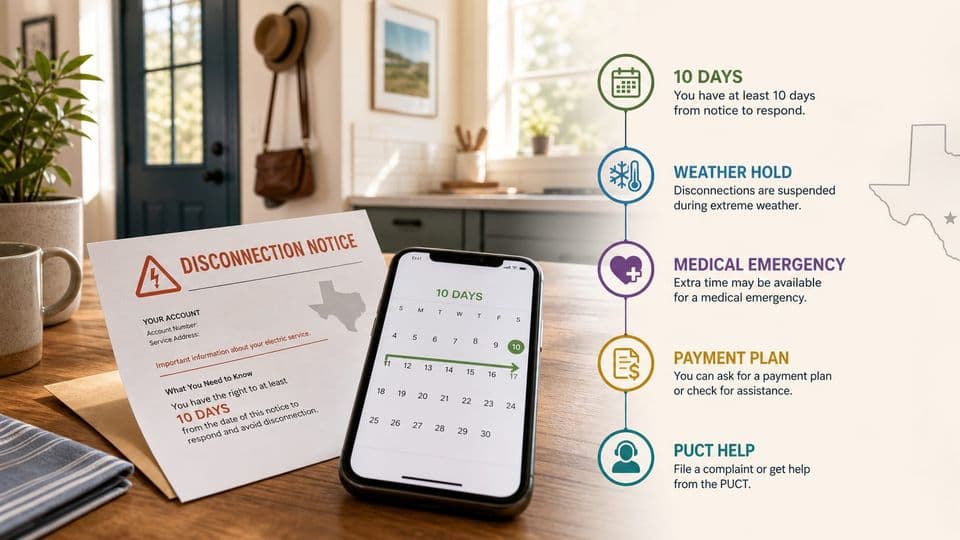
Key Takeaways
- 1Texas providers must issue a disconnection notice at least 10 days before service is shut off.
- 2Disconnection is prohibited during extreme weather alerts, such as National Weather Service heat advisories.
- 3Customers may have a right to a deferred payment plan with a 25% down payment and 5-month term.
- 4A medical emergency certificate can delay disconnection for up to 63 days.
- 5Service cannot be shut off for a previous occupant's debt or for non-electric charges.
Receiving a disconnection notice for your electricity is never a welcome sight, but Texas law provides a safety net of protections for residential customers.
The rules governing electricity shut-offs are designed to give you time to respond, protect you during extreme weather, and offer options for managing your debt. This guide covers the legal timeline, your consumer rights, and the practical steps you can take to keep your power on.
How the 10-Day Disconnection Timeline Works in Texas
The clock starts ticking the moment your provider prints the disconnection date on the notice. Under Texas regulations, the provider must give you at least 10 days from the date the notice is issued before they can shut off your service.
This is not the same as 10 days from when you receive it in the mail.
The 10-day window gives you time to make a payment, work out a payment plan, or dispute the charges. The countdown begins on the "date issued" printed on the notice, not the day you open your mailbox. If the notice is dated June 10, the earliest the provider can disconnect is June 20.
There is another important restriction. The disconnection cannot happen on a day when the provider's offices are closed for business. This rule prevents a situation where you wake up with no power and no way to reach anyone at the company to resolve the issue.

Knowing exactly when the 10 days start can make the difference between scrambling at the last minute and having enough time to set up a payment arrangement. Mark your calendar for the actual disconnection date, not the date you saw the notice. If your provider posts the notice to your online account, the date issued is the same as the date they uploaded it.
Required Information on an Official Termination Warning
A valid disconnection notice is not just a polite reminder that your bill is past due. Texas law requires the notice to contain specific information to be enforceable.
The notice must be titled "DISCONNECTION NOTICE" in bold, prominent letters at the top. This is not optional. The provider cannot bury the warning in fine print. The notice must also specify the total amount due and the exact disconnection date.
Beyond the basics, the notice must include contact information for the Public Utility Commission of Texas (PUCT) and local assistance agencies. This requirement ensures that even if you cannot afford to pay the full amount, you know where to turn for help.
If the notice you receive does not meet these requirements, it may not be legally valid. In that case, you have grounds to file a complaint with the PUCT and potentially stop the disconnection.
Situations Where a Provider Cannot Shut Off Your Power
Not every unpaid charge can lead to a disconnection. Texas law explicitly prohibits a provider from shutting off your power in certain situations.
A provider cannot disconnect you for refusing to pay for non-electric charges. This includes things like insurance plans, appliance repair plans, or any other product or service that is not related to your actual electricity usage. If the provider tries to bundle these charges with your electric bill and cut your power when you dispute them, they are in violation of the rules.
Another critical protection: a provider cannot disconnect you for debt left by a previous occupant of your home. If you moved into a house and the previous tenant left an unpaid electric bill, that debt belongs to them, not to you. Your power cannot be shut off over someone else's unpaid balance.
Similarly, underbilling charges that are more than six months old may not be grounds for disconnection in some cases. If the provider made a billing error and only discovered it six months later, they cannot use that as a reason to shut off your service.
Extreme Weather Protections and Temperature Moratoriums
Texas weather can be dangerous, and the state's disconnection rules reflect that reality. Providers are prohibited from shutting off power when extreme weather creates a health risk.
During the summer, a disconnection moratorium is triggered when the National Weather Service issues a heat advisory for the county where you live. When that happens, your provider cannot authorize a nonpayment disconnection for as long as the advisory is in effect. This rule applies regardless of how much you owe.
During the winter, a similar moratorium applies when temperatures are forecast to drop below 32°F for a sustained period. The idea is straightforward: no one should lose heat in freezing weather over an overdue bill.
These protections apply whether the extreme weather affects a single county or the entire state. If you live in a county under a heat advisory, your service is protected, even if other parts of Texas have milder weather.

The moratoriums do not erase your debt. You still owe the money. But they do give you breathing room to find a payment solution without losing power during a time when it could be dangerous.
Medical Emergency Protections for Vulnerable Customers
If someone in your household has a serious medical condition that makes electricity essential for their health, Texas law provides additional protections. A medical emergency certificate can delay disconnection for up to 63 days.
To use this protection, you need a signed certificate from a physician. The doctor must document the medical condition and explain why the loss of electricity would be life-threatening. This could apply to conditions that require oxygen concentrators, dialysis machines, CPAP machines, or electrically powered medical equipment.
The initial 63-day extension applies as long as you establish a payment arrangement with your provider. You still need to make good-faith payments, but the provider cannot shut off your service during this period.
If the medical condition persists beyond the initial 63 days, you can renew the certificate. You will need another signed document from your physician explaining that the condition has not resolved.
The key is acting quickly. The medical certificate protection does not apply retroactively. You must submit the certificate to your provider before the disconnection date. If you wait until the power is already off, you may need to pay reconnection fees before the medical protections take effect.
Rules for Disconnection During Weekends and Holidays
Texas law also restricts when a provider can shut off your power. The goal is to prevent a situation where you lose service on a Friday afternoon and cannot reach anyone to fix it until Monday.
Service cannot be terminated on a Friday or the day before a state holiday. If the provider tries to schedule a disconnection on a Friday, they are violating the rules.
There is an exception. If the retail electric provider (REP) is open for business on Friday and has a way for you to make a payment and restore service, the disconnection may proceed. But most REPs have limited weekend hours, which means this exception rarely applies in practice.
The same rule applies to holidays. If a state holiday falls on a Thursday, the provider cannot disconnect you on Wednesday simply because they know they will be closed the next day. The rule is designed to ensure you always have at least one business day after the disconnection to reach the provider.
Negotiating a Deferred Payment Plan to Keep Service On
If you receive a disconnection notice and cannot pay the full amount, a deferred payment plan may be your best option. Texas law requires providers to offer these plans to customers in disaster areas or during declared emergencies.
The terms of a deferred payment plan are regulated. The provider cannot require more than 25% of the past-due amount as a down payment. If you owe $400, the most the provider can ask for upfront is $100.
The remaining balance must be spread over at least five monthly billing cycles. This means you get five months to pay off the rest of the debt, in addition to paying your regular monthly charges.
Not every provider will proactively offer a deferred payment plan. You may need to ask for it. Contact your provider as soon as you receive the disconnection notice and request a payment arrangement. The provider is required to work with you, but they cannot read your mind.
Be aware that a deferred payment plan comes with some strings. If you miss a payment under the plan, the provider may resume the disconnection process. You also typically cannot switch to a different provider while you are on a payment plan. The "switch hold" prevents you from leaving until the arrangement is satisfied.
Assistance Programs for Texas Energy Bill Support
If you cannot afford your electric bill even with a payment plan, state-run assistance programs can help. The primary program is the Comprehensive Energy Assistance Program (CEAP).
CEAP provides financial assistance to low-income households to pay their electric bills. The program operates through local community action agencies and nonprofit organizations across Texas.
You may have heard about a program called LITE-UP Texas. This program is no longer active. If you see references to LITE-UP online, be aware that it has ended. Direct your attention to CEAP instead.
To find CEAP assistance in your area, call 2-1-1 Texas or visit the Texas Department of Housing and Community Affairs (TDHCA) website. The TDHCA maintains a list of local providers who administer CEAP funds.
When you call 2-1-1, a specialist will help you determine which local agency serves your county and will give you the contact information. You will need to provide documentation of your income, your electric bill, and proof of residency.
Some cities and counties also operate their own local energy assistance programs. These programs may have different eligibility requirements and funding levels. Check with your local utility or city hall to learn about programs specific to your area.
Steps to Restore Service After a Disconnection
If your power has already been shut off, do not panic. The process for reconnection is straightforward, but you need to follow the right steps.
First, make the payment or finalize the assistance commitment. You need to resolve the outstanding balance or have a confirmed payment plan in place before the provider can send the reconnection request.
Second, notify the provider that you have made the payment or arranged assistance. Do not assume the provider knows. Some providers process payments automatically, but others require you to contact them to start the reconnection process.
Third, confirm the reconnection fee. The fee is set by the transmission and distribution utility (TDU) in your area, not by your REP. Typical fees range from $10 to $50, but the exact amount depends on your location and the provider.
Once the provider receives your payment and requests reconnection, the work goes to the TDU. Reconnection typically occurs within 24 hours of the provider's request. If your provider requests reconnection at 10 a.m., the TDU will usually have your power back on by the same time the next day.
If the reconnection does not happen within 24 hours, contact your provider and ask for an update. The TDU may have encountered a technical issue, or the request may have been lost in the system.
Filing a Complaint with the Public Utility Commission
If you believe your provider has violated the disconnection rules, you have the right to file a complaint with the Public Utility Commission of Texas. The PUCT enforces the rules and can take action against providers who break them.
Start by contacting the PUCT Consumer Protection Division. The phone number is 1-888-782-8477. You can also file a complaint online through the PUCT website.
When you call, be prepared to provide the details of your situation. Have your account number, the date of the disconnection notice, and any documentation you received from the provider.
Once the PUCT receives an informal complaint, the provider must respond within 15 days. The PUCT will review the response and determine whether the provider followed the rules. If the provider violated the rules, the PUCT can order them to stop the disconnection, waive fees, or take corrective action.
Keep documentation of everything. Save copies of your disconnection notice, any emails or letters from your provider, and notes from any phone calls. If the case goes to a formal hearing, you will need this evidence to support your position.
The PUCT complaint process is free. You do not need a lawyer to file an informal complaint. The commission's consumer advocates can help you through the process and explain your rights.
Frequently asked questions
Sources & References
Editorial standards
SlashPlan publishes independent guidance to help Texans compare electricity plans. Our editorial team reviews each article without advertiser influence. See our editorial guidelines and monetization disclosure.
About the author
Roi CahanaEnergy advisor helping Texans better understand their electricity options and make more confident decisions. Focused on simplifying electricity plans, explaining confusing terms, and sharing practical guidance to help readers avoid common mistakes when comparing rates, contracts, and renewals.
Ready to compare plans?
Enter your ZIP code to see electricity plans available at your address.