Texas Electricity Pass-Through Charges Explained
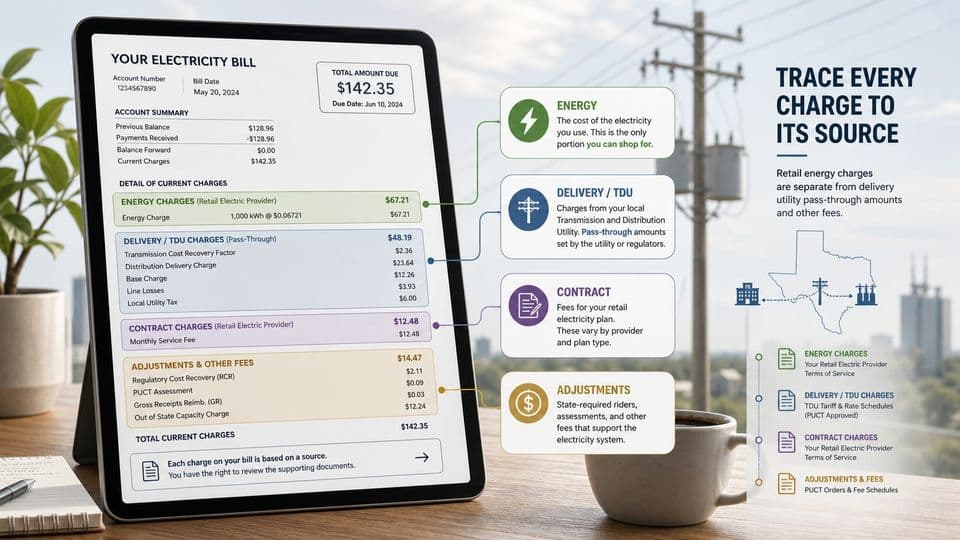
Pass-through charges on a Texas electric bill are often tied to delivery service, but not every fee belongs in that bucket. The useful first step is tracing the line item to the organization, rule, tariff, or document that created it.
Key Takeaways
- 1TDU and TDSP delivery charges are separate from energy charges because they relate to delivery service, not the electricity supply itself.
- 2A customer's service territory affects which delivery utility is tied to the address.
- 3Usage can affect some delivery-charge totals when tariffed delivery items include usage-based components.
- 4Contract fees, payment items, late fees, disconnection issues, and service-event charges should not be lumped into TDU delivery charges.
Pass-Through Charges Start With the Charge Source
Many Texas electric bills show line items that feel unexpected. The practical first step is to identify the source of each charge before assuming it belongs in any single category.
Pass-through charges is a reader-facing term that points to items that may originate outside the retail energy supply. In practice this label often covers delivery-related amounts tied to the local grid operator, but the same term sometimes gets applied to contract terms, payment activity, or service requests. The key is to trace the label back to its originating document.
Unexpected does not always mean improper. A charge can appear because usage changed, because a tariff includes both fixed and variable pieces, or because a one-time service action was recorded. Checking the bill label against the applicable rule, tariff, or customer contract helps separate routine delivery items from other categories.
REP, TDU, and TDSP Roles on a Texas Bill
Texas electric market rules separate the company that sells electricity from the company that delivers it. This separation is the main reason many bill line items are not created by the same organization that mails the statement.
The retail electric provider handles the customer account and supplies the energy portion of the bill. The transmission and distribution utility or transmission and distribution service provider owns and maintains the local wires, poles, meters, and related equipment that move power to the premises. The two roles are distinct, and their charges appear under different rule frameworks.
The bill sender and charge source can differ. When a line item is labeled as a TDU or TDSP charge, the amount follows the delivery tariff that applies to the service territory rather than the retail contract. The retail electric provider collects and forwards those amounts but does not originate them.
Delivery Charges Come From Local Grid Equipment
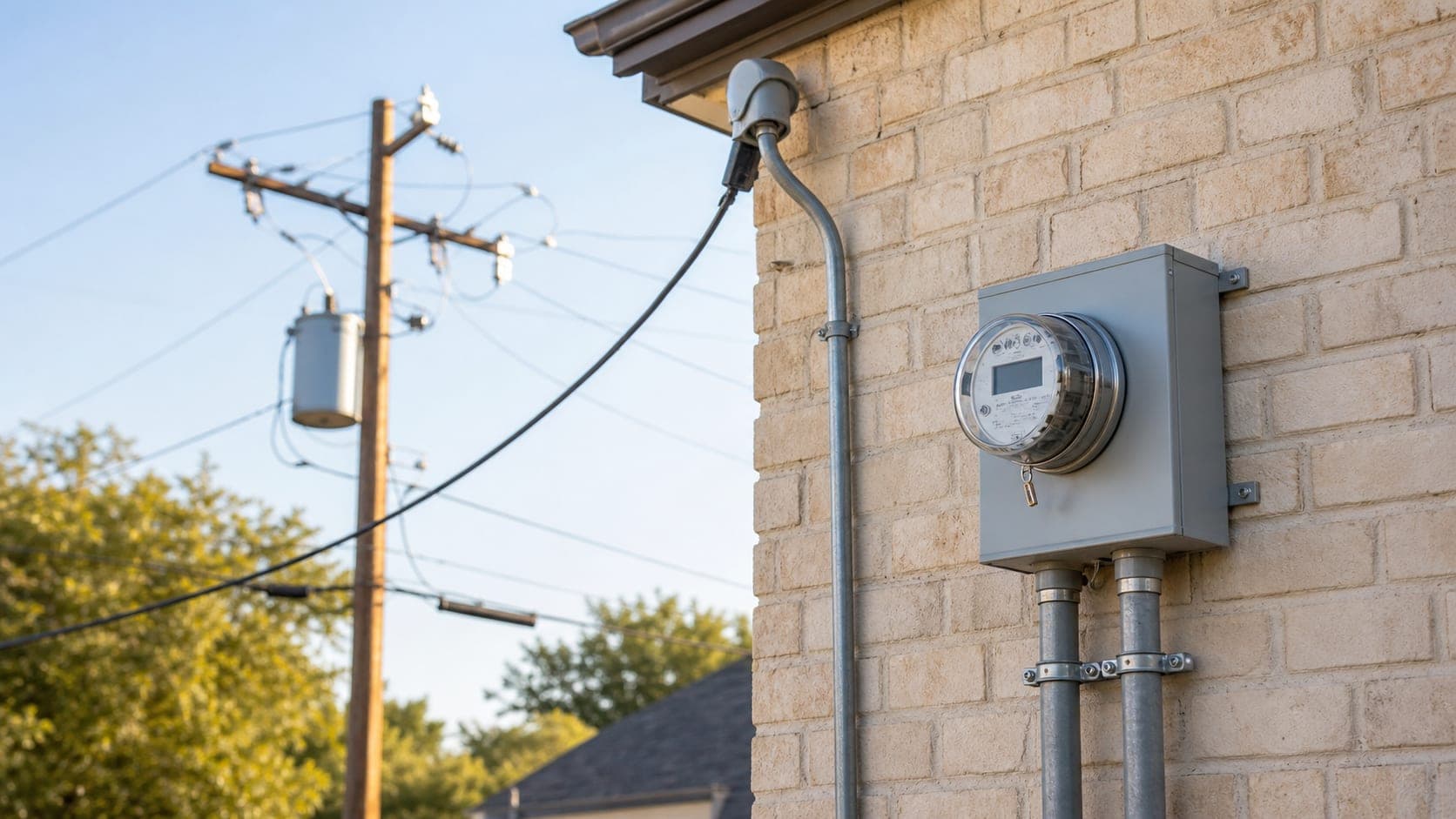
Delivery charges are tied to the physical infrastructure that brings power from the transmission system to the customer meter. This infrastructure includes distribution lines, transformers, service drops, and the meter itself.
Meters, wires, and service drops are delivery assets. The costs of owning, operating, and maintaining those assets are recovered through delivery tariffs rather than through the energy supply price. Because the equipment is local, the charges appear on the bill even when the customer buys energy from a competitive retail provider.
The delivery-service terms that apply to investor-owned utilities are set through official tariff rules. Those rules determine how fixed and usage-related components are presented on the bill and which service territory uses which tariff.
Service Territory Changes the Delivery Utility
A Texas address is assigned to one delivery utility based on the geographic service territory. Different utilities operate under separate tariffs, so the exact line-item labels and calculation methods can look different from one part of the state to another.
Address determines the delivery utility. The Public Utility Commission of Texas maintains a directory that links each service address to its transmission and distribution service provider. Checking that directory shows which organization's tariff applies before comparing any specific line item across bills.
Because service territories are fixed by geography, moving to a new address can change which delivery provider appears on future bills even if the retail electric provider stays the same.
Usage Can Change Part of the Delivery Total
Some delivery tariff components are calculated on a per-kilowatt-hour basis. When that structure exists, the delivery total on a bill can move when monthly usage changes.
Fixed pieces and usage-based pieces behave differently. A customer who reduces consumption will see the variable portion of delivery charges decrease, but any fixed customer charge or minimum bill component will remain unless the tariff itself changes. The opposite also holds: higher usage increases the usage-based portion while fixed amounts stay constant.
Fixed Delivery Pieces Can Apply Even in Low-Use Months
A delivery tariff can include customer charges or minimum bill amounts that do not disappear when usage drops. These items are listed separately from the energy charge on most Texas bills.
When a bill shows a delivery amount that stays roughly the same despite lower usage, the fixed component of the tariff is usually the reason. The tariff language, not the retail contract, determines whether that fixed amount applies in a given month.
Energy Charges Belong in a Different Bucket
Energy charges reflect the cost of the electricity itself. Delivery charges reflect the cost of moving that electricity through the local system to the meter. The two categories are governed by separate rules and appear under separate headings on a typical bill.
Because the categories are distinct, a change in the energy price does not automatically change the delivery line items. The reverse is also true. Keeping the two buckets separate helps when reviewing why one month's total differs from another.
Contract Fees Are Not Delivery Charges
Retail contract terms can create their own line items, such as early termination fees or renewal-related charges. These items originate in the customer's contract or terms of service, not in the delivery tariff.
Contract-related fees should be matched to the disclosure document the customer received at enrollment. When the fee label or amount does not match a delivery tariff, it belongs in the contract category rather than the TDU or TDSP bucket.
Payment, Late, and Adjustment Items Need Their Own Bucket
Payment activity, late-payment fees, bill corrections, and disputed-bill adjustments are handled under customer-protection rules that are separate from delivery-service tariffs.
When a bill shows an adjustment labeled as a correction, underbilling, or overbilling recovery, the source is the payment and adjustment rule rather than the delivery tariff. The same separation applies to late-payment items that appear because a prior bill balance was not paid by the due date.

Separating these items prevents them from being grouped automatically with routine delivery charges. Each category has its own source document and its own process for questions or disputes.
Disconnection and Reconnection Items Are Service Events
Disconnection, reconnection, and related service requests are operational events that fall under customer-protection and service rules. They are not part of the ongoing delivery-service tariff that applies every month.
When a bill lists a disconnection or reconnection fee, the amount is tied to the service event itself. The label and the amount follow the applicable service rule rather than the standard delivery tariff used for routine monthly billing.
Where to Check the Source of a Charge
Start with the bill label, then match it to the document that created the item. Delivery items point to the delivery tariff or TDSP information for the service territory. Contract items point to the retail contract or terms of service. Payment, adjustment, late, and disconnection items point to the customer-protection rules that cover those activities.
This source-matching approach keeps each charge in the correct category and avoids treating every line item as a uniform pass-through delivery charge.
Texas Pass-Through Charge FAQs
Editorial standards
SlashPlan publishes independent guidance to help Texans compare electricity plans. Our editorial team reviews each article without advertiser influence. See our editorial guidelines and monetization disclosure.
About the author
Roi CahanaEnergy advisor helping Texans better understand their electricity options and make more confident decisions. Focused on simplifying electricity plans, explaining confusing terms, and sharing practical guidance to help readers avoid common mistakes when comparing rates, contracts, and renewals.
Ready to compare plans?
Enter your ZIP code to see electricity plans available at your address.