Texas Power Plan Terms and Your Billed Rate
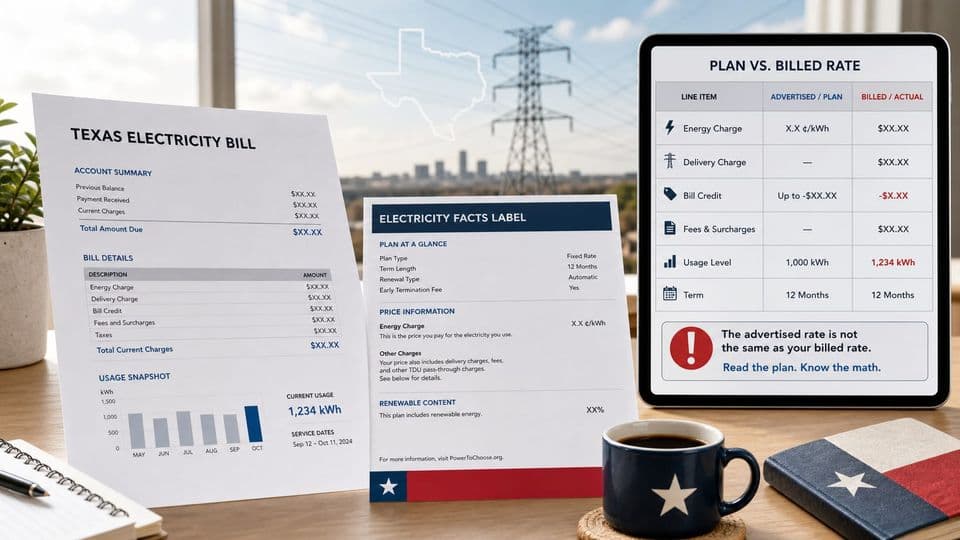
A Texas power plan can show one rate, but the bill can change once usage, delivery charges, credits, fees, and service-area details are applied.
Key Takeaways
- 1A stated Texas electricity rate is only useful when it is tied to the same usage level, service area, and plan documents that apply to the bill.
- 2TDSP or TDU delivery charges, fees, credits, and taxes or assessments when applicable can change the final bill total.
- 3Standard 500, 1,000, and 2,000 kWh examples are reference points, not a guarantee of an actual billed rate.
- 4Bill credits and tier rules should be read as conditions because crossing a usage threshold can change the total.
Texas Power Plan Terms and Your Billed Rate
A Texas electricity plan can advertise one rate, but the number on your bill often looks different. The difference is not a mistake. It is the result of how plan terms, usage assumptions, delivery charges, fees, and credits all combine into a single total. If you have ever looked at a plan summary, checked your bill, and wondered why the math did not line up, you are not alone. This article walks through the specific plan terms and billing mechanics that explain the gap.
The Rate in a Plan Is Not the Same as the Bill
The rate you see on a plan summary or an Electricity Facts Label is usually tied to a specific usage level.
Common reference points are 500, 1,000, or 2,000 kilowatt-hours (kWh) per month. That rate also assumes a particular service area and follows the pricing terms disclosed in the plan documents.
When your actual bill arrives, it reflects your real usage, the delivery charges from your local utility, any fees your retail electric provider charges, and credits that may or may not apply based on how much energy you used.
None of this means the plan rate was misleading. It means the plan rate is one input in a calculation, not the final answer. The goal here is to understand the calculation so you can read any Texas power plan terms with a clearer eye.
Start with the number the rate is tied to
Every stated rate has an assumed usage level underneath it. If a plan shows a rate of 12 cents per kWh at 1,000 kWh, that is the effective rate when you use exactly 1,000 kWh in a month, and only when the other conditions in the plan document are met.
Use 750 kWh or 1,500 kWh, and the effective rate can shift because fixed fees get spread over fewer or more kilowatt-hours.
The Plan Documents That Control the Math
The most important document for understanding a plan rate is the Electricity Facts Label, or EFL.
Texas regulations require retail electric providers to disclose pricing terms, contract length, fees, credits, and usage examples in a standard format. The EFL is what you see on the Power to Choose website or on a provider's plan page. It is the official source for the rate structure, not the marketing copy around it.
A few other documents matter too. The terms of service agreement lays out contract conditions, renewal rules, and early termination details. Some providers also include a bill estimation page that shows how charges stack up at different usage levels.
When you are trying to understand why a bill came out a certain way, the EFL and the contract are where the answers live.
Use disclosure language before marketing copy
Marketing headlines can say "low rates" or "great value" but the disclosure language in the EFL controls what you actually pay. If you compare two plans, the EFL is the document that shows whether the rate is fixed or variable, whether credits depend on usage, and what fees apply. Look at the disclosure table first, not the promotional banner.
Fixed Pricing Terms Still Leave Moving Bill Parts
A fixed-rate electricity plan means the cents-per-kWh charge for energy stays the same for the contract term. That is different from saying every monthly bill will be identical.
Your energy charge per kWh may be fixed, but the total bill moves when usage changes, when delivery charges adjust, when a credit condition is met or missed, or when a fee applies.
Many shoppers pick a fixed-rate plan expecting predictable bills. And fixed pricing does remove one variable. But the bill still depends on how much energy you use and how the other components behave.
Fixed does not mean one total every month
If you use 800 kWh one month and 1,200 kWh the next, the energy charge scales with usage. The delivery charge also scales partly with usage because the local utility charges a per-kWh rate for transporting electricity.
Fixed charges like a monthly base fee stay the same, which means the effective rate per kWh changes with your total usage. The plan is fixed in the sense that the pricing terms do not change during the contract. The bill total is not fixed.
Energy Charges and Delivery Charges Work Separately
Your Texas electricity bill has two main categories of charges that come from different organizations. The energy charge comes from your retail electric provider. It covers the cost of generating the electricity and the provider's operating expenses. The delivery charge comes from the transmission and distribution utility, often called the TDSP or TDU, that owns the poles and wires that bring electricity to your home.

These two charges appear on the same bill. Most retail electric providers handle the billing for both, so you see one statement. But the rates are set by different entities.
The energy charge is set by your provider per the plan contract.
The delivery charge is set by the local TDSP and regulated by the Public Utility Commission of Texas.
Delivery charges should be checked in official tariffs
Delivery charges change over time. The TDSP files tariffs with the PUCT that list the current rates for its service territory. Oncor, CenterPoint Energy, AEP Texas, and other TDSPs each have their own tariff schedules.
If you want to know exactly what delivery charge applies to your address, check the utility tariff for your area or look at the bill line item.
Standard Usage Examples Are Only Reference Points
Every Texas electricity plan shows an average price per kWh at 500, 1,000, and 2,000 kWh. Those three numbers are required by the PUCT disclosure rules. They give you a way to compare plans at common usage levels. But they are not a prediction of what your bill will look like.
The 1,000 kWh example, for instance, assumes that your home uses exactly that much in a billing cycle. If your actual usage is 600 kWh one month and 1,400 the next, the effective rate you pay changes because the fixed fees and tiered charges spread differently.
A 1,000 kWh example may not match the home
A household with two people in a small apartment might average 500 to 700 kWh per month. A family in a larger home with air conditioning in July might use 2,500 kWh.
The standard examples are useful for comparing plans head to head, but they do not tell you what your specific bill will be unless your usage happens to fall right at that level.
To get a closer estimate, look at your past twelve months of usage and apply the plan's pricing formula to your actual numbers.
Bill Credits Can Change the Effective Rate Quickly
Some Texas electricity plans include bill credits. A common structure is a credit that applies when your usage stays within a certain range, such as between 1,000 and 2,000 kWh. If your usage lands inside that window, the credit lowers the total. If it falls outside, the credit does not apply, and the effective rate goes up.
This kind of plan can look very attractive at the reference usage level where the credit applies. But one month of low usage or a high-usage summer can push you past the threshold. When that happens, the bill can be noticeably higher than the example suggested.
Credits often depend on a usage condition
A bill credit is not a discount that applies automatically every month. It is a conditional adjustment. The condition is spelled out in the plan documents and on the EFL.
Before you assume a credit will apply, check whether your typical monthly usage meets the requirement. If you are close to the boundary, consider what happens when you use a little less or a little more. The difference of a few hundred kWh can flip the credit on or off.
Tiered Pricing Needs the Exact Formula
Tiered rate structures add another layer of complexity. Instead of one flat rate per kWh, the plan charges different rates for different blocks of usage. For example, the first 500 kWh might be billed at one rate, and everything above that at another rate. Some plans use three or more tiers.
Cumulative and non-cumulative tiers need different math
Cumulative tier pricing means every kilowatt-hour in a tier gets the same rate. If the first tier covers 0 to 500 kWh and the second covers 501 to 1,000 kWh, you pay the first rate for the first 500 units and the second rate for the next 500 units.
Non-cumulative or all-in tier pricing means if you cross a threshold, the higher rate applies to all the usage. A 600 kWh month could be billed entirely at the higher rate.
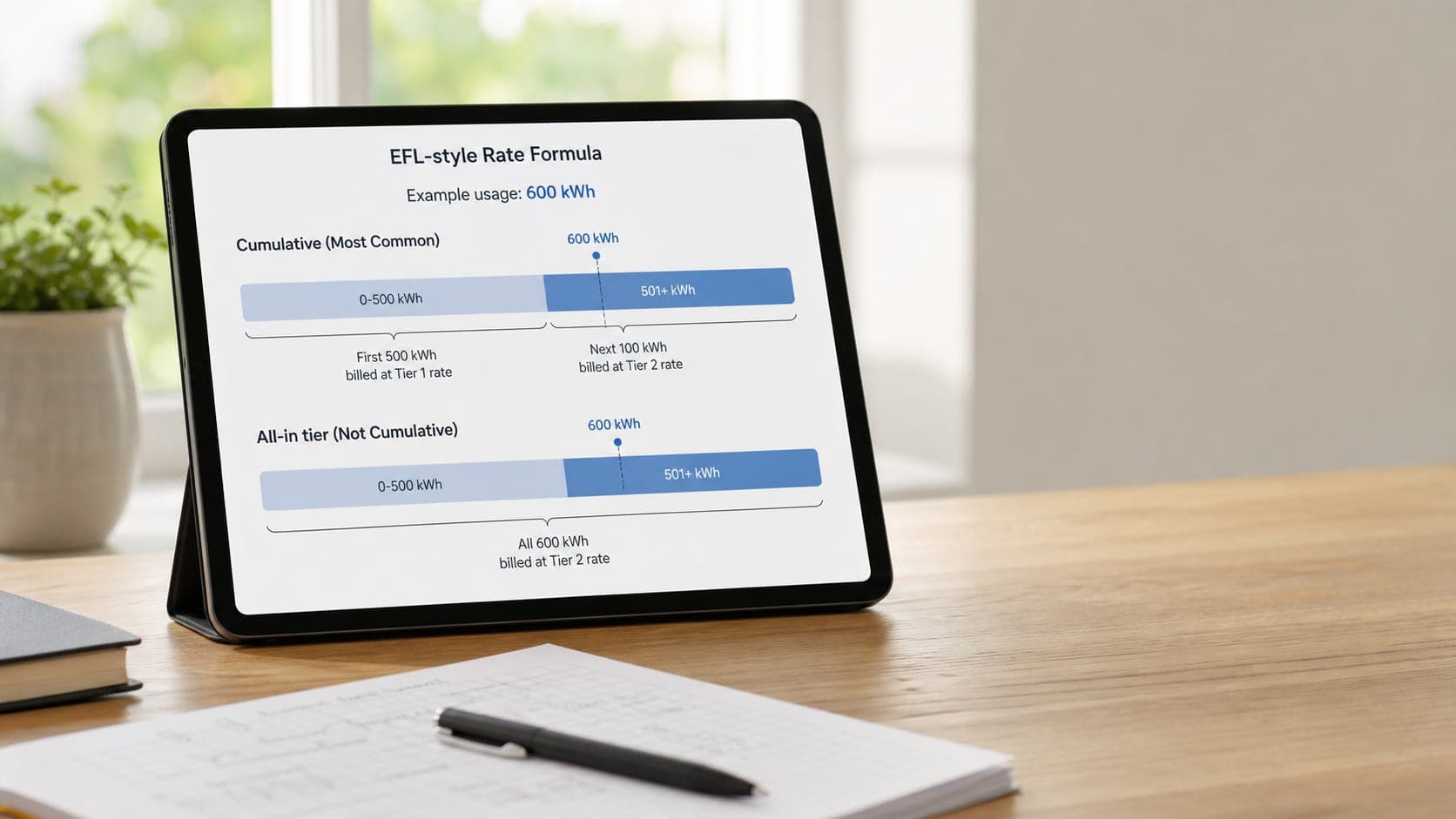
The EFL will specify how the tiers work. Read the formula carefully before you estimate your bill. A plan that looks cheap at 1,000 kWh may be more expensive at 800 or 1,200 kWh depending on where the tier breaks fall.
Fees Can Move the Bill Even When Usage Looks Normal
Recurring fees like a monthly base charge appear on every bill. They are usually a flat dollar amount that covers administrative costs. A plan with a low per-kWh rate and a high base charge can look good on a usage example but cost more for a home that uses less electricity.
One-time fees also play a role. Late payment fees, returned check fees, and early termination fees are standard disclosures.
They do not affect every bill, but they affect the total cost of the plan over time if you trigger them. Some plans also charge a fee for paying by phone or for requesting a paper bill. Check the EFL fee table for the full list.
One-time fees can change the real cost of a plan
An early termination fee is a good example. If you sign a 12-month contract that includes a $150 early termination fee and your situation changes mid-contract, that fee becomes part of the effective cost of the plan. It is not reflected in the per-kWh rate.
Always note the contract term and the early termination amount before you enroll, even if you do not plan to move.
Contract Term and Renewal Language Can Change the Context
The length of your contract matters for how you read the rate. A 12-month plan locks the pricing terms for one year. A 36-month plan does the same for three years. During that time, the energy charge stays the same, but the delivery charge from the TDSP can change because it is regulated separately and can be adjusted by the PUCT.
Renewal language is also part of the plan documents. Some plans convert to a month-to-month rate after the contract ends, often at a higher price. Others require you to actively renew or switch. Understanding the renewal terms helps you avoid a jump in your rate after the initial term.
Term length belongs beside the rate
A low introductory rate for a 12-month term is not the same as a moderate rate for a 36-month term. The shorter term gives you flexibility to shop again sooner. The longer term protects you from market price increases for a longer period. Both are valid, but the term length is part of the context that makes the rate meaningful.
Service Address Sets the Local Rate Context
Your ZIP code and service address determine which TDSP delivers your electricity and which plans are available to you. Power to Choose and other shopping sites use location to filter plans. That is why a rate example from a different city or utility territory may not apply to your home.
ZIP code is a location filter, not a statewide promise
A plan listed at a certain rate in Houston, which is in CenterPoint territory, may have different delivery charges than the same plan offered in Dallas, which is in Oncor territory. The energy charge may be identical, but the delivered cost per kWh will differ because the TDSP charges are different. When you compare rates, make sure you are looking at plans available at your specific address.
Commercial accounts and larger residential usage may require the same bill-math concepts with different assumptions. The usage patterns, demand charges, and contract structures can differ, but the principle of checking the plan document against your real usage still applies.
REP and TDSP Roles Appear on One Customer Bill
The retail electric provider handles your customer service, billing, and the energy charge. The TDSP owns the physical infrastructure and handles outages, meter reading, and line maintenance.
Even though you sign a contract with the REP, both organizations appear on your bill.
The REP may bill charges tied to the local utility
When you pay your electricity bill, you send money to the REP. The REP then passes the delivery charge portion to the TDSP.
This means the REP is your single point of contact for billing questions, but not every line item on the bill is set by the REP.
Delivery charges, taxes, and certain assessments are set by the TDSP or government entities. If you have a question about a delivery charge, your REP can explain it, but the rate itself comes from the utility tariff.
Current Rate Examples Need an As-Of Date
Texas electricity rates change frequently. Providers adjust pricing based on wholesale energy costs, demand, and competition. A rate that was the lowest in the market last month may be average or above average today. That is why any specific cents-per-kWh example should be treated as a snapshot, not a permanent benchmark.
A Neutral Reading Order for a Stated Rate
When you come across a Texas electricity plan rate, you can evaluate it with a consistent checklist. The goal is not to choose the cheapest plan, but to understand what the rate actually means for your bill.
- Identify the usage level tied to the rate. Is it 500, 1,000, or 2,000 kWh? Do you typically use close to that amount?
- Check the plan documents for the full pricing formula. Is the rate fixed or tiered? Are there credits with conditions?
- Separate the energy charge from the delivery charge. The delivery charge depends on your TDSP territory.
- Look at recurring fees and one-time fees. A low per-kWh rate with a high base charge may not save you money.
- Note the contract term and renewal language. Does the rate apply for a fixed period, and what happens when it ends?
- Confirm that the plan is available at your service address. A rate from a different ZIP code may have different delivery costs.
Read the charge, condition, and date together
A stated rate is useful only when you know the usage level, the service area, the plan document details, and the date the rate was published. If any of those pieces are missing or do not match your situation, the number is not a reliable prediction of your bill.
Texas Power Plan Rate FAQs
Related Bill and Document Guides
Sources & References
Editorial standards
SlashPlan publishes independent guidance to help Texans compare electricity plans. Our editorial team reviews each article without advertiser influence. See our editorial guidelines and monetization disclosure.
About the author
Roi CahanaEnergy advisor helping Texans better understand their electricity options and make more confident decisions. Focused on simplifying electricity plans, explaining confusing terms, and sharing practical guidance to help readers avoid common mistakes when comparing rates, contracts, and renewals.
Ready to compare plans?
Enter your ZIP code to see electricity plans available at your address.