How Your Electric Billing Cycle Affects Your Texas Bill
A Texas electric bill can change because of more days in the cycle, higher kWh use, delivery charges, fees, or plan structure. This guide shows what to check before comparing plans.
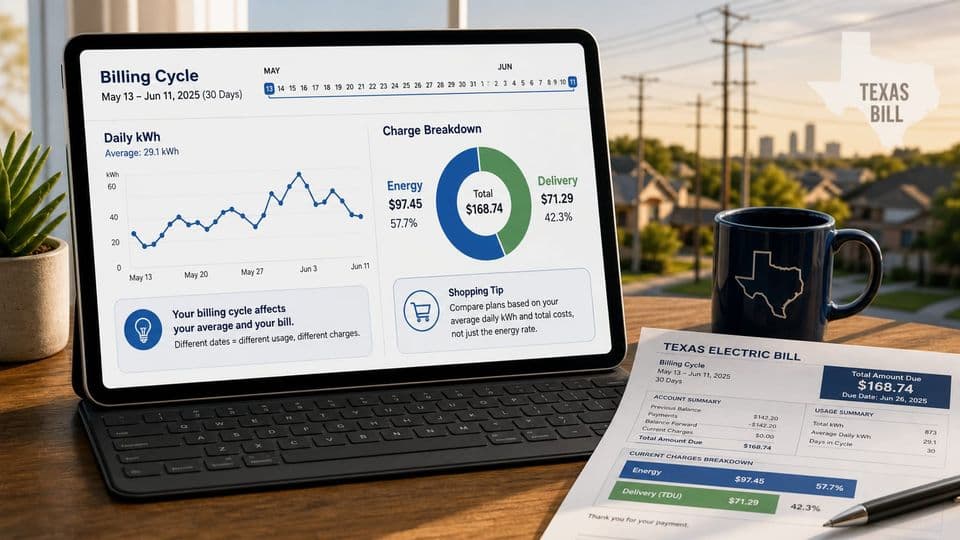
Key Takeaways
- 1A billing cycle is the date range of electricity usage covered by one bill, not the same thing as a plan contract term.
- 2A higher total bill can come from more service days, more kWh usage, weather, appliance changes, fees, delivery charges, or plan structure.
- 3Texas shoppers should compare average daily kWh and average daily cost before deciding that a rate changed.
- 4REP energy charges, TDU delivery charges, taxes, base charges, and bill credits can all affect the final amount due.
- 5The Electricity Facts Label, Terms of Service, and Your Rights as a Customer disclosure are essential for checking how a plan will bill your usage.
A Texas electric bill can shift from one month to the next even when daily habits stay roughly the same. The dates that define the billing cycle, the total days of service, the kWh recorded during that window, and how the plan and delivery charges apply all play a role in the final amount.
What your billing cycle actually covers
An electric billing cycle covers the specific dates of electricity service included on one bill. The start and end dates set the window for kWh measurement and most charges that appear.
Bills may list this range under service dates, billing period, or meter read dates depending on the layout chosen by the provider. The cycle is separate from the payment due date and from the contract term listed on a Texas electricity plan. For a broader walkthrough of the sections on a bill, see How to Read Your Electricity Bill in Texas.
Readers should locate the first and last day shown before comparing one bill to another.

Service dates, meter reads, and statement date
The service dates mark when usage began and ended for that bill. Meter read dates reflect when the provider recorded the meter, and these can differ slightly from the broader service window. The statement date is simply when the bill was generated and does not define the usage period.
Billing cycle vs. contract term
The billing cycle repeats with each new service window on the bill. The contract term is the length of the electricity plan agreement, such as twelve months under a fixed-rate offer. These two periods often do not align.
Where to look when bill labels differ
Check the usage section first for the date range, then review any summary that breaks out total kWh. If labels vary across providers, focus on the start and end dates rather than relying on section names.
How kWh turns daily habits into the usage line
kWh measures the total electricity used over time. Most residential Texas bills rely on this unit to calculate energy charges.
A 2 kW appliance running for five hours uses 10 kWh. Thermostat settings, appliance runtime, occupancy changes, and new loads such as EV charging all affect the kWh recorded during a cycle.
Daily average kWh offers a clearer comparison when one cycle contains more or fewer days than the prior one.
kW and kWh in plain English
kW describes the rate of power use at a moment. kWh multiplies that rate by the hours of use to produce the total recorded on the bill.
A simple device-runtime example
A space heater rated at 1.5 kW left on for four hours adds 6 kWh. Tracking a few common devices shows how small changes in run time add up across a month.
Why daily average kWh is the cleaner comparison
A cycle with 32 days can show higher total kWh than a 28-day cycle even when daily use stays similar. Dividing by the number of service days removes that distortion.
Why more days can make a normal month look high
Service periods vary in length. A cycle that stretches to 32 or 34 days often produces a higher total bill simply because more days of usage are included.
Compare both average daily kWh and average daily cost instead of the total amount due. This approach shows whether usage per day actually changed or whether the longer window alone explains the increase.
Total bill vs. average daily cost
Two bills with similar daily averages can differ by $30 or more when one cycle runs five days longer. The total due reflects the length of the period as much as the rate.
Total kWh vs. average daily kWh
A household that used 900 kWh in 30 days shows the same daily average as one that used 960 kWh in 32 days. Focusing on the daily figure prevents mistaking cycle length for a rate increase.
When a longer cycle is not the real problem
If daily kWh stays within a few units but the total rises sharply, the extra days likely explain most of the change. When daily kWh also climbs, other factors such as weather or new loads deserve attention next.
Where Texas energy and delivery charges split apart
In deregulated Texas areas the Retail Electric Provider sets the energy charge and manages the plan. The local transmission and distribution utility handles delivery of the power.
The two sets of charges may appear as separate line items or be blended into an average price on some bills. A fixed-rate plan locks the energy portion for the term but leaves regulated delivery charges subject to adjustment.
Taxes, recurring base charges, and minimum-use rules can also move the final amount owed even when kWh totals remain steady. Customers served by municipal systems or local utility arrangements may see different billing language and should rely on local documents, such as a City of Lubbock electric ordinance, rather than assuming every line item follows a competitive REP format.
REP energy charges
The REP portion covers the cost of the electricity itself. This rate can be fixed for the contract term or vary under indexed or time-of-use structures.
TDU delivery charges
TDU charges appear on every bill regardless of the chosen REP. These regulated fees recover the cost of poles, wires, and metering.
Taxes, base charges, and recurring fees
Local taxes, gross receipts taxes, and any monthly base or minimum charges add to the total. These items remain even during low-usage months.
Why fixed rate does not mean fixed bill
A fixed energy rate holds the cents-per-kWh price stable, yet delivery charges, taxes, and plan fees can still shift. The final bill reflects the full combination of those elements.
The line-item math worth checking before you pay
The billing summary shows totals. The billing details section reveals how those totals were calculated.
Review the recorded kWh, the rate applied to each block of usage, delivery charges, any base charges, bill credits, late fees, and taxes. Credits that reduce the bill only above a certain usage level can make one month appear inexpensive while nearby usage levels receive smaller or no credits.
Cross-check the math against the Electricity Facts Label, Terms of Service, and Your Rights as a Customer disclosure before deciding a plan performed differently than expected.
What the summary hides
The summary may show only an average price per kWh or a single total. The details expose whether that average came from usage blocks, credits, or fees.
Charges that deserve a closer look
Focus on the kWh amount, the precise cents-per-kWh rate, the split between energy and delivery, and any one-time account adjustments. These items explain most differences between bills. For a step-by-step review process, use this guide to audit your electricity bill.
How bill credits can change the average price
A credit that applies only after 1,000 kWh can lower the effective rate for high-usage months while leaving lower-usage months closer to the base rate. Read the credit rules on the EFL before assuming a plan will produce consistent monthly results.
The high-bill check: usage, weather, plan, or account charge
Start with usage. Hotter weather lengthens HVAC runtime, new appliances or EV charging add load, and changes in household occupancy shift daily kWh.
Next review the cycle length. More service days can raise the total without any change in habits.
Then examine the plan for rate adjustments, bill-credit thresholds, or new contract terms that alter pricing.
Finally check account-level items such as deposits, late fees, budget-billing true-ups, or corrections from an estimated reading to an actual reading.
Weather and HVAC runtime
Summer and winter temperature swings often drive the largest month-to-month changes. A few extra days above 95 degrees can add several hundred kWh in a typical Texas home.
Household changes and new load
A new refrigerator, larger television, or work-from-home schedule increases baseline use. Track these additions separately from the rest of the bill.
Plan changes and account charges
A rate change at the start of a new contract term or the loss of a one-time credit can shift the bill even when usage stays flat. Account adjustments such as returned-payment fees produce one-time spikes.
Estimated-read corrections
When an estimated reading is later replaced by an actual meter read, the next bill can rise or fall by the difference. The bill usually notes whether the reading was estimated or actual.
How to compare this cycle with last month
Gather the current kWh total and the same figure from the prior month and the same month one year earlier if available.
Divide each total by the number of service days to produce a daily average. This step prevents conclusions based solely on different cycle lengths.
Remove one-time account charges before comparing average price per kWh. A sharp rise in daily kWh with little change in average price points to usage as the main driver.
Compare the same season when possible
Summer cooling months and winter heating months often show different patterns. Matching the current bill to the same season the prior year reduces weather-related noise.
Normalize by service days
A 1,200 kWh bill over 32 days is lower on a daily basis than a 1,050 kWh bill over 28 days. Always divide before judging whether usage increased.
Separate one-time charges from energy usage
Late fees, deposit true-ups, and prior-period corrections belong in a separate comparison category. Removing them isolates the energy and delivery portions of the bill.
How billing cycles change plan-shopping math in Texas
Plan comparisons work best when anchored to actual kWh history rather than an assumed average month.
Texas plans often apply different rates or credits across usage tiers. The same household can see materially different results at 700 kWh, 1,000 kWh, and 1,500 kWh.
The Electricity Facts Label lists the usage level used for its average-price calculation and any credits or fees that apply at other levels. A plan that appears favorable for one recent cycle may not perform as well across an entire summer or shoulder season.
Use real kWh history before choosing a plan
Pull at least three recent cycles and note the range. A household that rarely drops below 900 kWh can safely ignore plans that only discount the first 500 kWh.
Watch usage tiers and bill-credit thresholds
Some plans reduce the bill only after a high monthly total. Households that stay near the threshold from one cycle to the next receive inconsistent savings.
Read the EFL before trusting the advertised average rate
The advertised average rate assumes a specific monthly kWh level. Actual bills reflect the rates, credits, and fees that apply at the household's real usage.
Match the plan to summer and shoulder months
A plan that rewards low shoulder-season usage may become expensive once air-conditioning load returns. Review EFL numbers at both low and high usage levels before enrolling.
Time-of-use and free-nights plans need your usage pattern
Off-peak pricing reduces charges only during specified hours. Savings appear only when a household can move meaningful load, such as EV charging or laundry, into those windows.
Households that run most cooling during weekday afternoons often see little benefit from time-based structures. Review the EFL and plan documents to confirm how delivery charges and base charges interact with the time-based rates.
When shifting usage can help
A household that can delay dishwashing, clothes drying, or vehicle charging until after 8 p.m. can reduce the energy portion of the bill under many free-nights offers.
EV charging and overnight load
Overnight EV charging aligns naturally with free-nights windows. The same household may still pay peak prices for daytime air-conditioning, so net savings depend on the size of both loads.
When a simple fixed-rate plan may be cleaner
Households with steady daytime occupancy or limited ability to shift load often find fixed-rate plans simpler to manage. The absence of time restrictions removes the need to monitor an hourly schedule.
When the meter reading or bill looks wrong
Check whether the bill states an actual or estimated reading when that label appears. A later actual reading can produce an adjustment on the following bill.
Start billing questions with the Retail Electric Provider listed on the bill. Contact the local TDU for delivery or outage issues.
Save the prior bill, the current bill, and the Electricity Facts Label before contacting the provider. These documents show the numbers under discussion.
Actual vs. estimated readings
Estimated readings rely on prior usage patterns. Hot or cold weather that differs from the pattern can produce a noticeable correction once the meter is read again.
Who to contact first
The REP handles plan pricing, bill calculations, and most account questions. The TDU responds to outages and meter problems.
What to save before disputing a bill
Keep the two most recent bills, the EFL from the current plan, and any email or portal confirmation of the enrollment. These items allow a clear comparison of the disputed charges.
Solar and buyback plans add another layer
Solar bills typically separate energy delivered by the grid from energy exported to the grid. A monitoring app may show total production, while the bill reflects only the net energy that crossed the meter.
Buyback credit values, rollover limits, and cash-out rules vary by Retail Electric Provider and by specific plan. Do not assume one-to-one net metering applies to every Texas solar installation.
Delivered kWh vs. exported kWh
Delivered kWh is the energy purchased from the grid. Exported kWh is the energy sent back. The bill normally shows both quantities and applies the plan's import and export rates separately.
Why your solar app and bill can disagree
Apps often report total panel output before inverter losses or before any power used on-site. The meter records only the surplus that leaves the home.
Texas buyback credits are plan-specific
Some plans credit exports at the full retail rate while others use a lower wholesale value. Rollover balances may expire or convert to cash only under stated conditions.
Demand charges are mainly a business-bill issue
kWh records total energy over time. kW demand records the highest rate of power draw during a short interval, often 15 or 30 minutes.
Demand charges appear more frequently on commercial accounts and certain non-standard residential rates. One short high-draw event can raise the monthly cost for customers billed under those structures.
Most residential shoppers can focus on total kWh, the energy price, TDU delivery charges, and plan fees rather than demand calculations.
kWh charges vs. kW demand
kWh drives the energy line on nearly every residential bill. kW demand affects cost only when the plan or rate class includes a demand component.
Why one short peak can matter for businesses
A single 15-minute spike in air-conditioning or equipment load can set the demand charge for the entire month. Business customers therefore review interval data in addition to monthly totals.
When residential shoppers can skip demand math
Standard residential plans in Texas do not apply demand charges. Checking the EFL confirms whether a plan uses kWh only or adds a demand component.
A simple end-of-cycle routine before switching
Collect the last 12 months of kWh data if available, or at least the most recent four to six cycles.
Divide each total by its service days to produce daily averages. Compare those averages across similar weather periods.
Read the Electricity Facts Label, Terms of Service, and Your Rights as a Customer disclosure before enrolling in a new plan.
If the recent bill rose mainly because of higher daily kWh, usage adjustments often produce larger savings than plan changes alone. If daily kWh stayed steady while the average price increased, shopping for a better plan fit becomes the clearer next step.
Electric Billing Cycle FAQ
Editorial standards
SlashPlan publishes independent guidance to help Texans compare electricity plans. Our editorial team reviews each article without advertiser influence. See our editorial guidelines and monetization disclosure.
About the author
Roi CahanaEnergy advisor helping Texans better understand their electricity options and make more confident decisions. Focused on simplifying electricity plans, explaining confusing terms, and sharing practical guidance to help readers avoid common mistakes when comparing rates, contracts, and renewals.
Ready to compare plans?
Enter your ZIP code to see electricity plans available at your address.