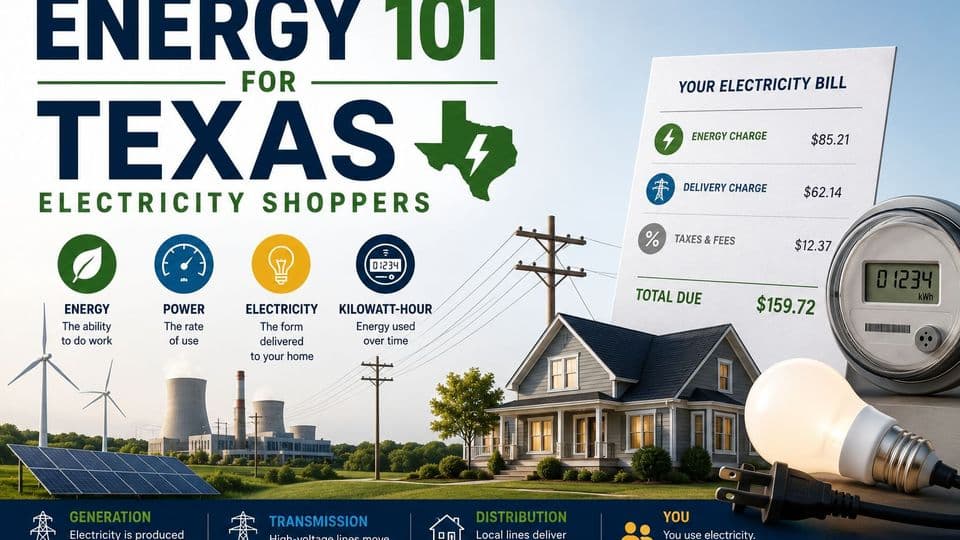
Energy 101 for Texas Electricity Shoppers
A guide on how energy becomes electricity, how that electricity reaches Texas homes, and which basics actually matter when comparing plans.
Key Takeaways
- 1Energy is the amount used, while power is the speed of use. Texas electricity bills are mainly tied to energy use measured in kilowatt-hours.
- 2Electricity is not a fuel. It is generated from sources such as natural gas, wind, solar, coal, hydro, or nuclear energy.
- 3A fixed retail energy rate does not necessarily freeze delivery charges or every bill line item.
- 4Texas shoppers should compare plans using actual usage history, not only the advertised price at one example usage level.
- 5The Electricity Facts Label, Terms of Service, and Your Rights as a Customer disclosure are the key documents to review before enrolling.
What energy means for your electricity bill
Energy is the ability to do work. In practice for Texas homes, that means the electricity that runs air conditioners, lights, refrigerators, and chargers. Retail plans bill for the total energy consumed over time, shown on statements as kilowatt-hours.
Shoppers often focus on the lowest advertised rate. That number can shift once base charges, delivery fees, and usage tiers are added. A plan that looks cheapest at 1,000 kWh may cost more at another level.
Texas separates the retail provider, which sells the plan, from the utility that owns the local wires and meters. Delivery charges come from the utility side and appear on almost every bill regardless of the chosen plan.
The one idea to remember before comparing plans
Your bill tracks how much energy you used, not how fast you used it. Keep that distinction in mind when plans list prices at different usage amounts.
Why basic energy terms show up on plan documents
Electricity Facts Labels and Terms of Service documents use terms such as energy charge, delivery charge, and kilowatt-hour so customers can see how the total bill is built.
Energy, power, and electricity are not the same thing
Energy is the total amount transferred or used. Power measures the rate of that use. A 1,500-watt space heater draws more power than a 60-watt LED bulb, but the heater can be turned off after an hour while the bulb runs all evening.
Electricity itself is one form of energy created by moving electric charges. It is delivered to homes through wires after being generated elsewhere.
Energy is the amount
Think of energy as the quantity on the meter at the end of the month. The meter records cumulative use.
Power is the speed
Power tells how quickly energy flows. Appliance labels list power in watts or kilowatts so users know the demand at any moment.
Electricity is the form delivered to your home
No home receives electricity directly from a wind turbine or a gas well. Generation happens at power plants or solar arrays, then the grid moves the electricity to the local delivery system.
The units that matter: watts, kilowatts, and kilowatt-hours
A watt measures power. One thousand watts equals one kilowatt. Kilowatt-hours measure energy used across time.
A 1,000-watt device left on for one hour uses 1 kWh. Ten 100-watt bulbs running for one hour also use 1 kWh.
What a watt tells you
Watt ratings appear on appliance nameplates and help estimate how much load a circuit or panel can handle.
How a kilowatt-hour becomes billable usage
Meters record kWh. The retail provider multiplies the kWh by the energy rate and adds other charges.
Why 500, 1,000, and 2,000 kWh examples can mislead shoppers
Fees and credits often change at different consumption levels. Comparing only one example usage hides how the bill actually moves with real monthly numbers.
Where electricity starts: energy sources

Electricity must be generated from another energy source. Natural gas, coal, nuclear fuel, wind, solar, and water are common starting points in Texas.
Retail plans sometimes advertise renewable content. That claim usually refers to how the provider accounts for generation rather than a direct wire from a specific wind farm to a home.
Fossil fuels, nuclear, solar, wind, and hydro
Texas generation mixes all of these. The mix changes daily with demand, fuel prices, and weather.
Why electricity is not a fuel
Electricity cannot be stored like gasoline. It must be produced at roughly the same moment it is used, except where batteries or pumped storage shift timing.
What source claims can and cannot tell a shopper
A renewable plan may retire certificates to match usage, but the actual electrons arriving at the meter still come through the shared ERCOT grid.
How energy becomes electricity
Power plants and renewable installations convert source energy into electrical form. Turbines spin generators in gas or nuclear plants. Solar panels create current directly from sunlight.
Conversion always loses some energy as heat. The losses do not appear as a separate line item on the bill.
Turbines, panels, and the conversion step
Wind turbines and solar arrays feed power into the transmission system alongside traditional plants.
Why energy losses happen
No process converts 100 percent of the original energy into usable electricity. The grid manages these realities through reserve margins and real-time balancing.
Why efficiency does not always show up directly on your bill
Retail rates already reflect average system costs. Individual household efficiency reduces kWh, which lowers the bill even if the rate stays the same.
Transmission, distribution, and why delivery charges exist

After generation, electricity travels long distances on high-voltage lines. Local utilities then reduce voltage and move power through neighborhood wires to homes.
In Texas, the retail energy charge covers the power commodity. Delivery charges cover the poles, wires, and meters owned by the transmission and distribution utility.
Transmission moves power across the grid
High-voltage lines carry electricity from generators to substations across the state.
Distribution gets power to the meter
Lower-voltage lines and transformers serve individual streets and homes.
How delivery charges differ from the retail energy charge
A fixed-rate energy charge locks only the provider’s portion in many plans. Delivery rates can still adjust with regulatory filings.
AC and DC voltage
Current is the flow of electric charge. Voltage is the pressure that pushes the charge through wires.
Household outlets supply alternating current that reverses direction 60 times per second. Batteries and electronics often use direct current.
Current is the flow
Higher current means more charge moving per second, which affects wire size and breaker ratings.
Voltage is the push
Standard Texas homes receive 120 or 240 volts from the utility.
AC at the outlet and DC in batteries
Inverters change DC from solar panels or batteries into AC for household use. Chargers do the reverse for phones and laptops.
Why your usage changes from month to month
Usage depends on how long each appliance runs and how much power it draws. Texas summer heat often drives the largest monthly jump because air conditioning runs many hours each day.
Home size, insulation quality, thermostat settings, and number of occupants also shift consumption.
Power rating times runtime
A 5,000-watt water heater used for 30 minutes adds far less to the bill than a 1,500-watt air conditioner running for eight hours.
Seasonal cooling and heating effects
Spring and fall months usually show the lowest usage. Extremely cold winter days can create secondary spikes when electric heat runs.
Why your best plan may change with your usage profile
A plan with a large bill credit at 1,000 kWh can become expensive if actual usage moves to 2,000 kWh for several months.
The energy basics hidden in the paperwork
The Electricity Facts Label shows the energy charge, any base charge, and average prices at sample usage levels. The Terms of Service detail contract length and early termination fees. The Your Rights as a Customer disclosure explains complaint procedures and disclosure rules.
Electricity Facts Label
This three-page document is required for every offer. It lists the key rate components and sample bills.
Terms of Service
Contract terms and fee schedules appear here, including how delivery charges are passed through.
Fees and credits that change the real price
Minimum usage fees, cancellation penalties, and usage-based credits can swing the final amount more than small differences in the energy rate.
Fixed, variable, indexed, and prepaid plans
A fixed-rate plan holds the retail energy charge steady for the contract term unless the documents state otherwise. Variable-rate plans can adjust monthly. Indexed plans tie pricing to a published formula or market price.
Prepaid plans require an account balance and disconnect service when the balance reaches zero.
Fixed-rate plans
These suit households that prefer predictable bills and plan to stay through the full term.
Variable-rate and indexed plans
Prices can drop or rise with wholesale conditions. They fit shoppers who monitor usage closely and can exit quickly.
Prepaid plans
No deposit or credit check is required for many prepaid offers, but service ends without warning when the balance is exhausted.
Renewable energy claims on Texas plans
Plans labeled renewable or green usually match a portion of usage with renewable energy certificates. The certificates represent generation from wind, solar, or other replenishing sources.
Renewable sources behind the claim
Texas leads the nation in wind generation. Solar capacity continues to grow.
What a renewable plan does not always mean
The electricity reaching the home still travels over the same grid as non-renewable power. The renewable attribute is an accounting step.
How to read green plan language carefully
Look for the exact percentage of renewable content and whether the provider retires certificates on the customer’s behalf.
Energy storage and batteries on the grid
Storage shifts energy from times of high production to times of high demand. Grid-scale batteries help balance the system. Home batteries can provide backup during outages.
Why storage matters when demand changes
Batteries reduce the need for plants that run only a few hours each year.
Grid batteries and home batteries are different tools
Grid projects support overall reliability. Home systems mainly protect individual households.
What storage does and does not change about a retail plan
Storage does not remove delivery charges or alter the basic retail contract.
Efficiency, conservation, and why energy does not disappear
Energy converts from one form to another. An air conditioner turns electrical energy into cooled air and heat rejected outdoors. Light bulbs turn it into visible light and warmth.
Energy changes form
Nothing is created or destroyed, only moved between useful and less useful states.
Efficiency means useful output
A modern heat pump moves more heat per kWh than an older resistance heater.
Lower usage still needs the right plan math
Even efficient homes must compare the full bill, including fees that remain regardless of kWh saved.
The Texas grid connection: ERCOT, TDSPs, and retail providers
ERCOT operates the wholesale market and maintains grid balance. Transmission and distribution service providers own and maintain the poles and wires. Retail providers sell plans and handle billing.
Who sells the plan
The retail electricity provider sets the energy rate and any promotions.
Who delivers the electricity
The local TDSP handles meter reading, outage restoration, and delivery charges.
Who handles many outage and wire issues
Customers call the TDSP for poles, wires, and most storm-related problems.
How to compare plans after learning the basics
Begin with 12 months of actual kWh history. Estimate the full bill under each plan instead of relying on the headline rate. Verify how delivery charges, base fees, and credits apply at the household’s typical usage.
Use your real kWh history
Avoid relying solely on the three standard usage examples printed on labels.
Compare the full bill estimate
Add energy charges, delivery charges, and any monthly fees or credits.
Watch for usage credits and minimums
Credits that apply only inside narrow bands can increase costs when usage falls outside those bands.
Match the plan type to your risk tolerance
Shoppers who dislike price swings usually prefer longer fixed-rate contracts.
Energy terms glossary for Texas shoppers
Science terms
- Energy: total work performed or heat transferred.
- Power: rate of energy use.
- Watt and kilowatt: units of power.
- Kilowatt-hour: unit of energy on the bill.
Grid terms
- Generation is the creation of electricity at power plants or renewable sites.
- Transmission is the long-distance movement on high-voltage lines.
- Distribution is the local delivery to homes.
Plan and bill terms
- Energy charge: price per kWh from the retail provider.
- Delivery charge: regulated fee from the TDSP.
- Base charge: flat monthly fee regardless of usage.
What to do before you pick a plan
Review at least one full year of usage before choosing an offer. Separate the retail energy rate from delivery charges in every estimate. Read the Electricity Facts Label and Terms of Service in full. Treat low advertised rates, large bill credits, and renewable claims as items that need verification against actual consumption patterns.
Energy 101 FAQs
Topics
Editorial standards
SlashPlan publishes independent guidance to help Texans compare electricity plans. Our editorial team reviews each article without advertiser influence. See our editorial guidelines and monetization disclosure.
About the author
Roi CahanaEnergy advisor helping Texans better understand their electricity options and make more confident decisions. Focused on simplifying electricity plans, explaining confusing terms, and sharing practical guidance to help readers avoid common mistakes when comparing rates, contracts, and renewals.
Ready to compare plans?
Enter your ZIP code to see electricity plans available at your address.