High Electric Bill From a Billing Error? What to Check First
A practical Texas billing checklist for deciding whether a high electric bill points to a billing error, real usage increase, or missing account detail.
Key Takeaways
- 1A high electric bill can be caused by a billing error, but the first check is whether billing days, kWh usage, or the charge mix changed.
- 2The strongest billing-error clues are meter-read problems, estimated or corrected usage, duplicate line items, missed credits, service-date errors, old-address charges, and account-detail mismatches.
- 3A usage increase can look like a billing error when Texas heat, HVAC runtime, appliances, or equipment issues push kWh higher.
- 4A dispute is stronger when you contact the energy company with one exact meter read, date range, line item, credit, address, or account-detail issue.
A high electric bill can be a shock, but not every shock means the bill itself is wrong. The first step is to separate the dollar amount from the actual evidence.
A billing error is possible, but the same symptoms can come from a longer billing cycle, higher electricity use, or a change in how charges are calculated.
Before you pick up the phone, take a few minutes to compare the basic bill facts against your previous statement.
Start with the bill facts before assuming an error
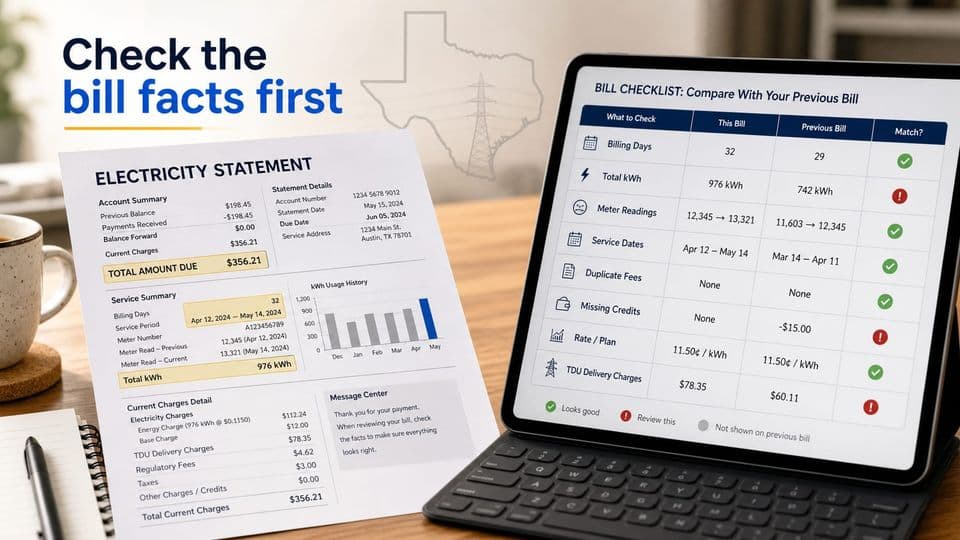
The dollar total grabs your attention, but it is not the most useful number for deciding whether an error exists. Pull out your previous bill and compare three things: the number of billing days, the total kilowatt-hours (kWh) used, and the amount due.
If the billing period is longer than usual, the higher total makes sense even without an error. A month with more days means more days of air conditioning, lights, and appliances adding up.
If the kWh usage is flat but the amount due jumped, you have a pricing or charge question. If the kWh went up, the reason is likely usage related. The goal here is to narrow the question. Write down one specific thing you want to investigate:
- Is it the meter reading?
- The number of days? A line item?
- The delivery charge?
Clarifying that focus will make every step that follows faster and less frustrating.
Billing days and kWh before dollars
Count the days on the current bill and compare them to the previous bill. A 33-day cycle will look higher than a 28-day cycle even when daily usage is the same. Then look at kWh. If kWh is higher, do not assume an error yet. Check whether the weather, thermostat setting, or a new appliance could explain the increase. If kWh is similar but the rate or fees are higher, that is a different category of review.
Meter readings deserve the first close look
A meter read mistake is one of the most straightforward billing errors to catch, but it is also easy to misinterpret.
Your electric bill shows the current meter reading, the previous reading, and the difference that was billed. Compare those numbers to see whether the usage recorded by the meter matches what you expect.
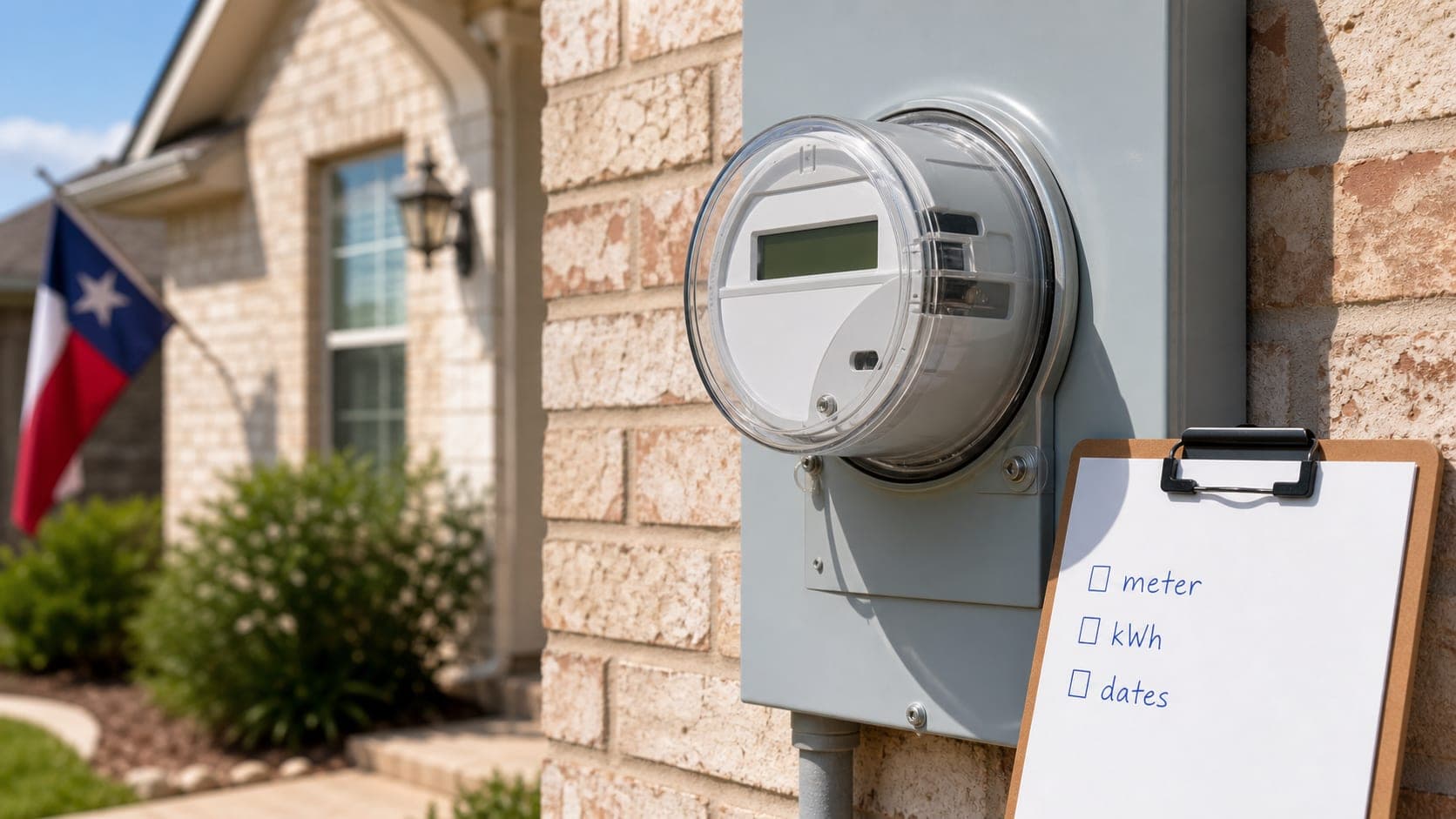
If the billed kWh is based on a reading that jumped sharply and your household usage did not change, the next step is to check whether the reading is marked as actual, estimated, or corrected. That label changes how you interpret the number.
An actual read is the meter value transmitted or read by the utility. An estimated read is a calculated guess based on past usage. A corrected read replaces a previous estimate.
Current and previous readings on the statement
Look at the meter reading column on the bill. It usually lists a previous reading, a current reading, and the total usage in kWh. If the current reading is lower than the previous reading, that points to a possible entry error.
If the reading difference is much larger than your normal pattern, ask whether the reading was estimated or corrected for a prior period. The bill issuer can tell you which readings were actually transmitted.
Estimated or corrected usage can explain a sudden jump
An estimated reading can cause a bill swing because the utility guesses usage based on history. If that guess is too low in one month and too high in the next, the difference shows up as a sudden jump when the actual read finally arrives.
That is not a billing error in the sense of a wrong charge, but it can look like one.
Check the language on the bill
Texas bills typically show the word estimated, actual, or corrected next to the meter reading. If you see an estimate, compare it to the actual reads on prior bills. If the estimate seems far off, ask the bill issuer to review the account. A corrected read can also bring in usage from a previous period that was not billed, which makes the current bill look larger than normal.
Estimated reads versus actual reads
The distinction matters because an estimate is not proof of an error. It is a placeholder that the utility will adjust later. If the estimate is close to your real usage, the next bill will be close to normal.
If the estimate is too high, you may be due an adjustment after the next actual read. The useful action is to ask for a specific review of the estimate and any corrective adjustment.
Service dates can expose move-in, move-out, or overlap mistakes
Timing errors happen more often than most people realize, especially after a move, account transfer, or provider change. Look at the start and end dates on the current bill. Do they match the period you actually received service at that address?
If you moved recently, compare the service dates on the final bill from the old provider and the first bill from the new provider. The same day should not appear on more than one bill. If it does, one of the bills is charging you for service that the other already covered. Overlapping billing periods are a clear reason to call and ask for a date-range review.
When one date appears on two bills
Gather both bills and highlight the overlapping dates. Call the company that issued the overlapping charge and explain that you have already paid for that period.
Ask them to verify the service dates and remove the duplicate. If the overlap involves different providers, start with the one whose bill looks incorrect.
Duplicate line items and missed credits are easier to spot than they look
A quick scan of the line items can reveal duplicate charges or missing credits without needing to understand every fee name.
Look for fees that appear twice with the same description and same amount. Look for base charges that repeat. If the bill includes a monthly credit or discount that was on the previous bill, check whether it appears this time.
Credits can be easy to miss when they are buried in the middle of the bill. If you receive a solar buyback credit, a low-income assistance credit, or a signup promotion that was supposed to last a certain number of months, compare the current bill to the one that first showed the credit.
If it is missing, that is a specific item to raise.
Do not treat a missing credit as an automatic refund. Ask the bill issuer to check whether the credit was applied to a different bill or whether a condition changed. The key is to name the exact credit or fee you want reviewed.
A wrong rate or plan detail belongs in the billing review
If your bill shows a rate per kWh, a base charge, or a plan code that does not match the contract or renewal notice you signed, that is a valid billing accuracy concern. This is not about shopping for a better rate. It is about whether the company charged you according to the terms you agreed to.
Pull out your Electricity Facts Label or the contract summary you received when you signed up or renewed. Compare the base charge, the energy charge per kWh, and the contract term. Look at any renewal notice if the plan recently ended. If the billed rate is different from what the document says, you have a specific mismatch to report.
Documents that prove the billed rate
Keep a copy of your contract or renewal notice handy when you call. Read the exact rate from the document and ask why the bill shows something different. The company can check whether a system error applied the wrong rate code to your account.
TDU delivery charges
In Texas, the electric bill includes charges from your retail electricity provider (the company you chose) and charges from the transmission and distribution utility (TDU or TDSP) that owns the poles and wires. Delivery charges are separate from the energy charge, and they are regulated.
If the delivery charge increased, it may reflect a change in the utility's rates, not your provider's calculation.
Compare the delivery charge line item to the same line on previous bills. If it matches your utility's posted rates, the charge is likely correct. If it does not, ask your provider for an explanation and refer to the official utility tariff.
Retail charges versus delivery charges
The retail charge is the part of your bill that comes from your chosen provider. The delivery charge comes from the local utility. The two are calculated differently, and a change in one does not normally indicate an error in the other.
If you have a question about delivery charges, start by checking your provider's customer service, but recognize that the utility sets those rates.
Incorrect taxes or account classification can change the total
Tax line items and account classification sometimes cause confusion. Look at the taxes on your bill. If the amount looks different from previous bills, check whether the tax percentage or the category changed. A residential account should not be charged commercial taxes unless the property classification changed.
If you notice an unexpected tax line or a different account type, ask the bill issuer to explain the change. This is usually a straightforward correction if the classification is wrong.
Old-address charges can survive a move if records do not match
After moving, a bill may still show charges for the previous address. This can happen when the move-out date and the final meter reading do not sync properly. Check the service address on the bill. If it is not the property where you currently live, or if it includes days after you moved out, that is a clear billing problem.
Look for final bills from the old address and compare the dates. If your old account shows charges after your move-out date, call the company and ask for a review of the specific date range. Keep your move-out documentation, such as the lease termination date or the final meter photo, to support your request.
Simple bill math can rule in or rule out a calculation problem
A basic math check does not require a spreadsheet. Look at the subtotals: usage charges, base charges, delivery charges, taxes, fees, and any credits.
Add them up on a piece of paper or in a notes app and compare the sum to the total due. If the totals do not match, you have found an error.
This check is not a substitute for a full account review, but it can catch obvious mistakes quickly. If you find a discrepancy, note the exact line items that do not add up and present that to the bill issuer.
For a broader step-by-step review, use this guide to audit your electricity bill before you dispute a specific charge.
Usage spikes can look like a billing error during Texas heat
Texas summers push air conditioners hard. A high bill in July or August is often the result of longer cooling hours, higher temperatures, and a thermostat set lower than usual.
Before treating the bill as a mistake, compare the kWh to the same month last year and to the previous bill.
If kWh is higher, the reason is probably usage. Check whether you changed the thermostat, had guests, worked from home more, or added a window unit. These changes can double the usage without any billing error.
Cooling load, appliances, and long run times
The most common cause of a sudden kWh jump in Texas is air conditioning.
A central AC unit running six extra hours a day adds a significant amount of kWh. A pool pump running longer or an older refrigerator working harder in the heat also adds up.
If the usage pattern matches a change in your home, the bill is likely correct even if the total stings.
New equipment or hidden loads can explain a repeat high bill
If high kWh persists across multiple bills, look for equipment changes that happened around the time of the first high bill.
A new electric water heater, a space heater used during a cold snap, a dehumidifier, or even a child's gaming computer left on can pull more power than expected.
Do not assume the meter is wrong just because the bill is high. Compare the usage pattern to what changed in the house. If you cannot identify a usage change, but the kWh is consistently higher, ask the bill issuer to check for a meter issue. That is a separate request from disputing a line item.
Gather evidence before calling your energy company
A prepared call gets faster results. Before you dial, collect the current bill, the previous bill, your account number, the service address, the bill dates, the kWh totals, and any meter reading details. Also have your plan contract or renewal notice ready.
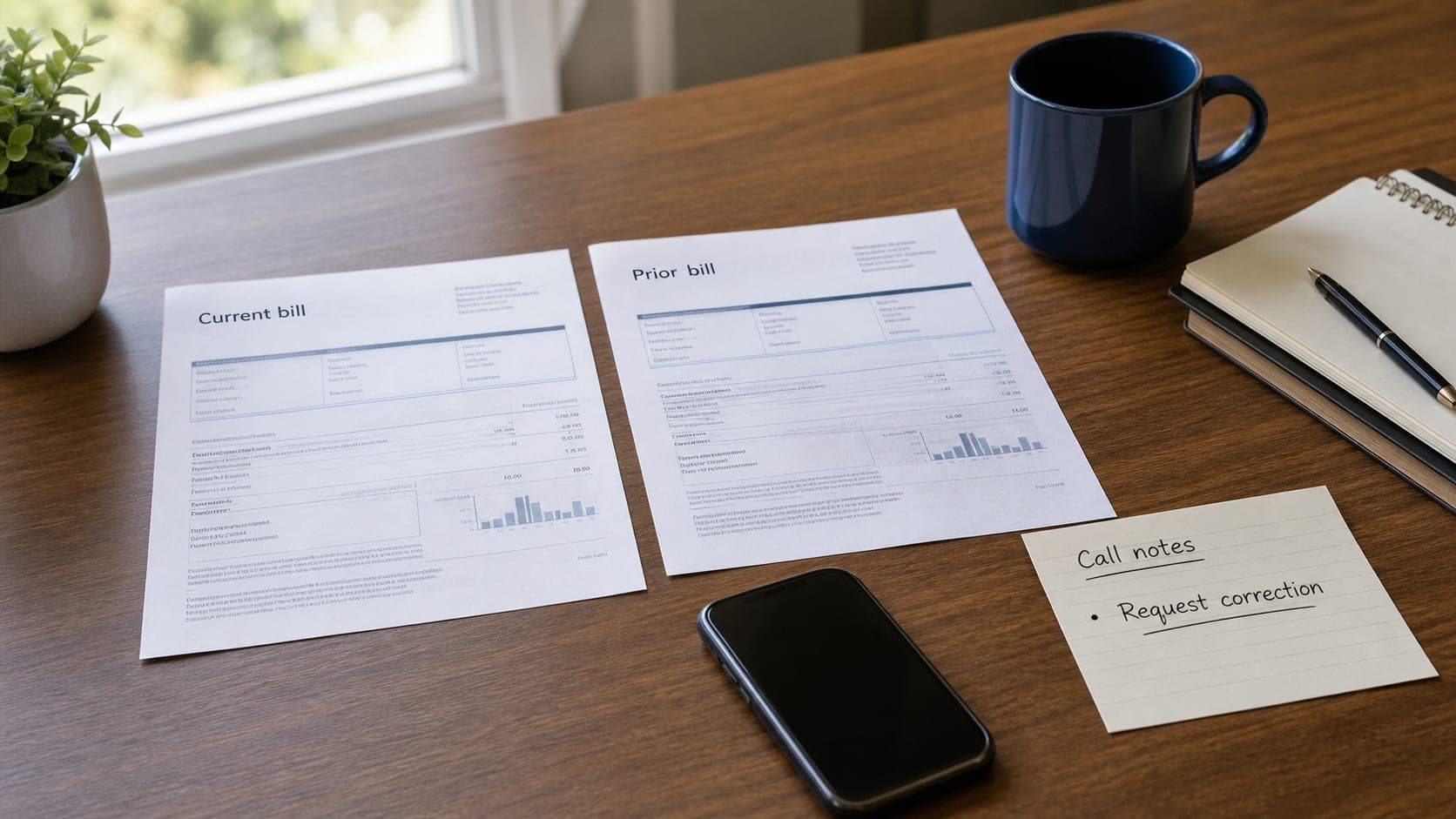
Write down one specific issue to raise. Do not say, "My bill is too high." Say, "The meter reading for October 15 shows 1,200 kWh more than the previous month, and the reading is marked estimated. Can you review that estimate?" A specific request gives the customer service representative a clear action to take.
If you have documentation such as a photo of the meter reading or a move-out notice, keep it accessible during the call. Ask for a case number or reference number and take notes on what the representative agrees to review.
Texas escalation starts with the Retail Energy Provider, then official complaint channels
Start with your energy company who issued the bill. Most billing questions can be resolved through the provider's customer service. If the representative cannot answer your question, ask to speak with a billing supervisor or a specialist.
If the issue remains unresolved after reasonable attempts, Texas customers have the option to file a complaint with the Public Utility Commission of Texas (PUCT). The PUCT complaint channel is for unresolved disputes after you have tried to work with the provider. Keep copies of all bills, correspondence, and notes from calls. The PUCT will ask what steps you took before filing.
Do not withhold payment entirely while disputing a bill unless your provider's contract or official rules specifically allow it. The safest approach is to pay any portion you agree is correct and note that you are disputing a specific item.
The PUCT website provides the complaint form and guidance for next steps.
High Electric Bill Billing Error FAQs
Sources & References
Topics
Editorial standards
SlashPlan publishes independent guidance to help Texans compare electricity plans. Our editorial team reviews each article without advertiser influence. See our editorial guidelines and monetization disclosure.
About the author
Roi CahanaEnergy advisor helping Texans better understand their electricity options and make more confident decisions. Focused on simplifying electricity plans, explaining confusing terms, and sharing practical guidance to help readers avoid common mistakes when comparing rates, contracts, and renewals.
Ready to compare plans?
Enter your ZIP code to see electricity plans available at your address.