Deregulated Cities in Texas: A Map and List of Energy Choice
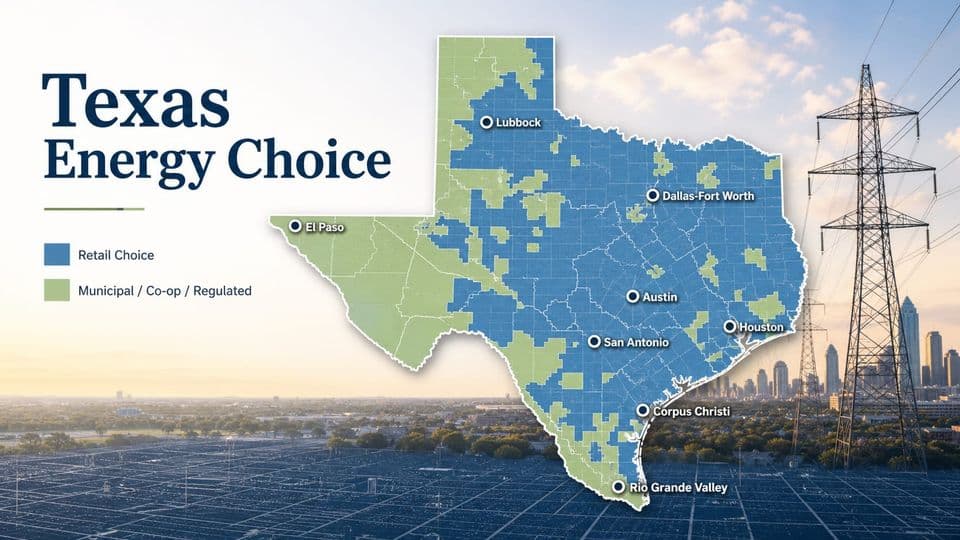
About 85% of Texas residents live in deregulated electricity markets, but choice isn't available everywhere. We list the major cities where you can choose your provider and explain why some remain regulated.
Key Takeaways
- 1Texas electricity choice is determined by geography and the specific utility territory serving an address.
- 2While 85% of Texas is deregulated, major cities like Austin and San Antonio operate their own municipal utilities and do not offer choice.
- 3Lubbock recently joined the competitive market in 2024, marking a major shift in the West Texas energy landscape.
- 4You can verify your deregulation status by identifying your Transmission and Distribution Utility (TDU) on your electric meter.
If you live in Texas, the answer to whether you can choose your electricity provider depends entirely on where you live.
Unlike most states, Texas split its electricity market into two distinct systems back in 2002. Some areas opened up to competition, letting residents shop around for power. Others stayed under the control of local utilities. The result is a patchwork of deregulated cities, regulated towns, and a few places where the rules change block by block.
This article covers which cities in Texas are deregulated, why some major metros like Austin and San Antonio remain outside the competitive market, and how you can confirm the status of your own address.
The Geography of Texas Electricity Choice
Location is the single most important factor in Texas energy shopping. You cannot choose a retail electric provider unless your address falls inside a deregulated area. That boundary is not determined by city limits alone. It depends on which utility serves your specific street.
The Origin of Texas Senate Bill 7
In 1999, the Texas Legislature passed Senate Bill 7, which restructured the state's electricity market. The law took full effect in 2002. It required the state's investor-owned utilities to separate their businesses into three distinct pieces: power generation, transmission and distribution, and retail sales. The idea was that if you separated the wires from the power plants from the billing, you could let multiple companies compete to sell you electricity while the physical infrastructure stayed under regulated control.
Not every part of Texas had to participate. The law allowed municipally owned utilities and electric cooperatives to opt out. Many of them did. That is why you can live in one Texas city and have dozens of providers to choose from, while a neighbor in the next town over has only one option.
Why Geography Rules Your Electricity Options
The deregulated portion of Texas covers roughly 85 percent of the state's population. That sounds like most people have a choice. But the 15 percent who do not live in some of the state's largest cities. Austin, San Antonio, and several other major population centers operate their own utilities and never joined the competitive market.
The key distinction is not whether you live in a big city or a small town. It is whether the utility that owns the power lines in your neighborhood is an investor-owned utility that was required to open its market, or a municipal utility or cooperative that chose to stay out.
How the ERCOT Grid Map Defines Choice
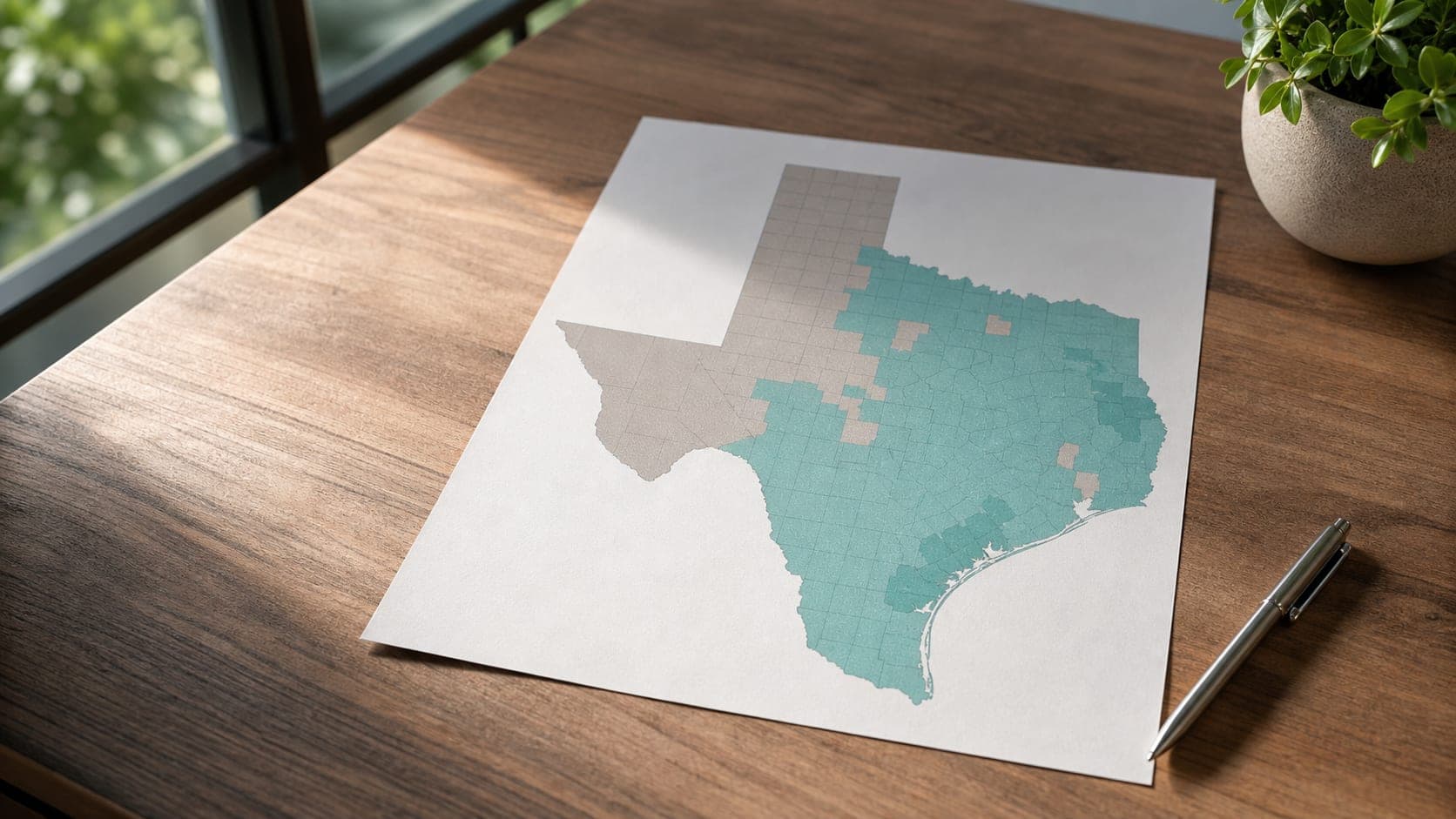
The Electric Reliability Council of Texas, known as ERCOT, manages the flow of electric power to about 90 percent of the state. If you live inside the ERCOT grid, you are in the territory where retail choice is possible. But being inside ERCOT does not guarantee you have choice. It only means the infrastructure is there.
ERCOT vs. Non-ERCOT Territories
ERCOT covers most of Texas, but not all of it. The Panhandle, parts of East Texas near the Louisiana border, and the far western tip of the state around El Paso operate on different grids. El Paso is part of the Western Interconnection. Parts of the Panhandle and East Texas connect to the Southwest Power Pool or the Midcontinent Independent System Operator.
These non-ERCOT areas generally do not have retail electricity choice. If you live in El Paso, you get your power from El Paso Electric, which operates as a traditional regulated utility. The same goes for Amarillo and much of the area north of Lubbock.
The Role of Transmission and Distribution Utilities (TDUs)
Even in deregulated areas, you cannot bypass the company that owns the power lines. Transmission and Distribution Utilities, or TDUs, are the regulated companies that maintain the poles, wires, and meters. They do not sell you electricity. They deliver it.
The major TDUs in Texas include Oncor, CenterPoint Energy, Texas-New Mexico Power, and AEP Texas. The TDU that serves your address determines which retail electric providers can operate in your area. If you move from an Oncor territory to a CenterPoint territory, the providers available to you will change, even if both areas are deregulated.
List of Major Texas Cities With Open Electricity Markets
The deregulated cities in Texas cover most of the state's major metropolitan areas. If you live in or near one of these cities, you can shop for your electricity provider.
Major Metro Areas with Retail Choice
Houston is fully deregulated. The city and most of its surrounding suburbs are served by CenterPoint Energy. Residents can choose from dozens of retail electric providers offering hundreds of different plans.
Dallas and Fort Worth are also fully deregulated. The Dallas-Fort Worth metroplex is served primarily by Oncor, which covers a massive territory stretching from the Oklahoma border down to Waco. Most suburbs in the DFW area are included, though there are a few exceptions where municipal utilities still operate.
San Antonio is not deregulated. CPS Energy, the largest municipally owned utility in the United States, serves the city. Residents do not have retail choice.
Austin is also not deregulated. Austin Energy, the city's municipal utility, provides power to residents and businesses. The city opted out of Senate Bill 7 in 2002 and has remained outside the competitive market ever since.
Secondary Cities and Suburban Hubs
Beyond the major metros, dozens of mid-sized cities offer retail choice. These include:
- Arlington (Oncor territory, fully deregulated)
- Corpus Christi (AEP Texas Central territory, deregulated)
- El Paso (not deregulated, served by El Paso Electric)
- Fort Worth (Oncor territory, fully deregulated)
- Garland (partially deregulated, some areas served by Garland Power & Light, a municipal utility)
- Irving (Oncor territory, fully deregulated)
- Laredo (AEP Texas Central territory, deregulated)
- Lubbock (recently transitioned to deregulation in 2024)
- McAllen (AEP Texas Central territory, deregulated)
- Plano (Oncor territory, fully deregulated)
- Waco (Oncor territory, deregulated)
Rural Areas with Deregulated Access
Rural areas are a mixed bag. If you live in a county served by an investor-owned utility like Oncor or AEP, you likely have retail choice even if you are far from any city center. But if your area is served by an electric cooperative, you probably do not have choice unless that cooperative has opted into the competitive market.
Why Some Cities Stay Regulated: The MOU Exception
Municipally owned utilities, or MOUs, are city-run power companies. They own the generation, transmission, and distribution infrastructure within their service territory. When Senate Bill 7 passed, these utilities were given the option to stay out of the competitive market. Most of them did.
Why Austin Energy and CPS Energy Are Exempt
Austin Energy and CPS Energy are the two largest MOUs in Texas. Both cities decided that keeping local control over electricity rates and infrastructure was more important than giving residents the ability to choose a provider.
Other cities with municipal utilities include Garland, Greenville, and Bryan. In each case, residents inside the city limits are served by the city utility and do not have retail choice. Residents just outside the city limits may be served by a different utility and may have choice.
How Electric Cooperatives Handle Retail Choice
Electric cooperatives, or co-ops, are member-owned utilities that serve many rural and suburban areas of Texas. Like MOUs, they were allowed to opt out of deregulation. Most of them did.
Member-Owned Utilities and Choice
Co-ops operate differently from investor-owned utilities. They are owned by the people they serve. Any profits are returned to members in the form of capital credits or lower rates. Because of this structure, many co-ops chose to remain regulated rather than open their territories to competition.
Some of the largest co-ops in Texas include Pedernales Electric Cooperative, Bluebonnet Electric Cooperative, and CoServ. Pedernales serves a large area west of Austin. CoServ serves parts of the DFW metroplex. In most cases, residents in these territories do not have retail choice.
The Opt-In Process for Texas Co-ops
A co-op can choose to opt into the competitive market, but the process is not automatic. The co-op's board of directors must vote to open the territory, and the transition requires regulatory approval. Very few co-ops have made this move. The result is that large swaths of rural Texas remain outside the deregulated market even though they are inside the ERCOT grid.
Energy Hubs in the Dallas-Fort Worth Metroplex
The Dallas-Fort Worth area is the largest deregulated region in Texas. Oncor serves most of the metroplex, and residents have access to a wide range of retail electric providers.
The Oncor Service Territory
Oncor's service territory covers more than 400 counties and 100,000 miles of power lines. It stretches from the Red River down to Waco and from the eastern edge of the Panhandle to the Louisiana border. Within this territory, most residents have retail choice.
DFW Suburbs with and Without Choice
Most suburbs in the DFW area are deregulated. Arlington, Plano, Irving, Frisco, McKinney, and Carrollton all offer retail choice. But there are exceptions. Garland has a municipal utility that serves parts of the city. Residents in those areas do not have choice, while residents in other parts of Garland served by Oncor do.
This creates what are sometimes called choice islands. Two houses on the same street can have different electricity options depending on which utility serves their specific block. If you are moving to a new address in the DFW area, it is worth verifying the status of your exact location rather than assuming the whole city is deregulated.
CenterPoint and the Houston Choice Territory
Houston is the second largest deregulated market in Texas. CenterPoint Energy serves the city and most of the surrounding Gulf Coast region.
The Houston-Galveston Market Zone
CenterPoint's territory covers Houston, Galveston, and most of the area between them. The market has been open since 2002, and residents have had access to retail choice for more than two decades. The Houston area is one of the most competitive electricity markets in the country, with dozens of providers offering plans ranging from fixed-rate contracts to variable-rate month-to-month options.
AEP Texas Central and the Coastal Bend
South of Houston, the territory shifts to AEP Texas Central. This utility serves Corpus Christi, the Rio Grande Valley, and much of the coastal bend. Residents in these areas also have retail choice, though the number of available providers may be smaller than in Houston or Dallas.
Recent Market Shifts: The Lubbock Transition
Lubbock made headlines in early 2024 when it became the first major Texas city in decades to switch from a regulated to a deregulated electricity market.
Lubbock's Move to the Competitive Market
Lubbock Power & Light, the city's municipal utility, had served residents for decades. But the city decided to join the ERCOT grid and open its market to competition. The transition required significant infrastructure upgrades and regulatory approvals. When it was complete, Lubbock residents gained the ability to choose their own retail electric provider for the first time.
The Impact of Grid Integration in West Texas
Lubbock's move is significant for two reasons. First, it shows that the deregulated market is not static. Cities can choose to join if they decide the benefits of competition outweigh the loss of local control.
Second, it brings a major West Texas population center into the ERCOT grid, which strengthens the overall reliability of the state's power system.
Other cities with municipal utilities may watch Lubbock's experience closely. If the transition goes smoothly, it could encourage more cities to consider opening their markets.
Market Status of South Texas and the Rio Grande Valley
South Texas is largely deregulated, but the market structure differs from the northern part of the state.
Laredo and the South Texas Utility Network
Laredo is also served by AEP Texas Central and offers retail choice. The city sits on the border with Mexico and has unique energy needs, but the deregulated market functions the same way as in other parts of the state.
Steps to Confirm Your Location's Deregulation Status
If you are not sure whether your address is deregulated, there are a few simple ways to find out.
Identifying Your TDU by Meter Label
The fastest way to confirm your status is to look at your electric meter. Most meters in Texas have a sticker or label that shows the name of the Transmission and Distribution Utility. If the label says Oncor, CenterPoint, AEP Texas, or Texas-New Mexico Power, you are in a deregulated area. If it says Austin Energy, CPS Energy, or the name of a local cooperative, you are not.

Official State Verification Resources
You can also check your status using the Public Utility Commission of Texas website or the ESI ID search on SlashPlan. The PUCT maintains a tool that lets you enter your zip code and see which retail electric providers serve your area. If the tool returns a list of providers, you are deregulated. If it tells you that your area is not open to competition, you are in a regulated territory.
Keep in mind that zip codes are not always accurate. Some zip codes cross utility boundaries. If you live near the edge of a city or in a suburban area where utility territories overlap, you may need to enter your full street address to get an accurate result.
What to Do If You Are in a Buffer Zone
Buffer zones exist where two utility territories meet. In some cases, one side of a street is deregulated and the other is not. If you are moving to a new address and the status is unclear, contact the utility that serves the area directly. They can tell you whether your specific address is inside a deregulated territory.
In Short
Knowing whether your city is deregulated is the first step to understanding your electricity options. If you live in a deregulated area, you have the power to shop around and find a plan that fits your needs. If you live in a regulated area, your rates are set by your local utility, and your options are limited to whatever that utility offers.
Either way, knowing which system applies to your address saves you time and confusion when you are setting up service or considering a switch.
Frequently Asked Questions About Deregulated Cities
Sources & References
Editorial standards
SlashPlan publishes independent guidance to help Texans compare electricity plans. Our editorial team reviews each article without advertiser influence. See our editorial guidelines and monetization disclosure.
About the author
Roi CahanaEnergy advisor helping Texans better understand their electricity options and make more confident decisions. Focused on simplifying electricity plans, explaining confusing terms, and sharing practical guidance to help readers avoid common mistakes when comparing rates, contracts, and renewals.
Ready to compare plans?
Enter your ZIP code to see electricity plans available at your address.