Does Choosing an Electric Company Affect Reliability in Texas?
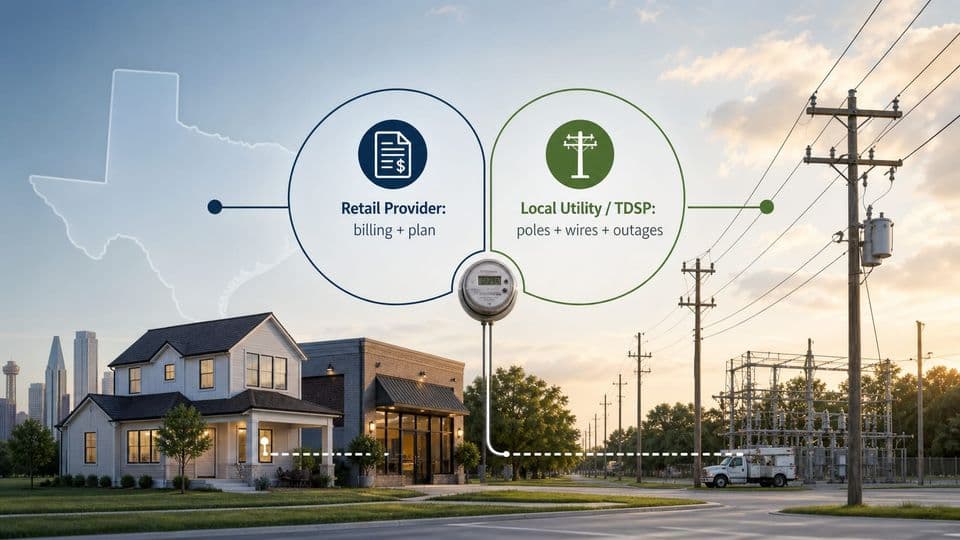
In Texas retail-choice areas, the retail electric provider usually changes the account relationship. It usually does not change the local delivery utility tied to the address.
Key Takeaways
- 1Choosing a retail electric provider does not change the local delivery utility tied to the address.
- 2The retail provider handles the customer-facing retail relationship, while the TDSP or utility operates the delivery facilities.
- 3For outages, the local delivery utility is the practical point of contact for reports, status updates, and restoration information.
- 4ERCOT manages the grid and retail switching in competitive choice areas, but it is not the field crew for a neighborhood outage.
Most Texas residents who can choose their electricity provider wonder whether that choice changes how reliable their power will be. The short answer is usually no. In retail-choice areas, the company you pick handles your account, billing, and customer service. It does not usually control the poles, wires, and equipment that deliver electricity to your home.
This distinction matters because Texas has a split electric system. One group of companies sells electricity and manages customer relationships. A different set of companies owns and operates the local delivery system. Understanding which company does what can save you time when you have an outage, a billing question, or a service issue.
Your provider does not control delivery reliability
This setup exists because Texas separates the competitive retail market from the regulated delivery system. The delivery system includes the poles, wires, transformers, and substations that carry electricity from generation sources to your home. These facilities are operated by Transmission/Distribution Service Providers (TDSPs), also called TDUs or delivery utilities.
This applies to addresses in competitive-choice areas. Some parts of Texas are outside the competitive market, and a few areas have municipal or cooperative utilities that combine retail and delivery roles.
The company on your bill is usually the retail provider
The company named on your electricity bill is usually a Retail Electric Provider (REP). REPs are part of the customer-facing side of the Texas electricity market. According to ERCOT, Competitive Retailers sell electricity at retail in the competitive market, and these retailers can include Retail Electric Providers. Competitive Retailers that operate as REPs must also be certified by the Public Utility Commission of Texas (PUCT).
A retail provider handles tasks such as:
- Setting your price plan and contract terms
- Sending bills and processing payments
- Managing customer service calls and account changes
- Handling enrollment and switching when you change providers
These tasks are important, but they do not control whether your lights stay on during a storm. The retail provider does not own the local wires or dispatch repair crews to fix a downed power line. If you have a question about your rate, your contract, or your bill, you contact your retail provider.
The delivery utility is tied to the local wires
While your retail provider manages your account, a different company operates the equipment that actually delivers electricity to your home. In Texas, these companies are called Transmission/Distribution Service Providers (TDSPs). ERCOT defines TDSPs as entities that own or operate equipment and facilities to transmit or distribute electricity in Texas.
TDSPs are regulated by the PUCT and must provide non-discriminatory access to the grid. That means the delivery utility must treat all retail providers and customers fairly when it comes to connecting service and restoring power. The delivery utility does not pick winners or losers among retail providers when it repairs lines or maintains equipment.
You can think of the delivery utility as the company that maintains the local roads while the retail provider is the company that delivers packages over those roads. The road condition affects every package, regardless of which delivery company drops it off. In the same way, the condition of the local electric delivery system affects every home on that block, regardless of which retail provider those homes use.
In Texas, your delivery utility is assigned by location. If you live in a specific area, you are served by a specific TDSP. You generally cannot choose your delivery utility the way you can choose your retail provider. The delivery utility is tied to the local infrastructure that was built to serve your neighborhood.
Changing providers usually keeps the same local grid equipment
Because the retail provider and the delivery utility are separate, switching providers at the same address usually keeps the same local grid equipment in place. The wires that connect your meter to the nearest transformer do not change when you pick a different company to supply your electricity.
This matters for a few reasons:
- Your physical connection to the grid stays the same, so the local delivery utility continues to maintain that connection.
- Outage restoration times depend on the delivery utility's damage assessment and repair process, not on which retail provider you use.
- Service quality issues that involve equipment, such as a damaged service drop or a failing transformer, are handled by the delivery utility regardless of your provider choice.
Some customers worry that a cheaper plan means less reliable service. In the Texas retail-choice model, that is usually not how the system works. The delivery utility does not know or care which retail plan you chose when it repairs a line or upgrades a substation. The delivery side of the system is designed to serve all customers in its territory without favoring one retail provider over another.
There are limits to this point. A retail provider can affect your experience in other ways, such as how clearly it communicates during an outage or how easy it is to reach a human when you call. Those differences are real, but they are not the same as changing the physical reliability of the delivery system.
Who restores power during an outage
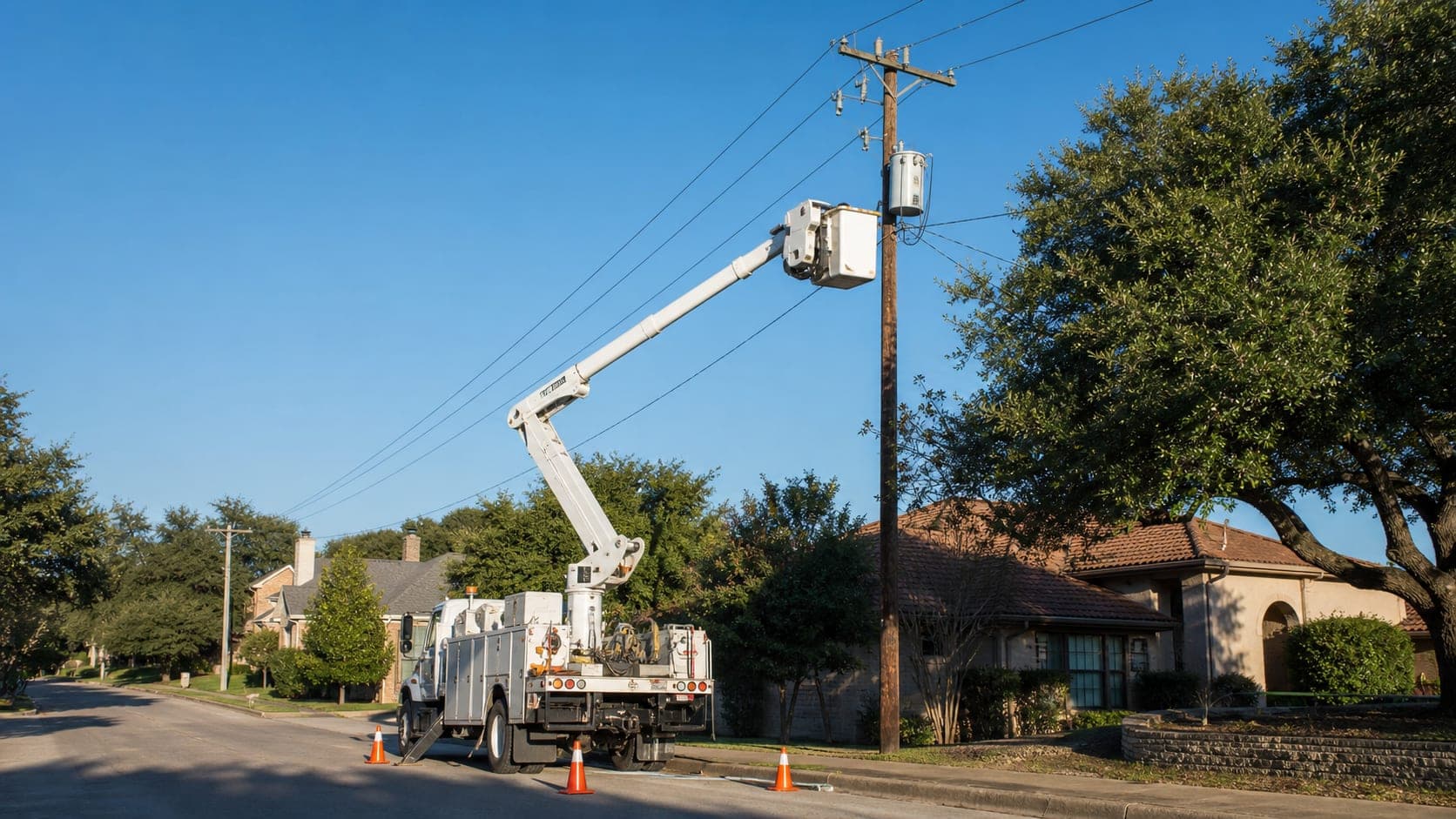
For a physical outage, the delivery-side utility or TDSP is the relevant field-response entity, not the retail provider. If a storm knocks down wires or a transformer fails, the delivery utility is responsible for repairing that equipment and restoring service.
Official utility outage pages show how this works in practice. For example, AEP Texas outage tracking page includes outage reporting, outage status, outage maps, notifications, restoration information, and crews responding to outages. The retail provider may point you toward an outage channel or give you updates, but the field response belongs to the delivery side of the system.
If your power goes out, here is a simple way to think about who to contact:
- If the issue is a neighborhood-wide outage, contact your delivery utility or check its outage map.
- If the issue affects only your home and your neighbors have power, you may still need to contact the delivery utility, because the problem could be a service drop or meter-base issue that the utility handles.
- If you are unsure which company to call, your retail provider can usually tell you the name of your delivery utility and the correct outage number to call.
This division of responsibility sometimes confuses customers, because the retail provider's name may be the one you see on your bill and in your email.
During a widespread outage, your retail provider may send messages about the situation, but those messages are usually based on information from the delivery utility. The actual repairs are handled by utility crews, not by the retail company.
Where ERCOT fits into the reliability picture
ERCOT manages electric power flow for most of Texas and administers retail switching in competitive-choice areas. ERCOT is the regional grid operator that balances supply and demand across the Interconnection. It also runs the systems that allow you to switch retail providers when you move or choose a new plan.
ERCOT does not restore power to your home during an outage. Its role is broader and operates at the grid level. ERCOT coordinates the flow of electricity across the statewide network, manages market operations, and oversees the retail switching process. If a local storm damages distribution lines, ERCOT does not send a truck to your street. The local delivery utility handles that work.
This distinction can be confusing because ERCOT is often in the news during major grid events. Those events involve grid-wide supply and demand, not the repair of local delivery equipment. For a typical outage that affects a neighborhood or a portion of a city, the key organizations are the local delivery utility and, in some cases, the municipal or cooperative utility that operates the local system.
What the PUCT oversees
The Public Utility Commission of Texas (PUCT) is part of electric utility oversight in Texas. ERCOT identifies TDSPs as PUCT-regulated entities. The PUCT certifies Retail Electric Providers and regulates delivery utilities, but it does not itself repair power lines or restore electricity to individual homes.
The PUCT's role is regulatory rather than operational. It sets rules, reviews rates, and handles consumer complaints that fall under its jurisdiction. If you have a dispute with your retail provider or your delivery utility, the PUCT can be a resource, but it is not the crew that fixes a downed wire.
A few key points about the PUCT's role:
- The PUCT certifies Retail Electric Providers before those companies can sell power in the competitive market.
- The PUCT regulates TDSPs and sets the rules they must follow for access, reliability, and outage response.
- The PUCT does not directly control whether your power stays on during a local outage. That responsibility belongs to the delivery utility.
Understanding these roles can help you direct your questions to the right organization. If your power is out, call your delivery utility. If you have a billing dispute, contact your retail provider and then the PUCT if the dispute is not resolved. If you want to know which company does what, check your bill or the materials that came with your account.
Common questions about electric company choice and reliability
Editorial standards
SlashPlan publishes independent guidance to help Texans compare electricity plans. Our editorial team reviews each article without advertiser influence. See our editorial guidelines and monetization disclosure.
About the author
Roi CahanaEnergy advisor helping Texans better understand their electricity options and make more confident decisions. Focused on simplifying electricity plans, explaining confusing terms, and sharing practical guidance to help readers avoid common mistakes when comparing rates, contracts, and renewals.
Ready to compare plans?
Enter your ZIP code to see electricity plans available at your address.