Shopping for a Texas Electricity Deal? Know Your Usage First
A Texas electricity deal can look cheap until your usage level, fees, credits, and contract terms change the real monthly cost. Start with your kWh history before comparing options.
Key Takeaways
- 1Your best electricity deal depends on your actual kWh usage, not a generic advertised example.
- 2Use a full year of usage when available, or several bills from different seasons when a full year is not available.
- 3Start with the service location because available Texas electricity offers depend on the address and retail-choice context.
- 4Apply one kWh amount across every option so fees, credits, thresholds, and monthly charges are compared fairly.
- 5Use actual usage history before averages, especially when comparing residential and commercial accounts.
- 6Do not use non-Texas examples, state averages, or marketplace savings claims as proof that a specific Texas deal fits your account.
A low advertised rate can look attractive until your monthly bill arrives and the total cost is much higher than you expected. In Texas, electricity plans are priced using complex structures that include base fees, usage thresholds, and bill credits. These variables change how much you actually pay depending on exactly how many kilowatt-hours (kWh) you consume. To find a plan that fits, you need to look past the headline rate and compare options based on your specific usage pattern.
Start with the kWh number on your bill
The most important number when shopping for electricity is not the total amount you paid last month. It is the total kilowatt-hours (kWh) you used during that billing cycle. A kilowatt-hour is the standard unit used to measure electricity consumption. If you ran a 1,000-watt appliance for one hour, you would use one kWh. Your total kWh usage for the month determines how the different parts of your electricity plan are calculated.
Where kWh appears on a Texas electricity bill
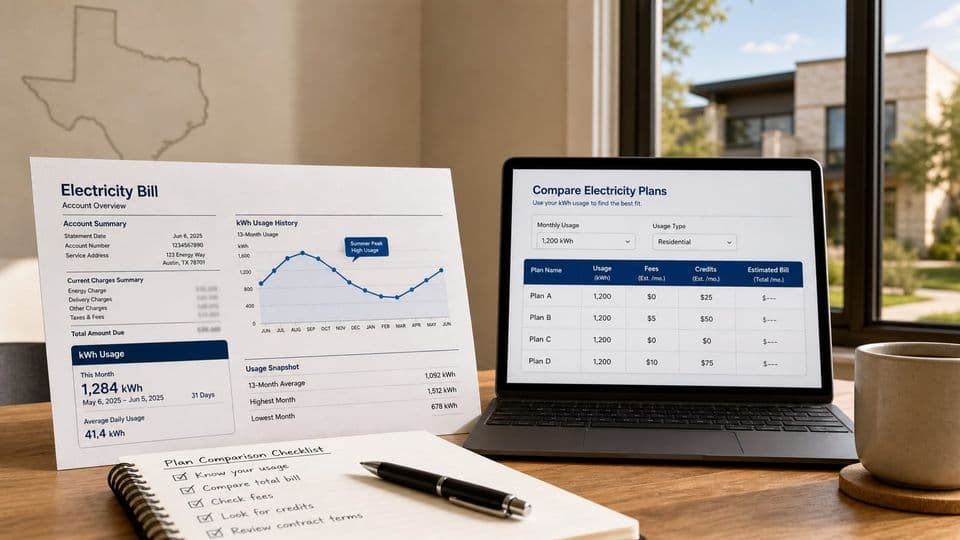
On a standard Texas electricity bill, you will usually find your usage details in a section labeled "Usage" or "Meter Readings." Look for the total kWh delivered during the billing period. This number is what you should use as the input when comparing estimated costs on shopping sites. If you only look at the dollars owed, you might miss how a change in rates or fees affects the final price at your specific consumption level.
Use more than one bill before you trust the estimate
Using a single month of usage to compare plans can lead to a poor match. Electricity consumption in Texas fluctuates significantly throughout the year. Most homes and businesses use more power during the summer for cooling and during the winter for heating. If you base your shopping on a mild spring or fall month, you might choose a plan that only looks good at low usage levels but becomes expensive when your air conditioner runs daily.
A full year beats one peak month
Using a full year or several bills from different parts of the year makes a usage-based comparison much more realistic than relying on one month alone. A full 12 months of data gives you a range to work with. You can see your lowest usage month and your highest usage month. When you compare plans, you can check whether a specific offer remains competitive across that entire range. If you do not have a full year of bills, gather at least three to four months from different seasons to avoid letting one unusual bill distort your comparison.
Pull usage history from account records when paper bills are missing
If you do not have your paper bills handy, you can still find your kWh history. Most Texas residents have access to their usage data through their retail electric provider's online portal or through Smart Meter Texas. Smart Meter Texas is the official website for retrieving interval data from advanced meters in the state. By logging in, you can download a history of your daily or monthly usage.
New address estimates are placeholders
If you have just moved into a new home and do not have usage history yet, you will have to use an estimate. However, treat this as a temporary placeholder. Estimates are often based on the average usage of similar-sized homes in your area, which might not match your lifestyle, the number of people living with you, or your specific appliances. As soon as you have one or two months of real bills at the new address, redo your comparison to make sure your plan is still the best fit for your actual consumption.
Check the service location before comparing prices
Before you spend time analyzing plan details, you must confirm which offers are actually available at your address. Retail electric choice in Texas depends on your specific service area. While many parts of Texas are deregulated, some areas are served by municipally owned utilities or electric cooperatives that do not participate in the competitive market. Your ZIP code is the starting point for finding offers, but it is not a guarantee of eligibility.
ZIP code does not guarantee retail choice
Even within the same ZIP code, different utility service territories can affect which providers you can choose. For example, if your home is served by a municipal utility like Austin Energy or CPS Energy, you generally cannot shop for a third-party retail electric provider. You must check your service location against the maps provided by the Public Utility Commission of Texas (PUCT) or use a shopping tool that filters by your specific utility and transmission/distribution service provider (TDSP).
Apply one usage amount to every option
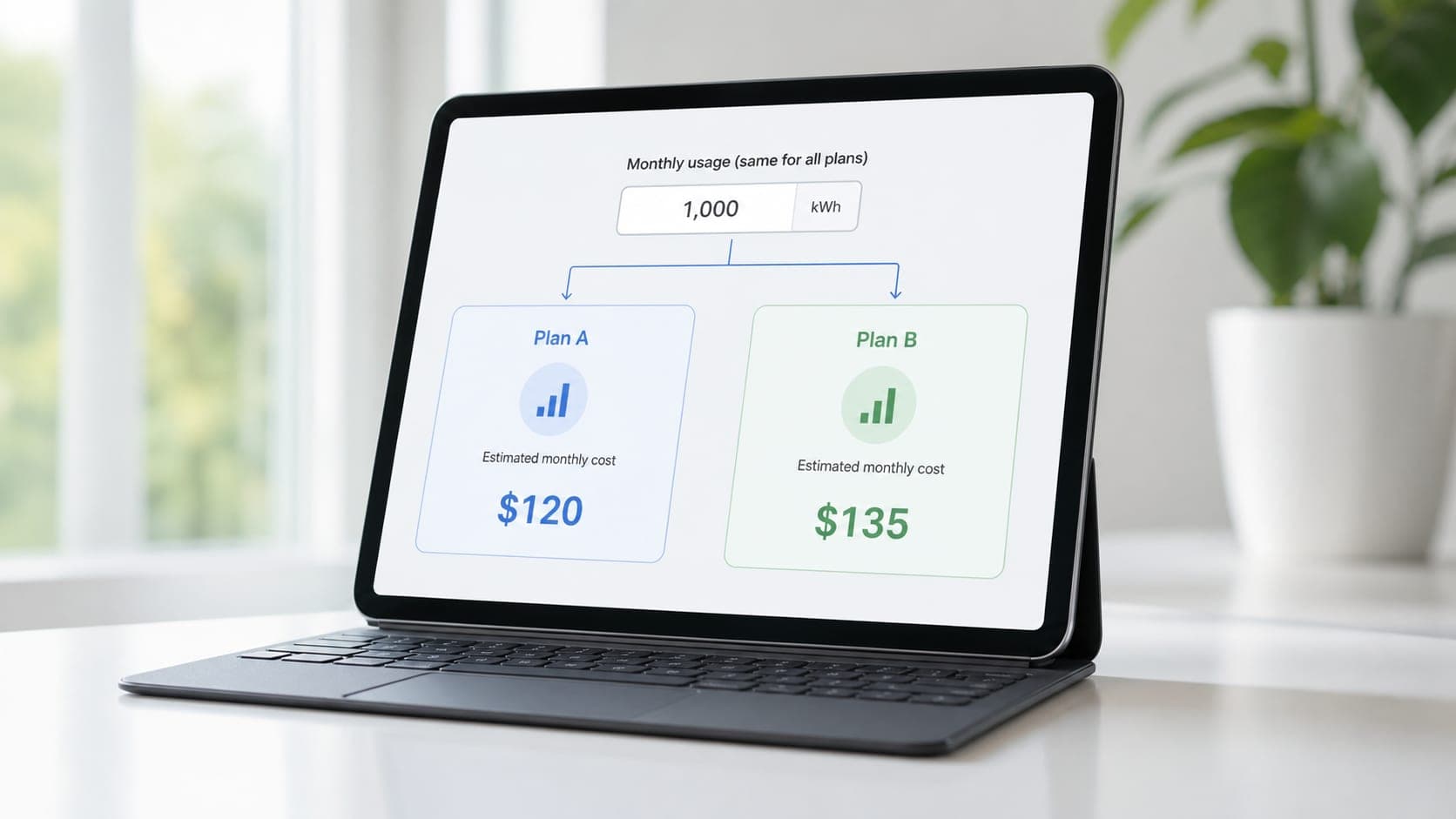
One of the most common mistakes in electricity shopping is comparing different plans using different usage levels. To get a fair comparison, you should apply the same kWh amount to every option you are considering. If you look at one plan based on 1,000 kWh and another based on 2,000 kWh, you are not making an apples-to-apples comparison. The estimated monthly cost will change significantly based on the usage input you provide.
Credits and thresholds change with usage
Many Texas electricity plans feature bill credits that only apply if your usage falls within a certain range. For example, a plan might offer a $50 credit if you use between 1,000 and 2,000 kWh. If your actual usage is 800 kWh or 2,500 kWh, that credit disappears, and your effective price per kWh rises. By applying one consistent usage number across all plans, you can see which offers actually provide the lowest estimated monthly bill at your specific consumption level.
Look for fees that move the monthly total
The "price per kWh" you see in advertisements is often a "rounded" figure that assumes you qualify for all the plan's discounts and credits. In reality, your monthly bill is made up of several parts: the energy charge, the transmission and distribution charges (TDSP), and any plan-specific fees. Some plans have a high monthly base fee but a low energy charge, while others have no base fee but a higher energy charge.
Monthly fees and minimum-use rules
Some providers charge a "minimum usage fee" if you do not consume enough electricity in a month. If you are a low-usage customer, a plan with a high minimum usage fee could end up costing you more than a plan with a slightly higher rate per kWh but no monthly minimum. Always look at the Estimated Monthly Cost provided on the Electricity Facts Label (EFL) or shopping site at your specific usage level to see how these fees impact your bottom line.
Read contract length through the usage lens
The length of your contract should align with your expected usage patterns and how long you plan to stay at your current address. Fixed-rate plans lock in your price for a set term, which provides protection against market volatility. However, if your usage is expected to drop significantly-for example, if your kids are moving out or you are planning to install solar panels-a long-term contract might not be necessary.
If your usage is highly seasonal, consider how the contract term covers your high-cost months. A 12-month plan that starts in the winter might seem cheap, but you will be locked in when the high-usage summer months arrive. Use your past usage history to predict how your consumption might change over the next 12 to 36 months and choose a term that matches your needs.
Separate home and business usage assumptions
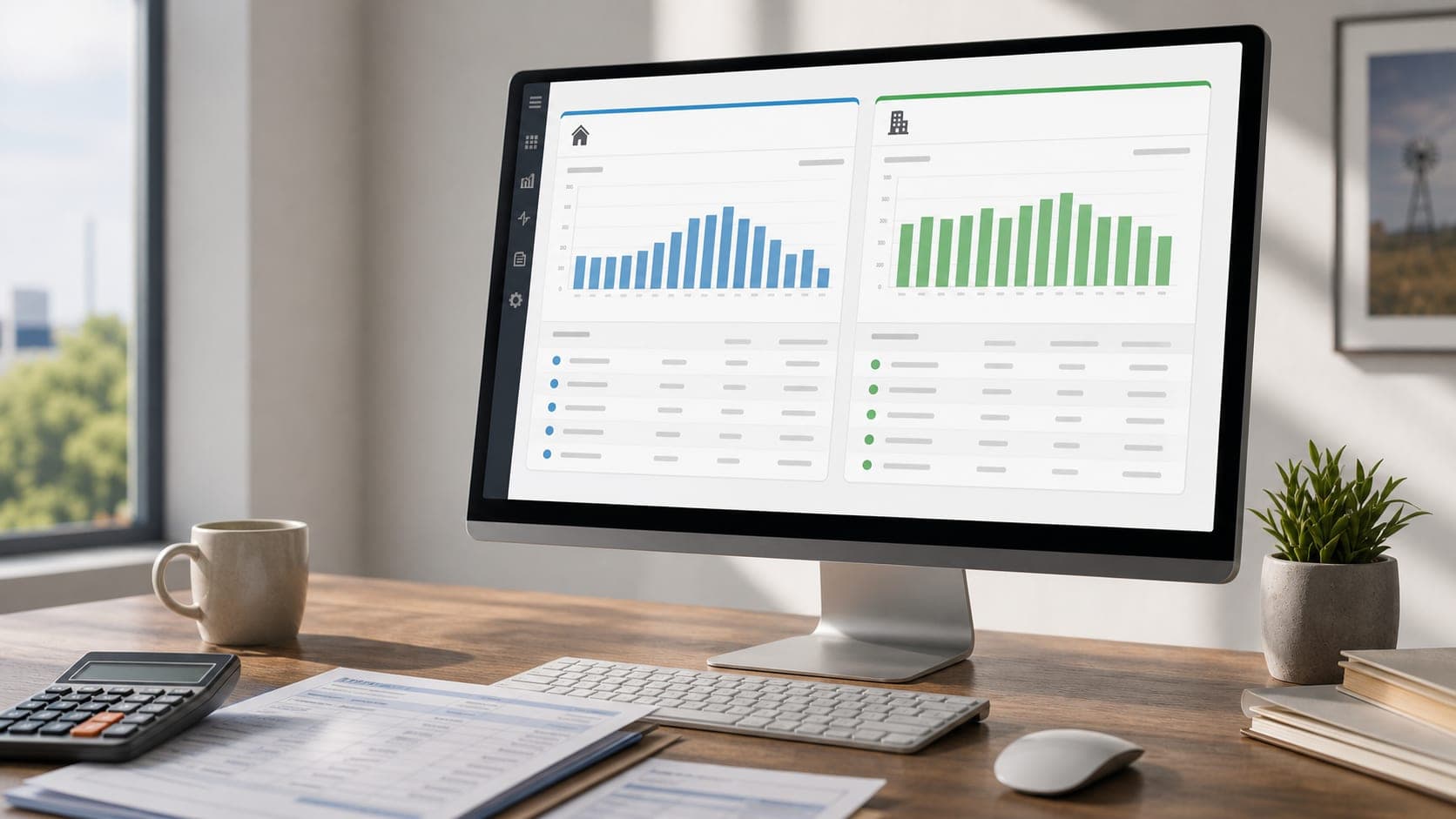
Residential and commercial electricity accounts operate differently and should never use the same usage estimates. A small business might have high power demands during the day but almost zero usage at night, whereas a home might have the opposite pattern. Commercial buildings often have different rate classes and demand charges that do not apply to residential customers.
Business hours can change the load pattern
When comparing Texas electricity plans for a business, you must use the business's own usage history rather than a shared generic estimate. The time of day you use electricity can affect the availability of certain commercial rates or time-of-use plans. Using a residential estimate for a commercial property will result in an inaccurate cost projection and could lead to overpaying for power during peak business hours.
Treat plan labels as cost structures, not shortcuts
You will often see plans labeled as "Fixed-Rate," "Variable-Rate," or "100% Green." These labels describe the structure or source of the electricity, but they do not tell you if the plan is a good deal for your usage. A fixed-rate plan can still be a bad deal if the fixed price is much higher than the market average. A green energy plan might have a higher rate per kWh that does not fit your budget.
Do not assume that one type of plan is always better than another. Instead, compare how the specific attributes of each plan affect your estimated monthly bill. If you prefer price stability, compare fixed-rate plans at your usage level. If you want to support renewable energy, compare the green plans at your usage level. Let your kWh data drive the decision, not the marketing label.
Do not let another city's example decide for you
When reading articles or watching videos about electricity shopping, you might see examples using rates from Houston, Dallas, or other major cities. While these examples can help you understand how to compare plans, they should not be used to choose a specific deal for your home. Rates and offers vary even within the same city based on your local utility provider (Oncor, CenterPoint, AEP, or TNMP).
Furthermore, sample rates from other states or cities (like those sometimes used in national energy articles) are not relevant to the Texas market. Always use your own service location and your own usage history. Relying on a neighbor's deal or a city-wide average can lead you to a plan that does not account for the specific fees charged by your local TDSP.
Use averages only as a rough reasonableness check
State and national averages for electricity consumption can be found in reports from the U.S. Energy Information Administration (EIA). These averages are useful for one thing: checking if your own usage is wildly out of step with the norm. If the average Texas home uses 1,100 kWh per month and your home uses 3,000 kWh, it might be worth checking for inefficient appliances or a leak in a pool pump.
However, you should not use these averages to shop for a plan. If you use 500 kWh a month and you shop based on the state average of 1,100 kWh, you will likely choose a plan that penalizes low usage. Your goal is to find the best deal for your specific home or business, not to match the average Texan.
Save the comparison details before you choose
Once you have found a few plans that look good based on your usage, save the details. Take a screenshot or download the Electricity Facts Label (EFL) for the plans you are considering. Note the date you checked the rates, the kWh usage you used for the comparison, and the estimated monthly cost. Electricity rates in Texas can change daily based on market conditions.
Saving this information helps you if you need to renew your contract or if you want to verify that the plan you enrolled in matches the one you compared. It also makes it easier to shop again in the future because you will have a clear record of what your "target" usage and price point looks like.
Choose the deal that fits your real usage pattern
Finding the right electricity plan in Texas is not about finding the lowest "teaser" rate. It is about matching a plan's fee structure, credits, and contract terms to the way you actually use electricity. Start by gathering your kWh history from your past bills or Smart Meter Texas. Use at least a few months of data to understand your high and low months.
One last check before enrollment
Before you sign up, do one final check. Make sure the estimated monthly bill at your average kWh usage is lower than other options. Check if you can realistically meet the usage requirements for any bill credits. Finally, confirm that the contract length makes sense for how long you plan to stay in the home. By following a usage-first approach, you avoid the common traps of electricity shopping and choose a deal that works for your specific situation.
Usage-first electricity shopping FAQ
Sources & References
Editorial standards
SlashPlan publishes independent guidance to help Texans compare electricity plans. Our editorial team reviews each article without advertiser influence. See our editorial guidelines and monetization disclosure.
About the author
Roi CahanaEnergy advisor helping Texans better understand their electricity options and make more confident decisions. Focused on simplifying electricity plans, explaining confusing terms, and sharing practical guidance to help readers avoid common mistakes when comparing rates, contracts, and renewals.
Ready to compare plans?
Enter your ZIP code to see electricity plans available at your address.