How to Shop for Electricity Plans With kWh History
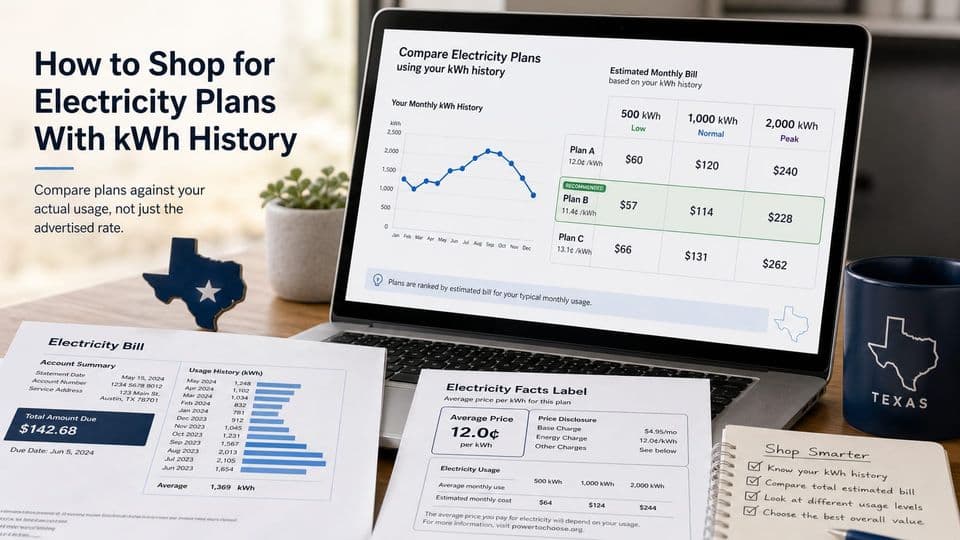
Your kWh history shows how a plan may perform across slow months, summer peaks, and the full contract term.
Key Takeaways
- 1Monthly kWh matters more than last month's bill because payments can change when rates, fees, credits, or usage patterns change.
- 2A full year of usage is the best starting point because Texas cooling season can change which plan fits the bill pattern.
- 3Group usage into low, normal, and peak months before checking plan documents.
- 4Use the plan documents to account for charges, fees, credits, contract length, and product type.
- 5Flat-bill, average-billing, variable, and indexed plans need extra review because past usage does not always predict future cost.
Most Texans look at the dollar amount on their last electric bill when trying to decide if a new plan is a good deal. The problem is that the amount you paid last month is a results number, not a usage number. To shop electricity plans with kWh history, you need to separate the kilowatt-hours you actually used from the final total that included delivery fees, taxes, and plan-specific charges.
Your monthly kWh history is the record of how much electricity moved through your meter during each billing cycle. When you compare that history against the pricing structure of a new plan, you stop guessing and start estimating what your bill will actually look like in March, in August, and every month in between.
Pull the Billing-Cycle kWh Record
Before looking at a single plan offer, find the usage data for your home or business. The goal is to build a list of monthly kilowatt-hour totals. A kilowatt-hour (kWh) is the standard unit of measurement on your bill. If you used 1,000 kWh in July, that means your home drew enough power to run a 100-watt lightbulb for 10,000 hours, or more realistically, to power your AC, fridge, lights, and electronics for that month.
Bills Show Usage, Dollars Show Outcomes
Your electric bill contains two different stories. The "Amount Due" is the outcome, but the "Usage" or "Meter Read" section is the data you need for plan shopping. Many shoppers make the mistake of assuming that if they paid $120 last month, they should look for a plan that costs $120. That approach fails because the plan you are leaving might have different base charges, bill credits, or delivery rates than the one you are considering.
Always pull the kWh number for each month. In Texas, you can usually find this in the "Usage Summary" or "Meter Data" section of your bill. If you have paper bills, look for the table that lists the "Billing Period" and the "kWh Used."
Provider Portals and Smart-Meter Data
If you do not have 12 months of paper bills on hand, log into your current retail electric provider's online portal. Most providers keep a 12-month history of your usage in a downloadable format.
For many Texans, the most accurate way to get this data is through Smart Meter Texas. This is the official website for smart-meter data in the state. If your home is equipped with a smart meter (which most are), you can register for an account and download your usage history in intervals ranging from 15 minutes to monthly totals. This data comes directly from the meter and is not influenced by your old provider's specific billing cycle quirks.
Build a Full-Year Usage Baseline
Once you have the numbers, the next step is to look at the full 12-month pattern. A single month of usage is a snapshot, but a full year is a movie. It shows you how your consumption changes with the seasons, holidays, and daily life.
A Full Year Catches Cooling Season
In the Texas electricity market, the "cooling season" (roughly May through October) is the most expensive time of year for most residential customers. If you only look at a November bill to choose a plan, you might pick a plan that looks great during low-usage months but becomes very expensive when your AC runs constantly.
Using a full year of usage helps you identify your "peak" months. For a typical family in Houston or Dallas, this might be July and August, where usage could double compared to a mild January. By seeing this range, you can check how a plan handles high-consumption periods.
Partial History Needs a Seasonal Note
Sometimes you might not have a full year of data, perhaps because you just moved or changed providers. If you only have four or five months of history, you must account for the missing seasons. For example, if you only have data from January to May, you should estimate how much higher your usage will climb during a Texas summer.
In these cases, look at your usage trend. Is it going up as the weather warms up? If you used 600 kWh in March and 900 kWh in May, a plan that looks cheap at 600 kWh might not be the best fit for your eventual 1,500 kWh summer peak.
Sort Months into Low, Normal, and Peak Bands
Raw data can be overwhelming. To make it useful for plan comparison, group your monthly kWh totals into three bands: Low, Normal, and Peak. This allows you to test how a plan performs across your actual life, rather than at a generic average.
- Low Usage: These are your coolest months or times when you were away from home.
- Normal Usage: These are the months where your usage stays in the middle of your range.
- Peak Usage: These are the hottest months or times of high activity.

Low Months Expose Base Charges
Many Texas electricity plans include a "base charge" or "monthly recurring charge." This is a fixed fee you pay just for having the service, regardless of how much electricity you use. If your usage is very low one month, that base charge makes up a larger percentage of your bill. By looking at your "Low" band, you can see if a plan with a high base charge but a low per-kWh rate is actually a bad deal for those specific months.
Peak Months Expose Credits and Tiers
Some plans offer "bill credits" if you use a certain amount of electricity. For example, a plan might give you a $50 credit if you use over 1,000 kWh. If your peak months always cross that threshold, that credit is valuable. However, if your usage is usually lower, you might never see that credit. Sorting your months helps you see if you are consistently hitting the usage levels required to trigger a plan's best features.
Tie the Usage History to the Texas Service Location
Your usage history is personal, but electricity plans are local. A plan that works for a home in Austin might not be available for a home in The Colony, even if the usage patterns are identical.
ZIP Code and Delivery Area Filter the Offer Set
In Texas, your "Transmission and Distribution Utility" (TDU) or "wires company" is determined by your physical address. This is the company that maintains the poles and wires (like Oncor, CenterPoint, or AEP). Every retail electric provider must add TDU delivery charges to your bill. These charges are the same regardless of which provider you choose, but they change based on where you live.
Before you start matching your kWh history to plan prices, enter your correct ZIP code or service address. This ensures that the energy charges you are comparing are combined with the correct delivery rates for your specific area.
Read the Plan Documents Beside Your Usage Bands
To accurately estimate your costs, you must read the Electricity Facts Label (EFL) and the Terms of Service for any plan you are considering. These documents are the legal source for how you will be billed.
Average-Price Boxes Are Checkpoints, Not the Verdict
Most shopping sites show an "average price per kWh" (e.g., 12.5¢ / kWh). This number is almost always calculated at 1,000 kWh of usage. If your home never uses exactly 1,000 kWh, this average is misleading.
Instead of looking at the average price, look at the "Price to Compare" at different usage levels listed on the EFL. Most EFLs show the price at 500 kWh, 1,000 kWh, and 2,000 kWh. Match these levels to your Low, Normal, and Peak bands.

Terms, Fees, Product Type, and Contract Length
The EFL will also list other important details:
- Product Type: Is it fixed-rate, variable, or indexed?
- Contract Length: How many months is the offer?
- Early Termination Fee: How much does it cost to break the contract?
- Renewable Content: What percentage of the energy comes from green sources?
You should read these documents while looking at your usage bands. For instance, if you see a "minimum usage fee" in the terms, check your "Low" usage months to see if you would trigger that fee.
Estimate the Total Bill at Each Usage Band
Now that you have your usage bands and you have read the plan documents, you can estimate what your actual bill would be under a new plan. Do not just look at the energy charge. You need to calculate the total estimated cost for a low month, a normal month, and a peak month.
Start with Energy Charge and Base Charge
Take your "Low" month usage (for example, 400 kWh). Find the energy charge (rate per kWh) on the EFL for that plan. Multiply 400 by that rate. Then, add any base charge or monthly recurring charge. This gives you the "provider" portion of your bill for a low-usage month.
Add Delivery Charges, Recurring Fees, and Credits
Next, you must add the TDU delivery charges. These are usually a combination of a fixed "monthly fee" and a "per kWh" charge. You can find the current TDU rates on your utility's website or listed on the EFL.
Finally, check for bill credits. If the plan gives you a $30 credit for using over 1,000 kWh, and your "Peak" month is 1,200 kWh, subtract that $30 from your estimated total. By doing this for your Low, Normal, and Peak months, you get a much more realistic picture of your annual electricity costs.
Test Bill Credits, Tiers, and Minimum-Use Rules
This is where many Texas shoppers get tripped up. A plan might have a very low energy charge, but it might also have a "minimum usage" fee if you don't use enough electricity.
Credits Can Reward One Usage Band and Miss Another
Some plans are designed to look very attractive at 2,000 kWh because they offer large bill credits at that level. However, if your usage drops to 800 kWh during a cool October, you might lose that credit and be left with a higher rate than you expected. When you estimate electricity plan cost from usage history, make sure the bill credits in the plan actually match your real-world usage pattern.
Minimum-Use Charges Can Reverse a Low Rate
A "minimum usage charge" is a fee that kicks in if your usage stays below a certain level (e.g., below 800 kWh for three months in a row). If your "Low" band months are consistently below that threshold, that "cheap" plan might end up costing you more than a plan with a slightly higher per-kWh rate but no minimum usage fee.
Compare Plan-Price Structures Only Through Written Terms
Not all electricity plans are priced the same way. The two most common types in Texas are fixed-rate and variable-rate plans. Your usage history helps you decide which structure fits your budget and your risk tolerance.
Fixed Plans Reduce Energy-Price Movement
In a fixed-rate plan, the energy charge (the price you pay per kWh) stays the same for the length of your contract. This makes it very easy to use your kWh history to estimate your bills. If you know you used 1,100 kWh in June last year and your rate is fixed at 11 cents per kWh, you can predict your energy cost for that month with high confidence.
Variable or Indexed Pricing Needs a Risk Tolerance
Variable or indexed plans do not guarantee a fixed price. The rate can change monthly based on market conditions. If you are shopping for one of these plans, your past kWh history is still useful for estimating how much electricity you will use, but it cannot predict what the price will be. If you prefer stability and want to use your usage history to lock in a predictable bill, a fixed-rate plan is generally the better match.
Review Flat-Bill and Average-Billing Offers Against the Full Year
Some companies offer "flat-bill" plans where you pay the same amount every month, or "average-billing" where the provider calculates a rolling average of your costs. These can be tempting if you had a very high bill last summer.
One High Bill Is a Weak Test
The danger with flat-bill offers is that they are often based on an estimate of your annual usage. If you had one unusually high bill due to a broken AC unit or a house full of guests, that one month might skew the "flat" payment higher than it needs to be.
Always compare a flat-bill offer against your full 12-month history. Calculate what you would have paid under that flat fee for the entire year. Did you overpay during the mild months? Does the flat fee account for delivery charges, or is it just the energy portion? Read the terms carefully to ensure the "flat" part of the bill actually covers everything.
Adjust the History for Home or Business Changes
Your past usage is a guide, not a prophecy. If your situation has changed, you need to adjust your history before using it to shop.
EVs, HVAC, Solar, Pools, Occupancy, and Square Footage
If you have added a major new appliance or changed your home, your old kWh history might be too low. For example:
- Electric Vehicle (EV): Charging an EV at home can add 300 to 1,000+ kWh per month depending on the commute.
- New HVAC: A high-efficiency unit might lower your summer peaks.
- Solar Panels: If you installed solar, your "net" usage from the grid will be much lower, and you need to shop for a plan that values low usage or handles solar buy-back rates.
If you are moving to a new home, try to get the past 12 months of usage for that specific address. A 1,500-square-foot home in El Paso will have a very different usage pattern than a 1,500-square-foot home in Beaumont.
Check Renewal and Price-Change Exposure Before Deciding
When you shop electricity plans with kWh history, you are usually looking for a new contract. However, you also need to think about what happens when that contract ends.
Contract-End Dates and Renewal Terms
Some plans have "evergreen" clauses where the rate changes automatically after the initial term ends. If you are using your usage history to estimate costs, make sure you are only estimating the cost for the duration of the fixed-rate term. If your plan is 12 months, calculate the cost for 12 months of your usage. Do not assume the price will stay the same after those 12 months.
Always check the "Renewal" section of the Terms of Service. Some providers automatically move you to a month-to-month variable rate at a much higher price once your contract expires. Set a reminder to shop again before that date.
FAQs
Helpful Next Reads
Sources & References
Editorial standards
SlashPlan publishes independent guidance to help Texans compare electricity plans. Our editorial team reviews each article without advertiser influence. See our editorial guidelines and monetization disclosure.
About the author
Roi CahanaEnergy advisor helping Texans better understand their electricity options and make more confident decisions. Focused on simplifying electricity plans, explaining confusing terms, and sharing practical guidance to help readers avoid common mistakes when comparing rates, contracts, and renewals.
Ready to compare plans?
Enter your ZIP code to see electricity plans available at your address.