How to Compare Texas Electricity Rates by Bill Cost
A billing-focused guide to comparing Texas electricity rates by the usage assumptions, charges, credits, and official source documents behind the number.
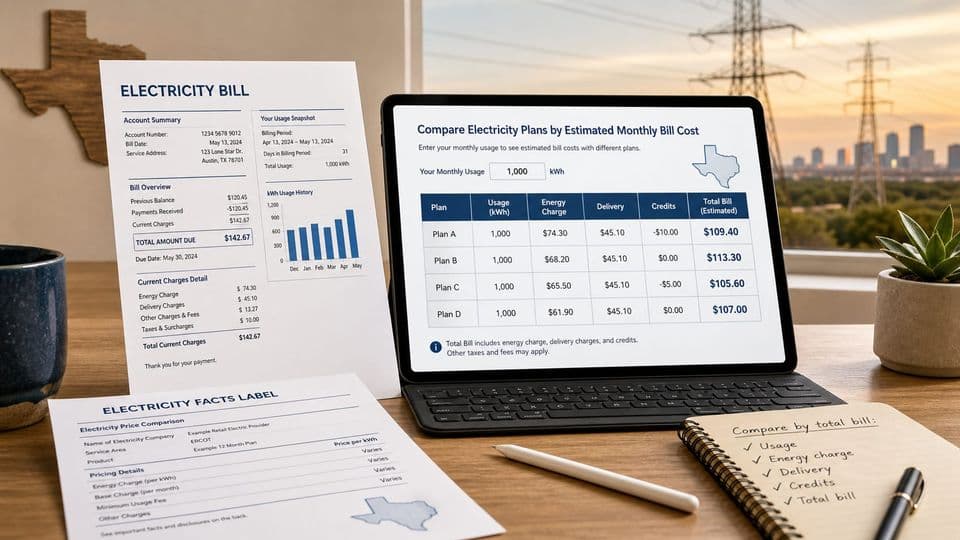
Key Takeaways
- 1The Electricity Facts Label is the key document for understanding average price, fees, credits, terms, and billing conditions.
- 2Retail energy charges and utility delivery charges are different bill components, and both can affect the total.
- 3Credits, minimum usage rules, rate type, and contract length should be treated as billing conditions rather than shortcuts to a simple cheapest-rate answer.
Picking a retail electric plan in Texas often starts with a single number: a rate per kilowatt-hour. That number can save you money or lead to a surprise on the first bill, depending on what you assume about your home's usage and what charges sit behind the headline price.
Start With Service Area and Monthly Usage
Electricity rates in Texas depend on where the account is located and how much power the home typically uses. The service area determines which retail offers are available and which utility handles the poles, wires, and meters.
A rate listed for one part of the state may not apply in another, so the first step is confirming the address belongs to a competitive service area served by a transmission and distribution utility such as Oncor, CenterPoint, AEP Texas, or TNMP.
Monthly usage gives the rate context because most plans show an average price per kWh calculated at a specific usage level. A home that uses 500 kWh in a mild month will pay a different effective rate than a home using 2,000 kWh in a hot summer month, even if both are on the same plan.
The average price per kWh displayed on a listing or source document only tells part of the story unless you match it to your own consumption.
If you have past bills, pull the kWh totals from the last 12 months. That range is the most reliable anchor for comparing rates. Without history, you can estimate based on home size, number of occupants, and seasonal patterns, but your actual meter data is always better.
Service area changes which charges can apply
The delivery utility serving your address sets the transmission, distribution, and metering charges that appear as a separate section on every bill. Those charges are regulated and do not come from the retail electric provider.
Comparing rates without knowing the service area means comparing offers that may never be available at your meter.
Use the Electricity Facts Label as the Rate Source
The Electricity Facts Label (EFL) is the disclosure document that breaks down the terms and pricing behind a retail electricity offer. Texas rules require retail electric providers to make an EFL available for every plan before a customer signs up.
The EFL is the document to read when you want to know what a rate actually includes, not the headline number on a comparison page.
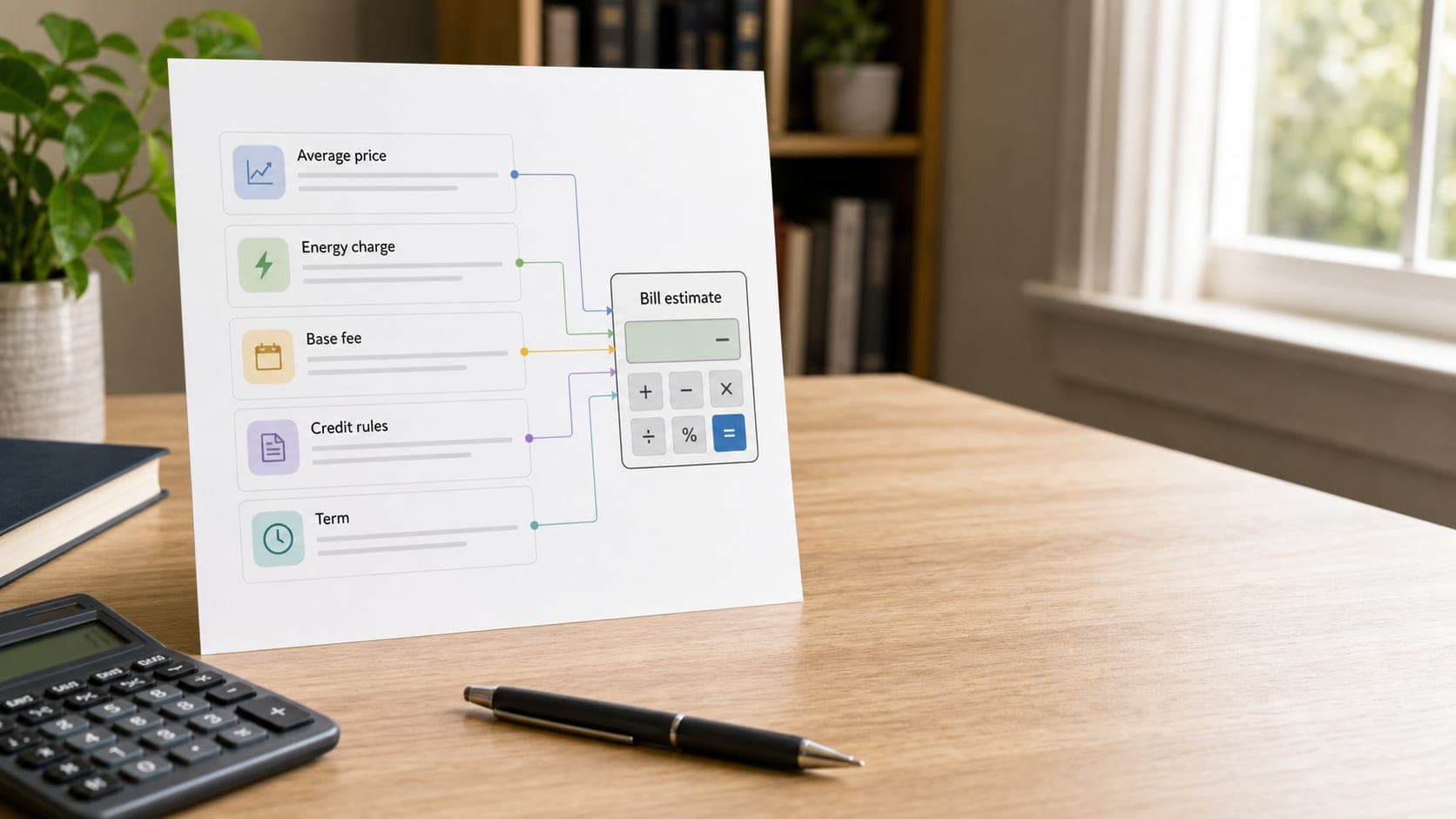
The EFL shows the average price per kWh at specific usage levels, the energy charge, any base charges, fees, credits, and the contract term. It also lists whether the rate is fixed or variable and includes the disclosure statement for renewable energy content when applicable.
Which EFL fields matter for a rate comparison
The most useful fields on an EFL for comparing rates are the average price at your expected usage level, the energy charge per kWh, any monthly base charge, the conditions for credits, and the contract length. The average price is a summary, but the energy charge and base charge tell you how the bill is actually calculated.
Credits that reduce the average price only apply when you meet specific conditions such as using above a certain kWh threshold or paying on time. Read the footnotes and conditions on the EFL just as carefully as the price numbers.
Read Average Price per kWh by Usage Level
The average price per kWh listed on an EFL or rate listing is calculated by dividing the total estimated bill at a specific usage level by the number of kWh used.
That means the same plan can show different average prices for different usage levels. A plan may advertise an attractive price at 1,000 kWh but produce a higher average price at 500 kWh if it includes a base charge that spreads across fewer kilowatt-hours.
Reading the average price at just one usage level can be misleading if that level does not match your home. A plan built for high usage may look expensive on a low-use bill, and a plan with a low energy charge but high base fee may punish a small apartment.
The EFL shows average prices at three or more usage tiers, such as 500, 1,000, and 2,000 kWh. Compare your expected range to those tiers.
How 500, 1,000, and 2,000 kWh examples can differ
A plan with a 10-dollar monthly base charge and a flat energy rate of 12 cents per kWh produces different average prices across usage tiers. At 500 kWh the average is about 14 cents per kWh because the base charge is spread thin. At 2,000 kWh the average drops to around 12.5 cents per kWh.
Looking at all three examples on the EFL shows how the billing structure affects different households. Your home's typical usage determines which tier matters most.
Separate Retail Energy Charges From Utility Delivery Charges
A Texas electricity bill is not a single line. It contains charges from two different entities: the retail electric provider you chose and the transmission and distribution utility that owns the local grid.
The retail energy charge covers the electricity supply and any provider fees. The utility delivery charges cover the cost of transporting that electricity to your home, maintaining the poles and wires, reading the meter, and responding to outages.
Delivery charges are regulated by the Public Utility Commission of Texas and do not change when you switch retail providers. They appear on your bill each month at rates set by the utility's tariff. Because delivery charges are separate from the retail energy charge, a fixed retail rate does not freeze the delivery portion of the bill.
If the utility adjusts its tariff rates, that change will show up on your bill even if your provider rate stays the same.
Utility delivery charges are not retail energy charges
Confusing these two categories can lead to frustration when a bill changes unexpectedly. If you see a jump in your total amount due, check whether the increase came from the retail energy charge or the delivery charge section of the bill. The retail provider has no control over delivery rates, so a fixed-rate plan cannot prevent delivery charge adjustments. Identifying the source of the change helps you decide whether the issue is with your plan or with regulated utility costs.
Check Base Charges, Minimum Usage Rules, and Credits
The billing structure behind a rate can shift the total you pay even when the energy charge per kWh looks low. Some plans include a monthly base charge that applies regardless of how much power you use. Others set a minimum usage threshold, meaning if you consume less than a certain number of kWh, you still pay as if you had hit that minimum. Credits that reduce the bill often come with conditions such as paying by a certain date or using above a specific amount of electricity in a month.
These conditions do not make a plan bad, but they change the math for households with very low or very high usage. A plan with a generous credit that triggers at 1,000 kWh may produce a lower average price for a family that uses 1,200 kWh each month. The same plan could cost a renter who averages 400 kWh more per kWh because the credit never applies and the base charge eats into a small bill.
Credits can disappear when usage misses the condition
Some credits are advertised as automatic deductions that lower the effective rate. Reading the fine print on the EFL shows whether the credit has a minimum usage requirement, an on-time payment condition, or a cap on how many months it applies. If your usage drops below the threshold for even one month, the credit disappears and the bill looks different than the sample calculation on the EFL.
Checking the credit conditions against your usage history helps avoid that gap.
Put Fixed and Variable Pricing in Billing Context
A fixed retail rate means the energy charge per kWh stays the same for the length of the contract. That part of the bill will not change due to market conditions. But fixed pricing applies only to the retail energy charge. Other parts of the bill, such as utility delivery charges, taxes, and any pass-through fees, can still change.
A variable retail rate means the energy charge per kWh can go up or down according to the plan's terms. The EFL and Terms of Service document describe how and when the provider may adjust the rate. Some variable plans track wholesale market prices, while others give the provider discretion to change the rate with notice. Reading the document tells you what triggers a change and how much notice you will receive.
Fixed rates do not freeze every bill line
The most common misunderstanding about fixed-rate plans is the assumption that the total bill will stay the same each month. Usage changes, delivery charge adjustments, and fees can all cause the total to vary. A fixed retail rate gives stability on the energy charge, not on the entire bill. Knowing this before you sign up sets realistic expectations and reduces the chance of frustration when a bill changes during a higher-usage month.
Account for Contract Length Without Treating It as a Recommendation
Contract length affects when the disclosed rate ends and what happens after that date. A 12-month contract locks in the retail energy charge for one year. When the term ends, the plan may switch to a month-to-month rate that is higher unless you choose a new plan. A longer contract such as 24 or 36 months means the rate is locked for a longer period, but it also means you are committed to that provider for more time.
Contract length is a timing issue, not a quality signal. A short contract offers flexibility to switch sooner, while a longer contract provides price certainty for a longer stretch. The right length depends on whether you want to revisit the market sooner or prefer to set the rate and leave it alone. The EFL and Terms of Service document show the contract term, the renewal process, and any early cancellation fees.
Term length affects when the rate can change
If you choose a plan with a 36-month term, the retail energy rate stays fixed for three years, but you also accept the risk that market rates may drop during that time and you cannot switch without a fee. A 6-month term gives you an earlier opportunity to shop again but leaves you exposed to rate changes sooner. Neither choice is objectively better. The decision depends on your tolerance for shopping frequency and market risk.
Compare a High-Usage Month Against a Low-Usage Month
Texas electricity bills vary significantly between seasons. A mild spring month may use 600 kWh while a hot August month may use 2,500 kWh for the same home. Running the rate through both scenarios shows how the billing structure performs across the year. A plan that looks good at 1,000 kWh may become expensive at 2,500 kWh if the energy charge above a certain threshold is higher or if the credit structure caps out.
Using only one usage scenario can hide how the rate behaves during peak summer months when your bill matters most. If you have past bills, check the highest and lowest usage months from the last year and compare those against the EFL tiers. If you are a new resident without history, estimate conservatively by looking at average usage for a home of similar size in your area.
Summer usage can change the better-looking rate
A plan designed with a low energy charge and a credit that triggers at 1,000 kWh may produce a great average price during moderate months. In summer when usage climbs to 2,500 kWh, the credit still applies but the energy charge on all those extra kilowatt-hours can raise the total significantly.
Comparing the rate at both a moderate and a high usage level reveals whether the plan scales well or becomes less competitive when you run the air conditioner.
Use Bill History When the Listed Rate Looks Too Simple
The simplest rate listing may hide details that only become clear when matched against a real bill. Pulling your past bills gives you the actual kWh range, the delivery charge lines specific to your utility, and any recurring fees that may not appear on the EFL.
That history turns an abstract rate comparison into a calculation specific to your account.
If you see a rate that looks much cheaper than what you currently pay, run the EFL numbers through your highest and lowest usage months before switching.
Sometimes the difference is real and the switch saves money.
Other times the gap narrows or disappears when delivery charges, base fees, or credit conditions are factored in. The bill history is the anchor that keeps the comparison grounded.
A past bill can reveal the right usage range
A single bill from a mild month may show 800 kWh, while a summer bill from the same year shows 2,400 kWh. Using only the mild-month number in a rate comparison would underestimate the real annual cost.
Pull at least three bills from different seasons to establish a realistic range. Most utilities provide online access to at least 12 months of billing history.
Verify Power To Choose and PUCT Source Details

Power To Choose is the official shopping website operated by the Public Utility Commission of Texas. It lists plans from retail electric providers that have registered with the state and includes EFLs and Terms of Service documents for each offer. The PUCT consumer information page provides guidance on customer rights, dispute resolution, and how to read bills and disclosure documents.
Compare Rates With SlashPlan
SlashPlan helps you see what plans are available in your area and include filtering tools, review summaries, and usage-based estimates. Using SlashPlan can reveal common concerns such as why two plans with similar energy charges produce different average prices or how credits affect the total.
End With a Bill-Focused Rate Check
Comparing Texas electricity rates by bill cost comes down to a short sequence of steps that rely on your own data.
Start by confirming the service area and the utility that delivers power to that address. That tells you which offers are available and what delivery charges apply.
Match the usage level on your past bills to the usage tiers on the EFL. If you have a single mild-month bill, also check a higher-usage season to see how the rate scales.
Read the EFL for the average price at your usage level, the energy charge, the base charge, and any credit conditions. Treat the average price as a starting point, not a promise.
Separate the retail energy charge from the utility delivery charges. A change in the delivery portion of the bill is not a problem with your plan, but it does affect the total.
Check the fixed or variable rate type, the contract term, and the renewal process. These timing factors matter when the rate can change.
A final check should identify the charge that changed
When your bill arrives in a month that feels higher than expected, run through the same steps. Look at usage, delivery charges, the retail energy charge, fees, and credits.
Identifying which component moved tells you whether the issue is your usage pattern, a utility rate adjustment, or a condition in your plan that you missed on the EFL.
That habit turns every bill into a useful check on whether the rate you compared is still working for your home.
Texas Electricity Rate Comparison FAQs
Editorial standards
SlashPlan publishes independent guidance to help Texans compare electricity plans. Our editorial team reviews each article without advertiser influence. See our editorial guidelines and monetization disclosure.
About the author
Roi CahanaEnergy advisor helping Texans better understand their electricity options and make more confident decisions. Focused on simplifying electricity plans, explaining confusing terms, and sharing practical guidance to help readers avoid common mistakes when comparing rates, contracts, and renewals.
Ready to compare plans?
Enter your ZIP code to see electricity plans available at your address.