Business Electricity Contract Guide for Texas
A practical guide to Texas business electricity contract terms, including fixed and variable pricing, fully bundled and energy-only structures, pass-through charges, demand clauses, minimum usage fees, bandwidth clauses, early termination fees, and renewal language.
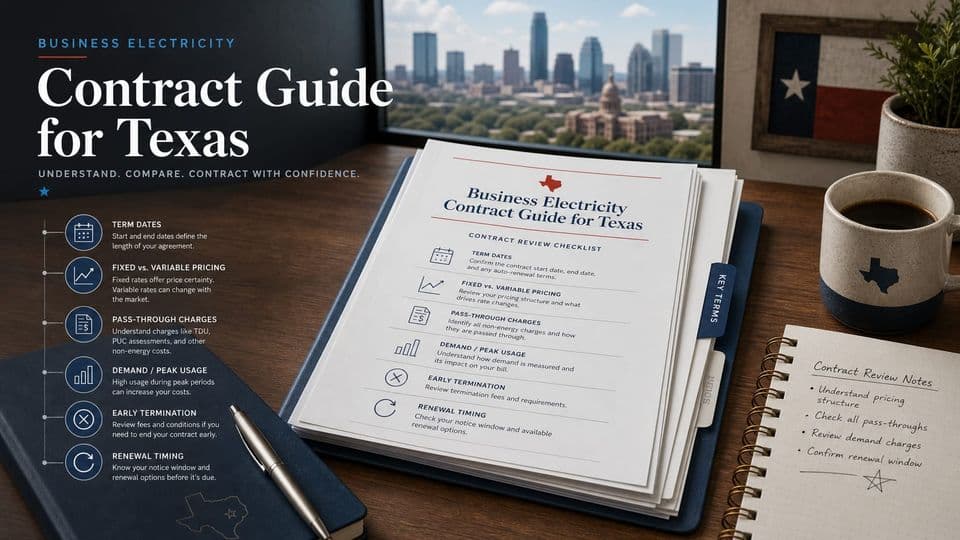
Key Takeaways
- 1A Texas business electricity contract can set the term, pricing structure, fees, renewal language, termination language, disclosure documents, and account-specific obligations.
- 2A fixed rate still needs review because the written contract should show what is included and what can pass through separately.
- 3Demand charges and usage-based clauses are most relevant when a business has peak-demand exposure or usage that changes by season, operating hours, or equipment.
- 4Minimum usage fees and bandwidth clauses should be read as contract-specific terms, not assumed to apply to every business.
- 5Early termination, auto-renewal, rollover, and renewal timing should be checked before a business exits early or lets a contract term expire.
- 6A disclosure document can help when it applies, but it does not replace the signed contract, rate schedule, fee schedule, renewal language, and termination language.
Most Texas business owners focus on the cents-per-kWh number when comparing electricity offers. That number matters, but it does not tell the whole story. The contract language behind that price controls what you actually pay, how your bill can change during the term, what happens if you move or close, and what you owe when the contract ends.
This guide explains how Texas business electricity contracts work, what the common terms mean, and which parts of the agreement deserve close attention before you sign or renew.
Contract scope for a Texas business account
A Texas business electricity contract sets more than the price. It controls the term length, the pricing structure, the fees that can appear, the renewal language, the termination language, the disclosure documents, and any account-specific obligations that apply to your location and usage pattern.
The written agreement usually includes several documents that work together. If you read only one page and stop there, you can miss language that changes the cost or the exit terms later.
Parties, term, price, and service obligations
Every business contract names the retail electric provider, the customer, the service address or account number, the start date, and the end date. It also states the pricing structure, the fixed or variable method, and the documents that define the rate.
The contract explains who handles customer service, billing, and outages. In Texas, the wires company that delivers power to your building is separate from the company that sells you the electricity. The contract should make clear which company does what, because that affects who answers which call.
Documents that control the agreement
The agreement can include a master contract or terms of service, a rate schedule or pricing addendum, a fee schedule, and a renewal or rollover exhibit. If a contract-specific disclosure document applies, it can summarize pricing, term, and fees, but it does not replace the full contract documents.
When you review a business offer, ask for the full set of documents. A one-page proposal or a verbal quote does not protect you the same way the signed contract and its exhibits do.
Fixed, variable, and indexed contract structures
Fixed, variable, and indexed are pricing structures you may see described in Texas electricity materials. They describe how the price can change during the contract term.
Fixed-rate language and price stability
A fixed-rate business electricity contract sets the price for the energy portion or for a broader set of charges, depending on how the contract defines fixed. The appeal is predictable billing for the components that are included. The caution is that fixed does not automatically mean every part of the bill is fixed.
Some fixed contracts include only the energy charge. Others include transmission, distribution, or regulatory components as well. The contract should state exactly what is included and what can change. If the document does not say it, do not assume it.
Variable or indexed formulas that can change
Variable-rate language ties the price to a formula or a market condition that can change from month to month. Indexed language ties the price to a published index, such as a wholesale market index, with an added margin.
These structures can move up or down. The contract should explain how the formula works, where the index is published, how often the price updates, and whether there is a cap or floor. If the language is vague, ask for the specific clause that explains the calculation before you sign.
Fully bundled and energy-only fixed pricing
Fully bundled and energy-only fixed pricing are shorthand ways to describe what the fixed price includes. They are not official legal terms, but you may hear them during negotiations or see them in proposals.
The important point is not the label. The important point is what the written contract says is included and what can appear as a separate line item.
Included charges in a bundled fixed price
A fully bundled fixed price is used to describe a fixed rate that includes more cost components in one rate. In some contracts, that can mean the energy charge, transmission, and distribution are combined into a single cents-per-kWh number.
The benefit is fewer moving parts on the bill. The risk is that the contract may still allow certain costs to pass through separately if the language permits it. Read the exclusions and the pass-through section even when the offer says bundled.
Energy-only pricing and separate line items
Energy-only fixed pricing fixes the energy portion while other charges may appear separately. You might see a fixed energy rate expressed in cents per kWh, then see transmission, distribution, ancillary services, or regulatory charges listed on the bill as separate items.
This structure can make the bill harder to read, but it can also make it easier to see which parts of the cost are changing. If you choose an energy-only structure, ask for a sample bill or a fully loaded estimate that shows the all-in effective rate based on your expected usage.
Pass-through charges and separate bill components
Pass-through charges are contract wording that may allow certain costs to be billed separately instead of being included in the fixed energy price. The exact treatment is controlled by the written agreement.
Delivery, transmission, and regulatory wording
Texas business contracts may name broad categories of pass-through costs. These can include delivery-related charges, transmission-related charges, regulatory-related charges, or market-related adjustments. The contract may use different names for similar concepts, so read the definitions.
Pass-through language can state that the provider may adjust these charges if the underlying cost changes. It can also state that the provider will provide notice or documentation. If the contract allows pass-throughs without documentation, that is a risk to note before signing.
Fee schedules that need a source document
Pass-through charges should point to a source document or a method for calculating the adjustment. If the contract mentions a fee schedule, ask for that schedule before you sign.
A fee schedule that lists each pass-through line item, the unit, the calculation method, and the update frequency makes it easier to monitor the bill. If the provider cannot produce a fee schedule, treat that as a reason to keep looking or to negotiate clearer language.
Usage history and load shape before signing
Your usage history affects how contract terms behave. A clause that looks harmless on paper can cost more for a business with seasonal swings, long operating hours, or equipment that creates sharp peaks.
Recent bills, interval data, and seasonal swings
Gather recent electricity bills, interval data if your meter provides it, and any notes about changes in how you use power. Total kWh use tells part of the story. When the power is used tells the rest.
If your business uses more in summer, or if you run heavy equipment at certain times of day, those patterns interact with demand clauses, time-of-use clauses, and pass-through language. The same contract can perform very differently for two businesses with similar total kWh but different load shapes.
Peak demand compared with total kWh use
Peak demand is measured in kilowatts (kW) and reflects the highest rate at which you drew power during a billing period. Total consumption is measured in kilowatt-hours (kWh) and reflects how much energy you used over time.
Some contracts price demand separately from consumption. If your business has a high peak relative to your total usage, demand-related language matters more for you than for a business with a flat, steady load.
Demand charges and ratchet clauses
Demand charges are tied to peak demand and are different from charges based only on total energy consumption. They are common for commercial and industrial accounts, but the exact treatment depends on your utility tariff, your location, your building type, and how your contract is written.

How peak demand can affect a commercial bill
A demand charge can be based on the highest 15-minute interval during a billing cycle, or on another interval defined by the utility or the contract. That one interval can affect the whole bill because demand charges are priced per kW.
If your business occasionally spikes the meter, even for a short time, that spike can raise the demand charge for the entire month. Understanding when those spikes happen and whether the contract allows demand control programs or load-shedding options can change the outcome.
Ratchet language that carries a peak forward
A demand ratchet is a contract-specific term that can carry a prior peak demand into future billing periods. Not every business contract includes ratchet language. Treat it as a clause to check, not as something every business has.
When a ratchet applies, the billable demand in a low-usage month may still be based partly on a higher peak from earlier in the year. The contract should define the ratchet percentage, the months affected, and how the provider calculates the final billable demand. If you do not see ratchet language in the documents, ask whether it is included before assuming either way.
Minimum usage fees and bandwidth clauses
Minimum usage fees and bandwidth clauses are contract-specific terms to look for if they appear in the written agreement. They are not required in every Texas business contract, and the thresholds or ranges vary by account.
Low-usage triggers and minimum usage fees
A minimum usage fee can apply when your account uses less than a stated amount of electricity over a defined period. The contract should state the trigger, the measurement period, and the fee that applies.
Low-usage triggers can matter for businesses with seasonal locations, reduced hours, or fluctuating occupancy. If you expect lower usage during part of the year, ask whether the contract includes a minimum usage provision and how it is calculated.
Bandwidth ranges for seasonal or irregular operations
A bandwidth clause can define an acceptable range of monthly usage compared with a baseline or an average. If your usage falls outside that range, the contract may allow a price adjustment or a fee.
The bandwidth range, the baseline method, and the consequence should all be in writing. If the provider mentions a bandwidth clause verbally but it is not in the documents, treat that as a red flag and ask for the exact language.
Early termination fees and exit language
Early termination and renewal terms should be checked in the written contract before a business leaves early or lets the term expire. The contract controls what happens if you exit before the end date.
Flat fees, remaining-month formulas, and contract-value formulas
A business electricity early termination fee can be structured in different ways. Some contracts use a flat dollar amount. Some use a formula based on the remaining months multiplied by a stated amount. Others use a contract-value method that can include margins, expected volumes, or other factors.
The written contract should explain the method, the conditions that trigger the fee, and any carve-outs for moves, closures, or forced outages. If the language is buried in fine print or inconsistent across documents, ask for a clean explanation tied to the exact clause.
Moves, closures, expansions, and other edge cases
Business changes happen. You may move to a new location, close one location while keeping another, or expand into a larger space with different load characteristics.
Early termination language does not always treat these events the same way. Some contracts allow exits without penalty for documented moves or closures. Some treat any exit as a breach. Read the force majeure, relocation, and assignment clauses as part of the exit review, not just the early termination paragraph.
Auto-renewal, rollover, and renewal timing
Auto-renewal, rollover, and renewal timing are contract lifecycle topics. The written agreement controls what happens when the initial term ends.

Renewal notices and exact dates to verify
The contract should state the end date, the renewal notice window, and what happens if you do not respond to a renewal offer. Some contracts require the customer to opt in to a new term. Others treat silence as acceptance of a renewal at a new rate.
Mark the end date and the notice window on a calendar. If the contract requires a written notice by a certain day, treat that deadline as firm. Missing it can lock you into a rate you did not expect.
Rollover terms after the initial period
Rollover language can define whether service continues on a month-to-month basis, renews for a fixed term, or switches to a holding rate after the initial period. Month-to-month rates can be higher than locked-in rates, so the rollover terms affect your cost if you stay past the end date.
Some contracts include a renewal rate formula that applies automatically unless you sign a new agreement. Others require active negotiation. Know which type you have before the clock runs down.
Documents to review before signing
A disclosure document, when applicable, can be one source document for pricing, term, and fee review, but it does not replace the full contract documents. Build a habit of reading the full set before you commit.
Contract, rate schedule, fee schedule, and renewal language
The most useful review includes the master contract or terms of service, the rate schedule or pricing exhibit, the fee schedule, the renewal and rollover exhibit, and any usage-specific clauses such as demand, minimum usage, or bandwidth language.
If any document is missing or labeled draft, do not sign based on the proposal or summary alone. Request the final version and confirm that every referenced exhibit or addendum is attached. Check that the legal business name, service addresses, account identifiers, contract dates, and pricing terms match across the documents.
Before signing
- Confirm that the legal business name, service location, and account information are correct on every document.
- Identify the exact contract start date, end date, and length of the initial term.
- Confirm whether the price is fixed, variable, or indexed and which components the stated price includes.
- Read every exclusion from the fixed price and identify any delivery, transmission, regulatory, or market-related charges that may pass through separately.
- Locate the calculation method and source document for every adjustable charge.
- Check whether demand charges or demand ratchets apply and how billable demand is determined.
- Look for minimum usage requirements, bandwidth ranges, or other clauses tied to your usage level or load pattern.
- Read the early termination formula and note how the contract treats a move, closure, assignment, expansion, or removal of one service location.
- Record the renewal notice window, the required method for giving notice, and the terms that apply if the contract rolls over.
- Keep the signed agreement, exhibits, fee schedules, pricing documents, and related correspondence together for the full contract term.
Do not rely on the contract title or the quoted cents-per-kWh number to answer these questions. Two offers can display the same energy price while producing different total costs because one includes more components, one allows additional pass-throughs, or one contains usage-based fees that the other does not.
The safest final check is simple: make sure you can explain what is fixed, what can change, what your usage can trigger, how you can exit, and what happens when the term ends.
If any answer depends on a document you have not received, the contract package is not yet complete.
Business Electricity Contract FAQ
Sources & References
Editorial standards
SlashPlan publishes independent guidance to help Texans compare electricity plans. Our editorial team reviews each article without advertiser influence. See our editorial guidelines and monetization disclosure.
About the author
Roi CahanaEnergy advisor helping Texans better understand their electricity options and make more confident decisions. Focused on simplifying electricity plans, explaining confusing terms, and sharing practical guidance to help readers avoid common mistakes when comparing rates, contracts, and renewals.
Ready to compare plans?
Enter your ZIP code to see electricity plans available at your address.