How Average Billing Works in Texas
Average Billing For Electricity
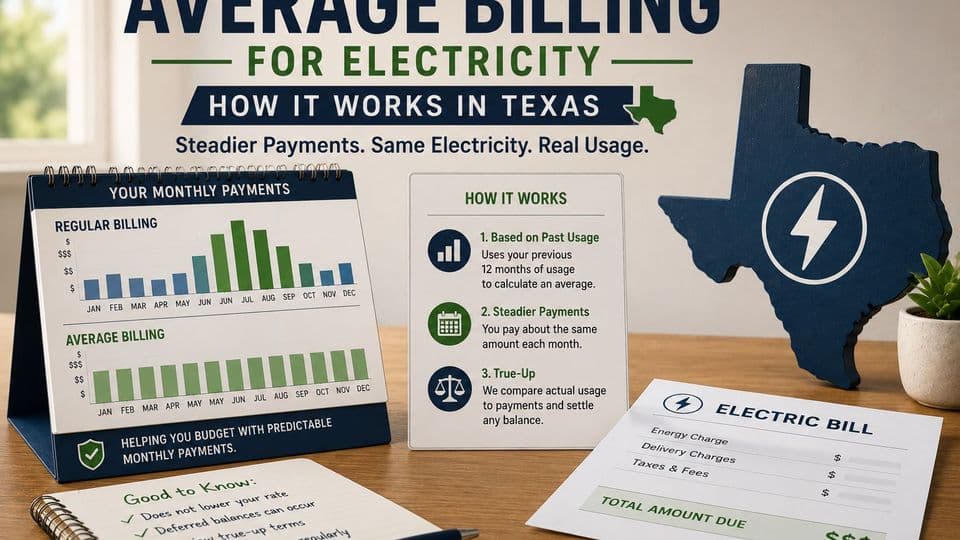
Key Takeaways
- 1Average billing smooths monthly electricity payments, but it does not lower the electricity rate by itself.
- 2A deferred balance tracks the difference between averaged payments and actual usage charges, and it can become an amount owed or a credit.
- 3Texas heat, cold snaps, EV charging, pools, and household changes can make the average less accurate.
- 4Cancelling average billing, switching providers, moving, or reaching the end of a contract may trigger a true-up.
- 5Before enrolling, ask the REP for the calculation formula, adjustment schedule, deferred balance rules, and cancellation terms.
A Texas electricity plan can look cheap until delivery charges, usage tiers, or monthly fees change the actual bill. Average billing addresses only one part of that problem by spreading payments into steadier monthly amounts.
What Average Billing Changes on an Electric Bill
Average billing smooths the monthly payment so bills feel more predictable across high-use and low-use months. It may also be called budget billing, balanced billing, or average monthly billing.
The customer still remains responsible for actual electricity used over time. Most Texas shoppers encounter the option when cooling loads swing sharply between summer and winter.
Average billing, budget billing, and balanced billing
In provider materials these names usually describe the same payment arrangement. Exact rules for how the average is calculated or adjusted can differ by Retail Electricity Provider.
The problem it solves: monthly cash-flow swings
Texas shoppers often face large summer bills followed by smaller winter ones. Average billing reduces the size of those swings by using prior usage to set a steadier amount each month.
How Providers Usually Set the Averaged Amount
Many explanations use a 12-month lookback based on past bills or usage. If less than a full year of history is available, some providers may use the available months instead.
The averaged payment may be updated as actual usage and charges come in. Before enrolling, ask the provider for its exact formula and adjustment schedule.
The common 12-month lookback
Providers often start with the previous twelve months of usage and divide total charges by twelve. Newer accounts may rely on shorter history or on estimates until more data arrives.
What happens if you have less than a year of history
The provider may average whatever months exist or set a preliminary amount that changes after the first true-up. Confirm the adjustment timing in the plan documents.
Where Deferred Balances Come From
A deferred balance is the gap between averaged payments and actual charges. Higher actual usage can create a debit balance that may be owed later.
Lower actual usage can create a credit balance that may reduce future bills or be settled later. Check your monthly statement or account portal for any running balance the provider displays.
Debit balances when usage runs high
When cooling or heating loads exceed the estimate, the difference adds to what you owe. The balance can grow across multiple months before a true-up.
Credit balances when usage runs low
Mild months or efficiency improvements can leave you ahead. The credit may appear as a lower future payment or as a settlement at contract end.
Why true-ups can surprise customers
A final true-up often occurs when average billing ends, you move, switch providers, or reach the end of your contract. Any remaining debit becomes due at that point.
Average Billing Compared With Regular Monthly Billing
Regular billing follows actual billing-cycle usage more directly. Average billing gives steadier payments but can make usage cost signals easier to miss.
A lower averaged bill during a high-use month can still mean a balance is building. A higher averaged bill during a mild month may mean the customer is paying ahead.
Predictability compared with usage transparency
Regular bills show the immediate cost of each month's kWh. Average billing conceals part of that signal until the deferred balance appears or a true-up occurs.
When regular billing gives a clearer signal
Households that want to see the direct effect of usage changes usually prefer regular billing. Average billing works better when cash-flow stability matters more than month-to-month visibility.
What Average Billing Does Not Change
Average billing does not lower the electricity rate by itself. It does not erase the cost of high usage.
It is separate from whether a plan is fixed-rate, variable-rate, prepaid, or bill-credit based. In Texas, readers should still check the Electricity Facts Label, Terms of Service, and Your Rights as a Customer disclosure before comparing advertised rates.
It does not lower the electricity rate
The energy charge per kWh remains the same. Only the timing of payments changes.
It does not guarantee lower total cost
Total cost still depends on usage, rate, delivery charges, and any deferred balance settlement. Average billing is a budgeting tool, not a discount.
It does not replace plan document review
Contract terms, cancellation fees, and true-up rules still apply. Read the full documents even when the monthly payment looks stable.
Best Fits for Average Billing
It can fit households that need predictable monthly expenses. It is most useful when usage is relatively stable and the customer still checks actual kWh.
Fixed-income households may value steadier payments, but they still need to watch the deferred balance. The recommendation should be conditional, not universal.
Fixed-income households and tight budgets
Customers with fixed monthly income often prefer the smoother cash flow. They should still verify the provider will recalculate when usage changes.
Stable homes with predictable routines
Homes with consistent occupancy and appliance use usually see smaller deferred balances. Seasonal or variable households should review the option more carefully.
Red Flags Before Enrolling
Be cautious if the home is new to the customer and usage history is not representative. Be cautious if household size, work-from-home habits, or occupancy are changing.
Be cautious if the customer would struggle with a final true-up bill. Be cautious if the current contract is near expiration and the provider may apply a different rate after the term.
New home, new habits, or uncertain occupancy
Recent movers often lack twelve months of usage data from that address. The initial average may need frequent updates.
Customers who dislike final-bill adjustments
Anyone who prefers to close every month without carry-over balances may find the deferred amount stressful. Regular billing avoids that accumulation.
Contract timing and holdover-rate risk
If the fixed-rate term ends while average billing is active, the provider may move you to a variable or holdover rate. Check renewal options before the term expires.
Texas Weather and Usage Swings That Can Break the Estimate
Summer air conditioning can push actual usage above the averaged amount. Cold snaps can also affect homes with electric heat or heavy space-heating usage.
Mild weather may create credits or reduce an existing debit balance. Readers should compare actual kWh usage against the averaged bill during extreme weather months.
Summer cooling spikes
Extended heat waves drive air-conditioning loads far above the twelve-month average in many Texas homes. The deferred balance grows fastest during these periods.
Cold snaps and electric heat
Rare winter freezes can cause electric heat strips or heat pumps to run almost continuously. Accounts without gas backup often see large debit balances afterward.
Mild months that can create credits
Spring and fall shoulder seasons sometimes produce lower usage than the historical average. These periods can offset part of a prior debit.
Life Changes That Can Throw Off the Average
Adding an electric vehicle, pool, or large appliance can raise usage beyond the average. Efficiency upgrades may lower actual usage, which can create a credit if the averaged amount lags behind.
Long vacations, remote-work changes, or new household members can make historical usage less reliable. Customers should ask the REP about recalculation rules after major changes.
Adding an EV, pool, or large appliance
Fast EV charging or a new pool pump often adds several hundred kWh per month. The averaged payment will not reflect that increase until the provider updates the figure.
Efficiency upgrades and lower actual usage
New insulation, a more efficient HVAC system, or LED lighting can reduce consumption. The average may stay higher than needed until the provider recalculates.
Long vacations or remote-work changes
Extended absences lower usage. Returning to full occupancy or shifting to remote work raises it. Either shift can move the deferred balance in the unexpected direction.
What Happens at Renewal, Cancellation, or Provider Switch
A remaining deferred debit balance may become due when average billing ends or the contract closes. A deferred credit balance may be refunded or applied to a future bill, depending on provider rules.
Switching providers may trigger settlement of the balance. Readers should check the balance before cancelling, renewing, or changing providers.
Cancellation and switch timing
Most providers settle the deferred balance when service transfers. Confirm the exact process with the current REP before requesting a switch.
End-of-contract debit balances
A debit that has built over several high-usage months can appear as a large final bill. Planning ahead helps avoid payment surprises.
Credits after overpayment
If actual usage stayed below the average, the provider may apply the credit to the next bill or issue a refund. Ask how credits are handled in the plan terms.
Alternatives for Smoothing Bills Without Provider Average Billing
Customers can self-budget by setting aside extra money during lower-use months. Plan comparison with real usage history may reduce surprises better than smoothing payments alone.
Bill-credit plans can help some usage profiles, but thresholds can backfire if usage lands outside the credit range. Fixed-rate plans can reduce energy-rate uncertainty, but average billing is still a separate payment arrangement.
Build your own bill-smoothing buffer
Set aside the difference between the averaged amount and your regular bill during mild months. This creates a personal reserve for summer peaks without involving the provider.
Compare plans with your actual usage
Reviewing twelve months of kWh data helps identify plans whose rate structure matches real consumption. This step often yields more savings than payment smoothing alone.
Watch bill-credit thresholds carefully
Bill-credit plans reward usage within a narrow band. Exceeding the threshold can eliminate the credit and raise the effective rate.
How to Monitor an Average Billing Account
Compare the averaged payment against actual kWh usage each month. Watch whether the deferred balance is growing for several months in a row.
Check usage after extreme weather, new appliances, EV charging, or changes in household occupancy. Review the account before renewal season so a balance does not collide with a plan switch.
Compare the averaged amount with actual kWh
Each bill shows both the averaged payment and the month's actual usage. Tracking both numbers reveals whether the average is still reasonable.
Check the deferred balance before renewal
A growing debit near contract end increases the chance of a large settlement bill. Addressing the balance before renewal gives more options.
Do not let a smooth bill hide rising usage
Steady payments can mask gradual increases in consumption. Regular kWh reviews keep usage visible even when the dollar amount stays flat.
A Practical Decision Rule for Texas Shoppers
Choose average billing if steady cash flow matters and the customer is willing to track the deferred balance. Skip it or be cautious if usage is changing, the contract is near expiration, or a final true-up would be hard to absorb.
Do not use average billing as a substitute for comparing rates, plan documents, and historical usage. Ask the REP for the calculation formula and true-up rules, then compare the plan against your actual kWh history before enrolling.
Average Billing for Electricity FAQs
Sources & References
Editorial standards
SlashPlan publishes independent guidance to help Texans compare electricity plans. Our editorial team reviews each article without advertiser influence. See our editorial guidelines and monetization disclosure.
About the author
Roi CahanaEnergy advisor helping Texans better understand their electricity options and make more confident decisions. Focused on simplifying electricity plans, explaining confusing terms, and sharing practical guidance to help readers avoid common mistakes when comparing rates, contracts, and renewals.
Ready to compare plans?
Enter your ZIP code to see electricity plans available at your address.