Can I Cancel My Electricity Contract in Texas?
A Texas electricity contract is not always impossible to leave. The answer depends on your contract terms, end date, move status, and the official PUCT rules that apply.
Key Takeaways
- 1A Texas electricity contract can be canceled or switched, but any fee depends on the contract terms and timing.
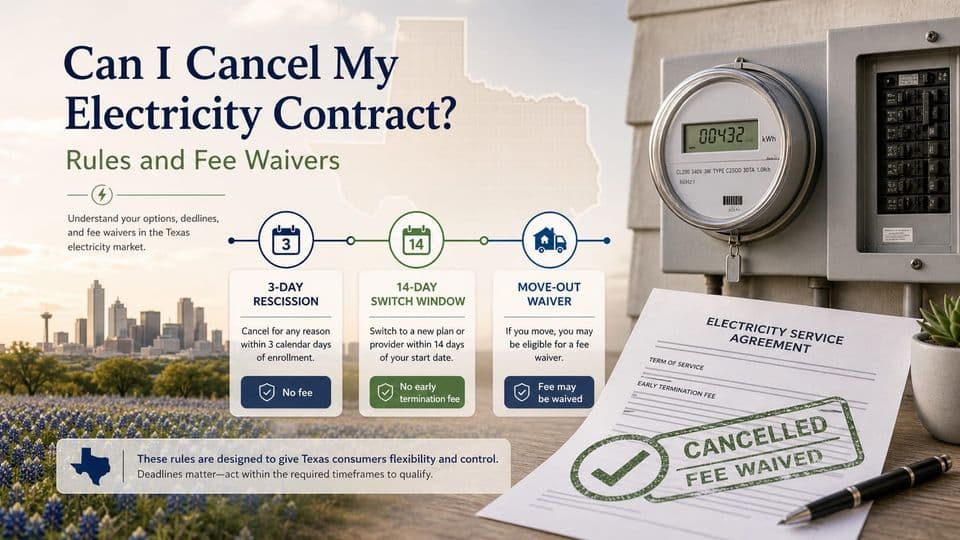
- 2PUCT rules limit termination penalties when a customer switches no earlier than 14 days before the contract expiration date.
- 3Moving out can qualify for a termination-fee exception if the customer leaves the premises and provides evidence when requested.
- 4A recent enrollment may fall under a separate right-of-rescission rule, which is not the same as canceling months into a contract.
- 5Before canceling, confirm the end date, fee, effective date, move-out proof, and any rescission deadline in writing.
Texas uses a deregulated electricity market, which means most residents and businesses choose their own retail electric provider (REP). These choices come with contracts that have specific terms for how long the service lasts and what happens if you stop service early. Whether you can cancel without paying a penalty depends on your contract language, your reason for leaving, and specific rules set by the Texas Public Utility Commission (PUCT).
Many people believe they are locked into a contract until the very last day no matter what. While it is true that ending a fixed-term agreement ahead of schedule can trigger an early termination fee, there are official exceptions.
These exceptions include a window near your contract's expiration date and a specific move-out provision.
Understanding these details before you call your provider can save you money and prevent billing surprises.
Can you cancel a Texas electricity contract?
You can request to cancel your electricity contract or switch to a new provider at any time, but the financial outcome depends on your specific contract and the timing of your request. In Texas, retail electric providers are required to follow PUCT rules that protect customers in certain situations. If you are still under a fixed-term contract, the provider may charge an early termination fee unless a specific rule applies to your situation.
It is helpful to distinguish between three different actions that often get grouped together:
- Cancellation: This usually means you are ending service entirely, perhaps because you are moving out of the state or closing a vacation home.
- Switching: This means you are changing from one retail electric provider to another while staying at the same address.
- Move-out: This is a specific type of cancellation where you are moving from the premises and no longer need service at that specific address.
Each of these actions is treated slightly differently under standard contract terms and PUCT regulations. For example, the rules for switching providers near the end of a contract are different from the rules for canceling because you are moving.
The information in this guide applies to residential and small commercial customers in areas of Texas with a deregulated market. If you live in a city with a municipal utility or a co-op, these specific PUCT contract rules may not apply to you.
Cancellation, switching, and move-out mean different things
Contract records that control your answer
Before you make any decisions, you need to find the documents that define your agreement. Your contract is not just a receipt, it is a set of legal terms that includes your price, term length, and the conditions for ending service.
The most important documents to review are:
- EFL - Electric Facts Label
- TOS - Terms of Service
- YRAC - Your Rights As a Customer
According to PUCT rules, providers must make these documents available to you. You can usually find them by logging into your online account portal or by calling the provider's customer service line and asking for a copy of your current terms.
Contract terms, end dates, and provider notices
The single most important date in your contract is the electricity contract end date. This date determines when you can switch without a fee. If you cancel or switch before this date, you are generally subject to the early termination fee listed in your Terms of Service. However, if you wait until the contract has officially expired, the fee should no longer apply, and you may be on a month-to-month or "holdover" rate.
Always look for the "Expiration Date" or "Term End Date" on your documents. Do not assume your contract ends exactly 12 or 24 months from the start date, as some contracts have specific end-of-month requirements.
Early termination fees and when they apply
An early termination fee (ETF) is a charge some retail electric providers use to recover the cost of signing you up and the risk of losing your business before the contract term is up. In Texas, the amount of the fee and the conditions for it are set by the provider within the boundaries of PUCT rules.
If you are unsure how much your fee is, do not guess. Ask your provider to point to the specific section of your contract that outlines the charge. Under PUCT rules, the provider must be able to identify the contract term or rule that supports a quoted fee. If you feel a fee was applied incorrectly, you have the right to request a billing investigation or contact the PUCT for assistance.
How the fee should be tied to the contract
A provider cannot charge an early termination fee unless it is explicitly stated in the terms you agreed to. If you signed up for a "no-contract" or "month-to-month" plan, there should be no termination penalty for ending service. However, many fixed-rate plans in Texas do include these fees to ensure the provider can recover their costs if you leave early.
The 14-day window near the contract end date
One of the most important protections for Texas electricity customers is the PUCT rule regarding contract expiration. PUCT rules prohibit a retail electric provider from charging a termination penalty if a customer switches service no earlier than 14 days before the contract expiration date.
This means you do not have to wait until the last day of your contract to make a change. You can shop for a new plan and schedule a switch up to two weeks before your contract ends. This gives you time to avoid a "holdover" rate, which is often much higher than the rate you were paying under your fixed-term contract.
To use this rule, you must know your exact contract end date. If you schedule a switch 15 days before the end date, the provider may still try to charge the fee. Because the timing is so specific, it is a good practice to get the switch date confirmed in writing.
How to use the contract expiration date
Mark your contract end date on your calendar as soon as you enroll in a plan. Many providers send a renewal notice about 30 to 45 days before the contract ends, but you should not rely solely on this notice. If the notice is delayed or lost in the mail, you could miss your 14-day window and end up on a month-to-month rate that is significantly more expensive.
Moving out of an address during a contract
If you need to cancel your electricity contract because you are moving, you may be exempt from the early termination fee under PUCT rules. The PUCT includes a move-out exception for customers who are moving from the premises and no longer require service at that address.
To qualify for this exception, you must be moving your permanent residence. Simply wanting to get out of a contract because you found a better price does not qualify as a move-out. The rules are designed to ensure that you are not penalized for a life event that makes the contract impossible to fulfill.
You should notify your provider of your move-out date as soon as possible. Most providers require at least a few days' notice to schedule a final meter reading. If you move out and leave the electricity on in your name, you could be responsible for the usage of the next tenant.
Proof a provider may request
While many providers will waive the fee for movers without much hassle, they have the right to request evidence that you have moved. This might include a lease agreement for a new home, a closing document on a home purchase, or a utility connection confirmation at a new address.
If your provider asks for proof, provide it promptly. If you are moving within the same city or even just down the street, you can still qualify for the move-out exception as long as you are leaving the old premises.
However, if you stay in the same service area and want to keep the same provider, you should ask if they can transfer your contract to the new address without a fee instead of canceling it.
Canceling soon after enrollment
If you just signed up for an electricity plan and immediately realized it was a mistake, you might have a way out that does not involve an early termination fee. PUCT rules include a "right of rescission" for certain retail electric provider selections.
This right allows you to cancel the enrollment within a very short window after you receive your confirmation. This is not the same as the 14-day window before your contract ends. This is a "cooling off" period that applies to the start of the relationship.
The length of this window and the specific rules for how to cancel can vary based on how you signed up (e.g., online, over the phone, or in person). You should check your enrollment confirmation email or letter immediately. It will tell you the deadline and the phone number or website to use to rescind the agreement.
The right of rescission is a separate rule
Do not confuse the right of rescission with the ability to cancel later in the contract. Once that initial window closes-often within three business days of enrollment or receipt of terms-you are bound by the contract terms. If you are unsure if you are still within the rescission window, call the provider's customer service line immediately and ask for the "rescission department" or a supervisor.
Provider, TDU, and utility roles when service changes
When you need to cancel or switch, knowing who to call is essential. In Texas, there are two main types of companies involved in your electricity service:
- Retail Electric Provider (REP): This is the company you chose that sends you the bill, sets the price, and manages the contract. You call them to cancel, to ask about early termination fees, or to switch to a different plan they offer.
- Transmission and Distribution Utility (TDU): This is the company that owns the poles, wires, and meters. They are responsible for delivering the electricity and fixing outages. Your TDU does not handle your contract cancellation or early termination fees.
Even if you are unhappy with your TDU (for example, if Oncor or CenterPoint is slow to restore power), you cannot "cancel" them. You can only switch your retail electric provider. If you call your TDU to cancel your service, they will likely tell you to contact your REP.
Who handles the retail contract
Always start with your retail electric provider. They are the ones who can look up your contract, see your end date, and tell you the exact amount of your early termination fee. If you are switching to a new provider, the new provider will usually handle the notification to the old provider, but you should still confirm that the switch was processed correctly.
Contract expiration notices and renewal risk
PUCT rules require providers to send notices about contract expiration and renewal. These notices are meant to give you time to decide whether to stay with your current provider or switch to a new one. However, many customers ignore these notices or mistake them for junk mail.
If you do not respond to a renewal notice, your contract may automatically move to a "month-to-month" or "variable" rate. These rates can be much higher than the fixed rate you were paying. In some cases, staying on a holdover rate for just one month could cost you more than the early termination fee would have been to leave early.
When you receive a renewal notice, check the "Renewal Rate" against the rate you are currently paying. If the new rate is higher, it is a signal that you should use your 14-day window to switch to a different plan or a different provider.
Notices should trigger a contract review
Treat any mail or email from your provider about your contract status as a prompt to check your current terms. Log into your account and verify your end date. If the notice says your contract is ending, check if you are already in your 14-day penalty-free window.
Weighing a fee against savings without turning this into shopping
Sometimes, the math suggests that paying the early termination fee might actually save you money in the long run. This is a personal financial decision, but it is one you should make with real numbers rather than guesses.
To do a high-level comparison, you need two numbers: the amount of the early termination fee and the difference in monthly cost between your current plan and a new plan you are considering.
Example:
- Your early termination fee is $150.
- Your current plan costs $120 per month.
- A new plan would cost $95 per month.
- Your savings would be $25 per month.
- It would take you 6 months ($150 divided by $25) to "break even" on the fee.
If you plan to stay at that address for more than six months, paying the fee might make sense. If you might move again in three months, it is probably better to stay where you are.
Simple payback math, kept high level
You do not need a complex spreadsheet to do this. Write down your fee and your estimated monthly savings. If the time it takes to recover the fee is longer than you expect to stay at the address, it is usually not worth canceling. Remember that the "savings" are only estimates based on the usage provided, your actual bill will depend on how much electricity you use.
A final checklist before you cancel
Before you make the final call to your provider or click the "switch" button on a new plan, run through this checklist to avoid unnecessary costs:
- Confirm the End Date: Check your contract or call your provider to get the exact date your term ends.
- Check the ETF Amount: Ask for the exact dollar amount of the early termination fee in writing or through a recorded line.
- Verify the 14-Day Window: If you are within 14 days of your end date, confirm that the provider will not charge the fee.
- Prepare Move-Out Proof: If you are moving, have proof to show that you are moving, like a new lease-agreement, or other documents showing your association with the new address.
FAQs About Canceling a Texas Electricity Contract
Sources & References
Editorial standards
SlashPlan publishes independent guidance to help Texans compare electricity plans. Our editorial team reviews each article without advertiser influence. See our editorial guidelines and monetization disclosure.
About the author
Roi CahanaEnergy advisor helping Texans better understand their electricity options and make more confident decisions. Focused on simplifying electricity plans, explaining confusing terms, and sharing practical guidance to help readers avoid common mistakes when comparing rates, contracts, and renewals.
Ready to compare plans?
Enter your ZIP code to see electricity plans available at your address.