Can You Change Your Mind After Switching Electricity Providers?
If you enrolled with a new Texas electricity provider and want to undo it, timing matters. This guide explains pending switches, active plans, cancellation documents, and what to ask before you act.
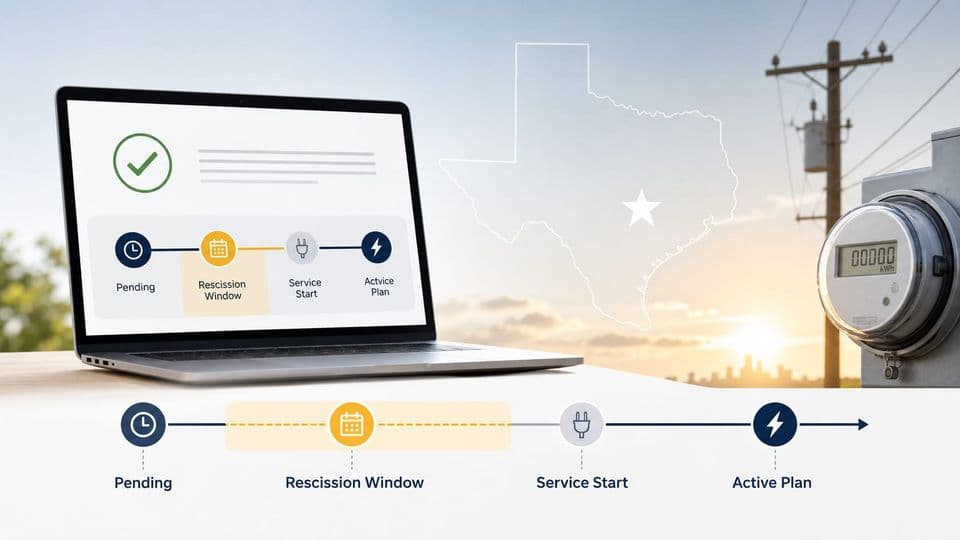
Key Takeaways
- 1Before acting, confirm whether the enrollment is pending, active, or tied to a move-out request.
- 2Check the Terms of Service and provider confirmation for any rescission deadline before relying on a cancellation window.
- 3Once the new plan is active, use your own plan documents to confirm cancellation terms and any early termination fee.
- 4Use precise language with the provider so a cancellation or rescission request is not confused with a move-out or disconnection request.
- 5Save confirmation numbers, emails, service start notices, and final account records until the enrollment status is clear.
Switching electricity providers in Texas is usually a straightforward process, but what happens if you change your mind after enrolling with a new provider? It depends on whether your enrollment is still pending or if the new plan is already active.
If you act quickly, you may be able to stop the switch before it completes. If the new plan has already started, your options are different and depend on your contract terms.
This guide explains the key timing rules, where to find the language that controls your cancellation rights, and what to ask each company so you do not accidentally disconnect power or trigger a fee you did not expect.
Start With Whether the Switch Is Pending or Active
The most important question to answer is whether your enrollment is still pending or whether the new plan is already active. Your options change completely once the service start date has passed.
Pending enrollment vs. active plan
When your enrollment is pending, the switch has not yet completed and your current provider is still supplying power. In this window, you may be able to cancel the switch or exercise a right of rescission if one applies to your account. The new provider can tell you whether the enrollment is still pending and whether rescission is available.
Once the new plan is active, you are no longer in a pre-switch window. You now have an active contract with the new provider, and canceling involves ending that contract rather than stopping a switch. At this point, your Terms of Service, contract documents, and any applicable PUCT rules control what happens next.
The service start date is the practical dividing line. If you do not know whether the start date has passed, check your enrollment confirmation email, your provider account portal, or call the new provider and ask for the current status.
Use the Rescission Window Before the Deadline Passes
Rescission is the formal term for canceling a transaction within a limited window after enrollment. In Texas, certain electricity enrollments may be subject to rescission rules, but the deadline and scope depend on the official PUCT rule and your specific account documents.
The Terms of Service date matters
Your Terms of Service is the first place to check for a rescission deadline. The deadline may be measured from the date you enrolled, the date you received required disclosures, or another trigger depending on the type of account and transaction. Do not assume that the signup date is the only date that matters.
If your Terms of Service mentions a rescission window, note the exact deadline and act before it passes. Ask the provider to confirm in writing that your cancellation request was received and processed within the window. If the deadline has already passed, rescission is no longer available and you will need to look at your active contract terms instead.
The Texas right of rescission is not a universal guarantee that applies to every enrollment in the same way. The official PUCT rule sets the framework, but your account type, the required disclosures you received, and the timing of those disclosures can all affect whether rescission applies to your situation.
Contact the New Provider First, Then Confirm the Current Account
If you want to stop a pending switch, start with the new provider that accepted your enrollment. That provider can confirm whether the switch is still pending, whether the service start date has passed, and whether rescission is available for your account.
Questions to ask on each call
When you call the new provider, ask specific questions and write down the answers. Good questions include:
- Is my enrollment still pending, or has the switch already completed?
- What is the service start date for this enrollment?
- Is rescission available for this account, and if so, what is the deadline?
- If I cancel now, will there be any fee or charge?
- Can you send written confirmation that the enrollment has been canceled?
After you speak with the new provider, call your current provider to confirm your existing contract end date and account status. Your current provider may still have records that show whether the switch is proceeding and what your options are if you want to stay with them.
Always ask for written confirmation. A verbal promise that the switch has been stopped is not the same as a written record that you can reference later if there is a dispute about the timing or the status.
Check the Contract Documents Before Canceling an Active Plan
Once the new plan is active, you are no longer in a rescission window. The cancellation process and any fee are controlled by your contract documents, not by a generic switching rule.
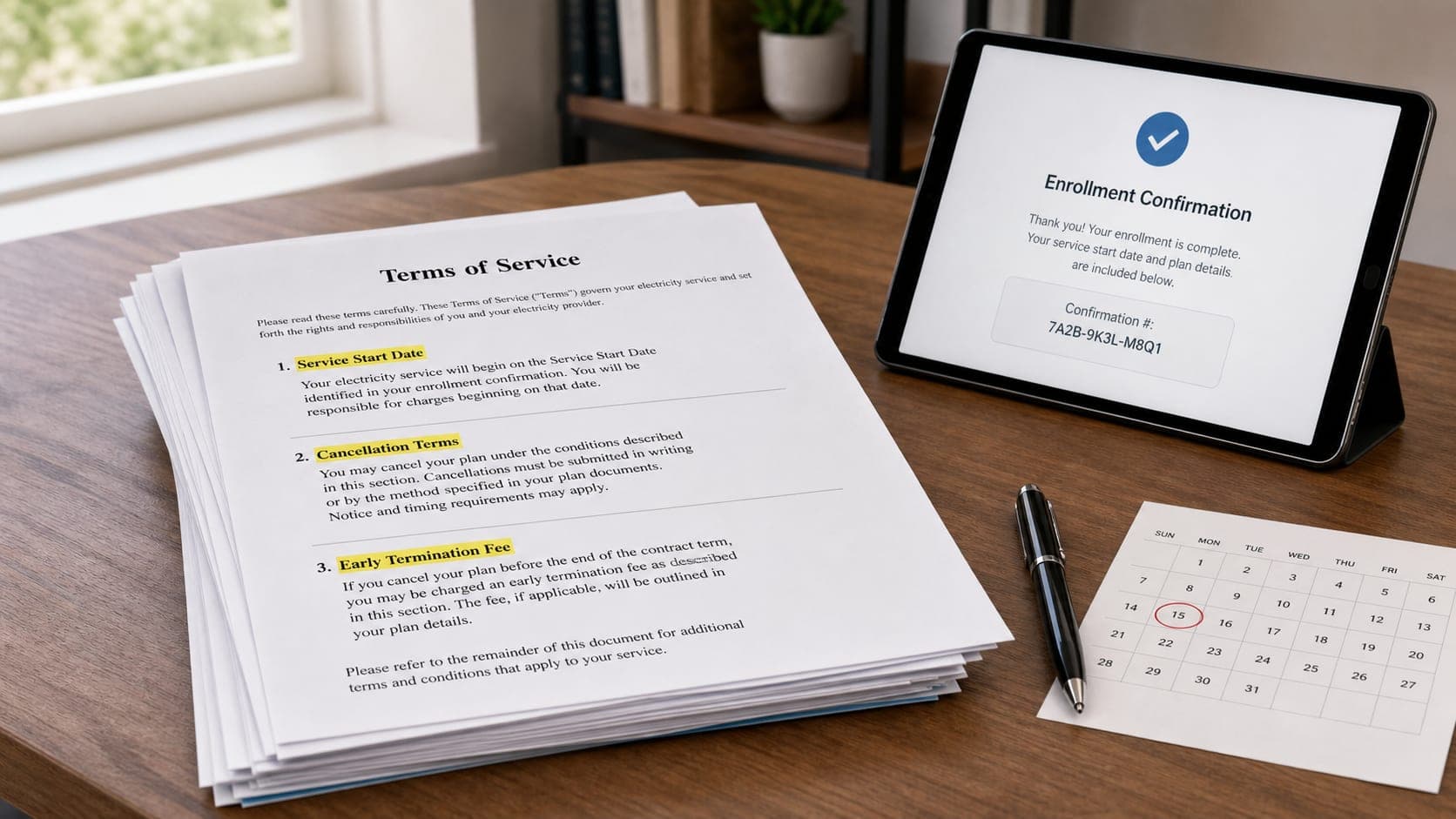
Where cancellation terms usually appear
Look for the following items:
- Contract length and end date
- Early termination fee language and fee amount
- Cancellation process and any required notice
- Any provider-specific cancellation window or satisfaction guarantee
- The service start date and whether the plan has a renewal provision
If you cannot find these terms, call the provider and ask them to point you to the exact document and section that covers cancellation. Ask them to send a written response that quotes the relevant language so you have a record.
Early Termination Fees Depend on Contract Timing
An early termination fee is a charge that some providers assess when you cancel a fixed-term contract before the end date. Whether the fee applies, and how much it is, depends on your contract documents and applicable PUCT rules.
The final 14 days before contract expiration
Texas rules restrict certain early termination fees near contract expiration, but this is not a blanket right to cancel any plan at any time. The timing must be applied to your actual contract end date, not to an assumed two-week window.
If you are near the end of your contract, check the contract end date in your documents and confirm with the provider whether an early termination fee would still apply. Do not assume that the final 14 days are always free of fees, because the rule has specific conditions and may not apply to every contract type or provider.
If you are outside a rescission window and not near contract expiration, the provider's contract terms become especially important. Some contracts have no early termination fee, while others specify a fee that decreases over time or applies only if you cancel before a certain point.
A Move-Out Request Changes the Cancellation Question
Moving out of a home is different from switching providers at the same occupied address. If you tell a provider you are moving, they may treat your request as a move-out or service stop rather than a simple cancellation.
Proof, forwarding address, and move-out date
When you move out, the provider may ask for a move-out date, a forwarding address, or proof that you have relocated. These requirements are account-specific and may vary by provider. If you are moving and want to cancel your electricity plan, be clear about the move-out date and ask the provider what documentation they need.
Moving does not automatically waive an early termination fee. Some providers may waive the fee if you provide proof of a move, but this is not a Texas-wide rule and it is not guaranteed. Check your contract documents and ask the provider for their specific process.
If you are not moving and only want to cancel a switch or change providers, be careful not to use move-out language when you speak with the provider. Asking to "disconnect service" or "stop service" may be interpreted as a request to cut power at the address, which is not what you want if you plan to keep the lights on.
Retail Provider and Local Utility Roles Are Different
A common concern is whether canceling a switch will interrupt power at the home or business. Understanding which company handles what can reduce confusion and help you ask the right questions.
Your Retail Electric Provider sells the electricity plan, handles enrollment, bills you, and manages the contract. Your local utility owns and maintains the poles, wires, meters, and delivery system. In most switch situations, the utility does not decide whether your retail contract can be canceled.
If your power is out, that is usually a delivery issue rather than a provider-switching issue. In that case, use the process for reporting a power outage in Texas instead of calling only the provider that sold your plan.
Canceling a pending provider switch should not be the same as asking to disconnect electricity at the address. Use clear language when you call: say that you want to cancel or rescind the enrollment, not that you want to stop service to the home.
What to Do If You Already Signed Up With a New Provider
If you have already enrolled with a new electricity provider and want to change your mind, take these steps in order:
- Find your enrollment confirmation and Terms of Service.
- Check the service start date.
- Call the new provider and ask whether the enrollment is pending or active.
- Ask whether rescission applies and what the exact deadline is.
- If the plan is active, ask whether an early termination fee applies.
- Request written confirmation of any cancellation, rescission, or account-status change.
- Confirm with your current provider whether your existing plan remains active.
The earlier you act, the more options you are likely to have. Waiting until after the service start date may turn a simple cancellation request into an active-contract termination.
FAQ
Can I cancel after I already signed up with a new electricity provider?
Maybe. If the enrollment is still pending, you may be able to cancel the switch or use a rescission right if one applies. If the new plan has already started, you are canceling an active contract and need to follow the contract terms.
How long do I have to change my mind after enrolling with a Texas electricity provider?
There is no single answer that applies to every situation. The rescission deadline depends on the PUCT rule, your account type, the required disclosures, and the timing shown in your Terms of Service or enrollment documents. Check those documents and call the new provider as soon as possible.
Who should I contact if I want to stop the switch?
Contact the new provider first. That is the company that accepted the enrollment and can confirm whether the switch is still pending. After that, contact your current provider to confirm whether your existing account remains active and whether any contract-end or fee issue applies.
A provider switch should not normally be handled like a service disconnection. The important point is to use clear language with the provider: ask to cancel or rescind the enrollment, not to disconnect power at the address. If there is an actual outage, contact the local utility responsible for delivery.
Can I switch again after my new electricity plan starts?
Yes, but switching again is different from rescinding a pending enrollment. Once the new plan is active, a second switch may count as canceling an active contract, which means an early termination fee could apply depending on your documents.
Can I avoid an early termination fee near the end of my electricity contract?
Possibly, but do not treat the final 14 days as a blanket cancellation right. The timing must be tied to your actual contract end date and the conditions in the applicable rule and contract documents. Confirm the fee status with the provider before you authorize a new switch.
Does moving change my options after I signed up for electricity?
Moving can change the process, but it does not automatically waive every fee. If you are moving, ask the provider what proof or documentation is required and whether the early termination fee applies. If you are not moving, avoid using move-out or disconnect language when you only want to cancel a switch.
Bottom Line
You can sometimes change your mind after switching electricity providers, but timing controls your options. If the switch is still pending, act quickly and ask the new provider about cancellation and rescission. If the new plan is already active, review your contract documents and ask whether an electricity contract cancellation fee applies.
Use precise language, get written confirmation, and check the service start date before assuming your switch can still be stopped.
Changing Your Mind After an Electricity Switch: FAQs
Editorial standards
SlashPlan publishes independent guidance to help Texans compare electricity plans. Our editorial team reviews each article without advertiser influence. See our editorial guidelines and monetization disclosure.
About the author
Roi CahanaEnergy advisor helping Texans better understand their electricity options and make more confident decisions. Focused on simplifying electricity plans, explaining confusing terms, and sharing practical guidance to help readers avoid common mistakes when comparing rates, contracts, and renewals.
Ready to compare plans?
Enter your ZIP code to see electricity plans available at your address.