Commercial TDSP Charges in Texas
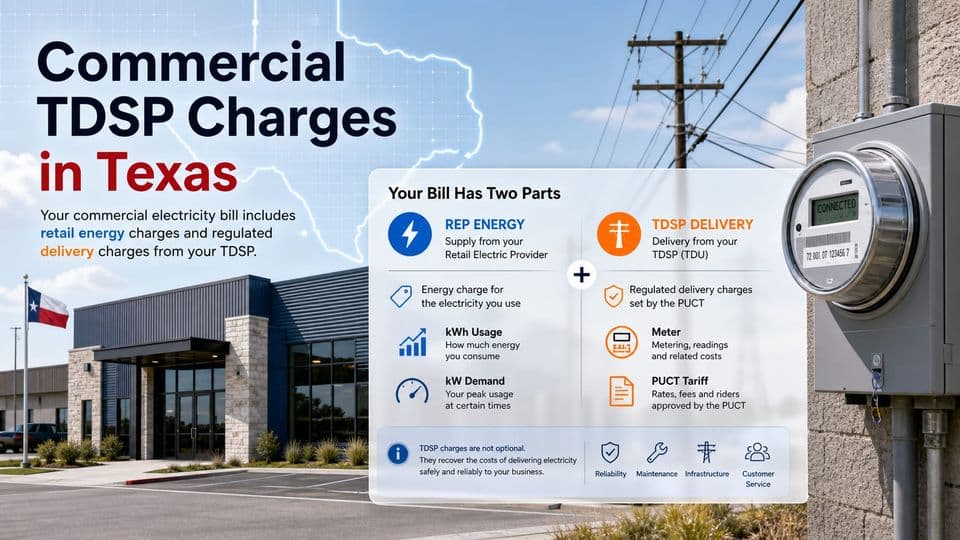
Commercial TDSP charges are regulated delivery charges tied to the local utility serving a Texas business address. The exact charge depends on the utility tariff, service class, usage, demand, and meter setup.
Key Takeaways
- 1Commercial TDSP charges are regulated delivery charges tied to the local utility serving a Texas business address.
- 2TDU and TDSP can refer to the same delivery utility role in Texas electricity context.
- 3A REP sells and bills retail electricity service, while a TDSP delivers and meters electricity and maintains delivery infrastructure.
- 4Commercial service can differ from residential service because service class, kWh usage, kW demand, and meter setup can affect how delivery charges are applied.
- 5Exact commercial TDSP charge figures depend on the current utility tariff, service class, and effective date.
Every Texas business owner receives an electricity bill with two distinct parts. One part covers the actual energy supply, while the other covers the physical delivery of that power to the building. Commercial TDSP charges represent the second part. These are regulated fees tied to the utility that owns the poles, wires, and meters serving a specific address.
In Texas, the delivery system is deregulated alongside the retail energy market, but the delivery utility itself is a regulated monopoly. This means a business can choose its retail electric provider (REP), but it cannot choose its Transmission and Distribution Service Provider (TDSP). The TDSP is determined by the physical location of the service address.
Understanding these charges is critical for managing overhead. Because these are regulated delivery charges, they appear on every bill for that location, regardless of which company sells the electricity. The exact amount depends on the utility's tariff, the service class of the building, and how much power the business uses and demands.
What commercial TDSP charges mean in Texas
TDSP stands for Transmission and Distribution Service Provider. In many contexts, this is the same role as a Transmission and Distribution Utility (TDU). The official Oncor delivery-charges guide states that the terms TDSP and TDU are often used to describe the same delivery utility role.
Commercial TDSP charges are the costs for using the local grid to deliver electricity. These are not payments for the electricity itself. Instead, they cover the maintenance of the infrastructure that moves power from the generator to the business. These charges are "commercial" because they apply to non-residential accounts, which often have different service requirements than homes.
TDSP, TDU, and delivery utility terms
The terminology can be confusing because different documents use different acronyms. When reading a Texas electricity bill or tariff, a business should treat "TDSP" and "TDU" as interchangeable references to the local utility. The four main TDSPs in Texas are:
- Oncor Electric Delivery
- CenterPoint Energy Houston Electric
- Texas-New Mexico Power (TNMP)
- AEP Texas (North and South)
Delivery charges in one plain sentence
A commercial TDSP charge is a regulated fee that pays for the upkeep of the local power lines, the reading of the electric meter, and the response to power outages.
Who does what on a Texas electricity account
A Texas business electricity bill involves two separate companies. The first is the Retail Electric Provider (REP). The REP markets electricity plans, handles customer service, and sends the monthly bill. The second is the TDSP, which handles everything related to the physical delivery of the electricity.
The REP role
The REP buys electricity on the wholesale market and sells it to the business. The REP is responsible for the "supply" portion of the bill. They also handle billing and collections. However, the REP does not own the power lines that run to the building.
The TDSP role
The TDSP is responsible for the "delivery" portion of the bill. According to official utility sources, the TDSP performs several essential functions:
- Delivery and Metering: They physically deliver electricity and ensure the meter records usage accurately.
- Infrastructure Maintenance: They maintain the poles, wires, transformers, and substations.
- Outage Response: They are the ones to call when the power goes out, as they manage the local grid's reliability.
- Usage Reading: They read the meter to determine how much electricity the business used during the billing cycle.
Why the delivery utility can appear on a retail bill
The TDSP bills the REP for the cost of delivery. The REP then passes these costs through to the business on a single monthly statement. This is why a business cannot "shop around" to avoid TDSP charges. Even if a business switches its REP to get a lower supply rate, the TDSP charges from the local utility will remain because the physical location of the business has not changed.
The official source that controls exact charges
Delivery rates are not set by the retail market. They are regulated and approved by the Public Utility Commission of Texas (PUCT) through formal tariff schedules. A tariff is a legal document that lists the specific rates, rules, and conditions for service.
PUCT-approved tariff schedules
Every TDSP must file its rates with the PUCT. These rates are public record. If there is ever a conflict between a summary found on a website and the official tariff, the tariff is the correct source. For a business trying to understand its charges, the tariff is the ultimate authority.
Why summaries are not enough for exact commercial figures
Many online guides provide "average" delivery charges. These are often misleading for commercial accounts. Commercial delivery charges can vary based on the service class (e.g., General Service, Industrial) and the specific rate schedule applied to the meter. A business should always look for the specific tariff schedule that matches its account type.
Effective dates and source documents
Tariffs change. The PUCT and the utilities regularly update delivery rates to account for infrastructure investments or regulatory adjustments. An old rate sheet is useless for current budgeting. Always check the "Effective Date" on the tariff document to ensure the numbers match the current billing period.
How business service can differ from residential service
Residential delivery charges are usually straightforward. They typically involve a small fixed customer charge and a per-kilowatt-hour (kWh) charge for usage. Commercial accounts, however, are more complex.
Service class changes the question
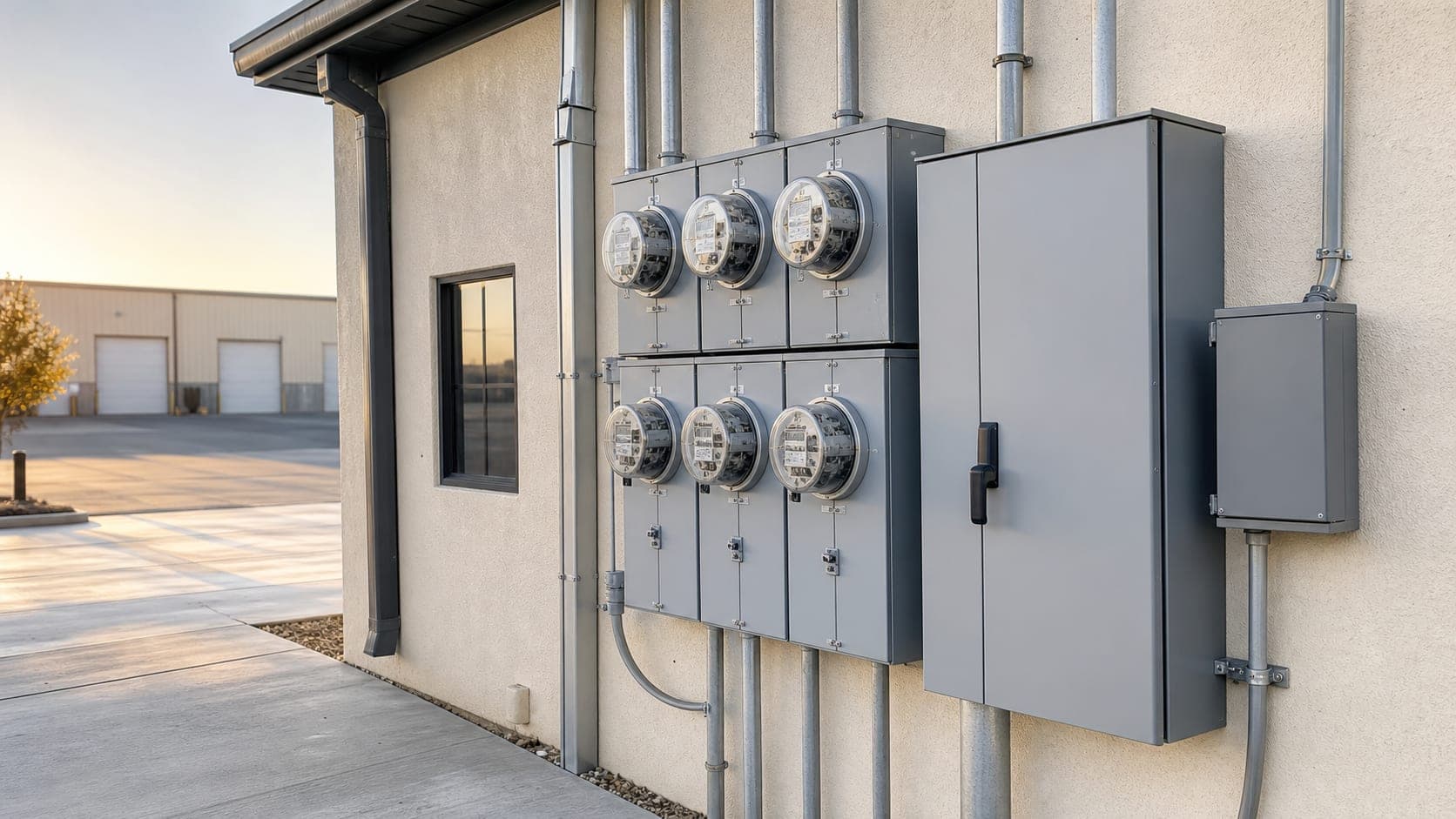
Utilities group accounts into "service classes." A small office might be in a "Secondary Service" class, while a large manufacturing plant might be in a "Primary Service" class. Each class has its own tariff with different rate structures. What applies to a small retail shop will not apply to a large warehouse, even if both are served by the same TDSP.
Secondary service and non-residential context
In the utility world, "Secondary Service" usually refers to accounts where the utility's transformer steps the voltage down to the level used by the building's wiring. These are common for most small to medium-sized businesses. However, "Primary Service" accounts take high-voltage power directly, which requires the business to own and maintain its own step-down transformers. The TDSP charges for these two types of service are calculated very differently.
Residential examples can mislead business readers
Many educational materials use residential examples because they are simpler. They might mention a "Customer Charge" of a few dollars. In commercial contexts, these fixed charges can be much higher, and additional charges for "demand" (kW) may appear. A business owner who only looks at residential explanations may be surprised by the actual line items on a commercial bill.
kWh usage and kW demand are different measurements
Two units of measurement dominate commercial electricity discussions: kWh and kW. While they sound similar, they measure different things, and both can affect TDSP charges.
kWh as energy used over time
A kilowatt-hour (kWh) is a measure of volume. It represents the total amount of electricity consumed over a period of time. If a business runs a 1,000-watt (1 kW) machine for one hour, it has used 1 kWh. Most delivery charges include a "per kWh" component to pay for the wear and tear on the grid caused by moving that volume of energy.
kW as a demand-related measure
A kilowatt (kW) is a measure of intensity or "demand." It represents the maximum amount of power the business pulls from the grid at any single moment. Think of kW as the width of a pipe and kWh as the total amount of water that flows through it. In many commercial tariffs, the TDSP charges based on the highest peak of demand (kW) during the billing cycle. This is because the utility must build its grid to handle the business's peak usage, even if that peak only happens for 15 minutes.
Per-kWh and per-kW wording
When reading a commercial tariff, look for language that specifies "per kWh" or "per kW." The Distribution System Charge (DSC), for example, might be assessed based on energy (kWh) for some service classes and based on demand (kW) for others. Knowing which one applies is essential for forecasting costs.
Meter reads and multipliers can change the explanation
The foundation of any electricity bill is the meter read. The TDSP is responsible for reading the meter and providing that data to the REP.
Meter reads across the billing period
Usage is calculated by taking the difference between the meter reading at the end of the billing period and the reading at the beginning. The TDSP uses these readings to determine the total kWh and, if applicable, the peak kW for the period.
Meter multipliers on business accounts
For some large commercial or industrial accounts, the meter does not measure the total amount of electricity flowing into the building. Instead, it measures a "sample" of the power. A "meter multiplier" is a factor used to scale up that sample to reflect the actual total usage. If a business has a transformer-rated service, the meter multiplier is a critical detail. If the multiplier is entered incorrectly or misunderstood, the resulting TDSP charges will be wrong.
Fixed monthly charges and usage-based charges answer different questions
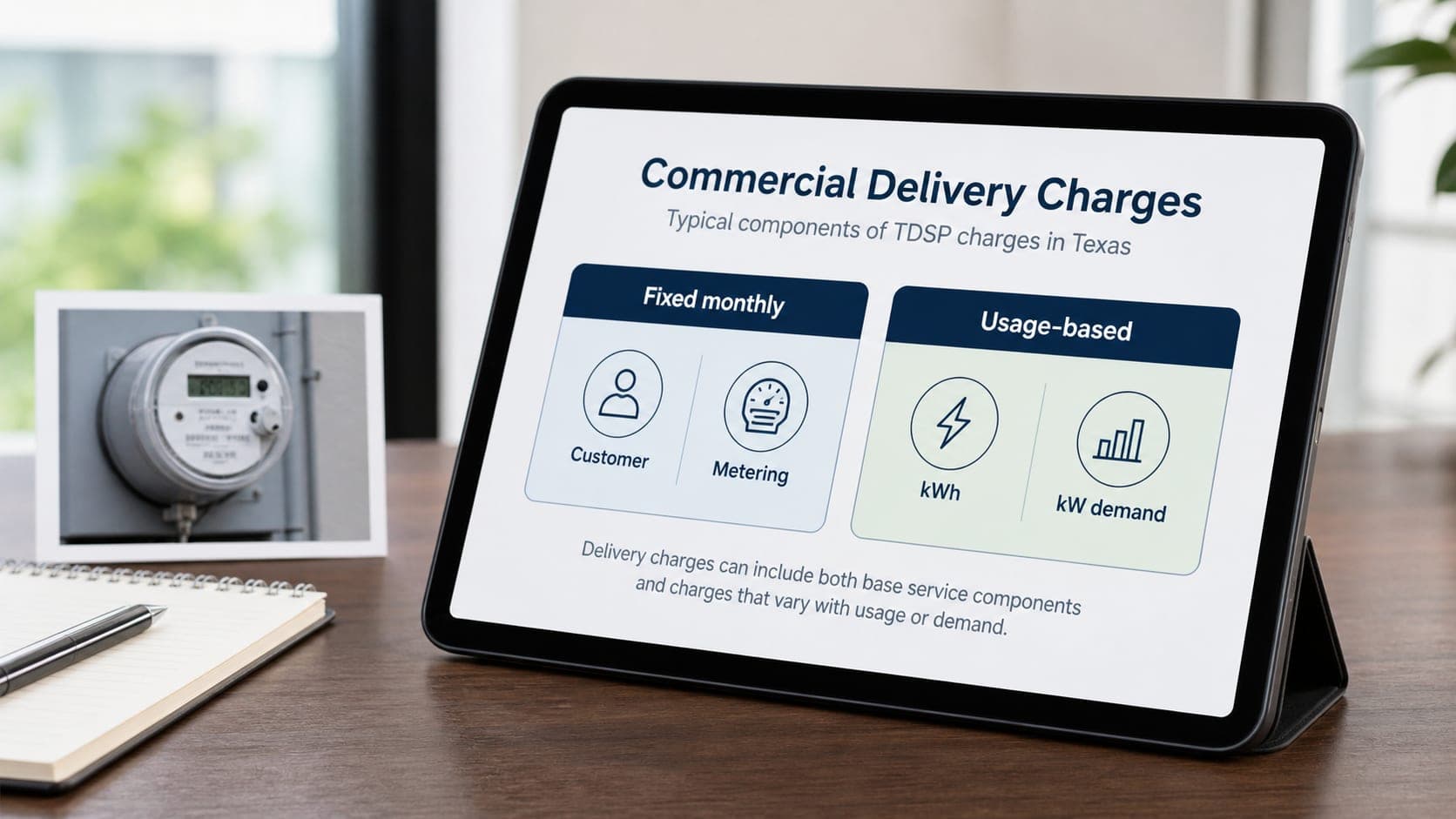
A commercial TDSP charge is rarely a single flat fee. It is usually a collection of several smaller charges, some of which are fixed and some of which vary.
Fixed delivery-charge examples
Fixed charges are the same every month, regardless of how much electricity the business uses. In a residential context, these are often called "Customer Charge" and "Metering Charge." In a commercial context, these fixed fees can be higher to cover the administrative and infrastructure costs of maintaining the account and the physical connection to the grid.
Usage-based delivery-charge examples
Variable charges move up and down with the business's activity. According to official utility sources, these often include:
- Distribution System Charge (DSC): Covers the cost of local wires and transformers.
- Transmission Cost Recovery Factor (TCRF): Recovers the cost of high-voltage transmission lines.
- Distribution Cost Recovery Factor (DCRF): Allows the utility to recover certain approved capital investments.
- Energy Efficiency Cost Recovery Factor (EECRF): Funds state-mandated energy efficiency programs.
- Nuclear Decommissioning Charge (NDC): Specific to areas that receive power from nuclear plants, used to fund the future decommissioning of those plants.
Why line-item names can vary
Not every commercial account will see every one of these line items. The presence and name of these charges depend on the specific TDSP and the specific tariff schedule. For example, a small commercial account might see a simple "Delivery Charge," while a large industrial account might see several itemized recovery factors.
Charge totals can move for more than one reason
It is common for a business to look at its bill and wonder why the delivery charges changed from one month to the next. Because many TDSP charges are usage-based or demand-based, they are sensitive to how the business operates.
Usage changes
The most obvious reason for a change is a change in kWh consumption. If the business has a busy month and uses more electricity, the "per kWh" portion of the TDSP charges will increase. Similarly, if the business reduces its hours of operation, the delivery charges should drop accordingly.
Demand and service characteristics
For commercial accounts, demand (kW) is a major driver of costs. If a business turns on several large machines at the exact same time, it creates a high "peak demand." Many TDSP tariffs include a "Demand Charge" that is based on that single highest peak. One month of high peak demand can lead to a significant increase in delivery charges, even if the total kWh for the month was not unusually high.
Tariff-based adjustments
The PUCT and utilities periodically adjust the rates within the tariff. These are not random price hikes by a provider; they are regulated changes. When a utility finishes a major infrastructure project, like burying power lines or upgrading a substation, they may be allowed to recover those costs through an updated rate factor. These changes are reflected in the "R" factors (like DCRF or TCRF) on the bill.
Texas delivery utilities are tied to service territory
A common question from new business owners is whether they can choose their TDSP to get a better rate. In the Texas deregulated market, the answer is no.
The service territory rule
Delivery utilities have exclusive service territories. If a business is located in Dallas, it is served by Oncor. If it is in Houston, it is served by CenterPoint. There is no overlap and no competition for the delivery of electricity. The wires in the ground belong to one company, and that company is the only one authorized to service that area.
Why the TDSP cannot be switched
Because the TDSP is tied to the physical location, a business cannot switch its TDSP by changing its retail electric provider. The REP simply bills for the TDSP that is already there. The only way to change a TDSP is to move the business to a different physical address that happens to be in a different utility's territory.
Exact commercial figures need the right tariff details
Because commercial TDSP charges are so dependent on specific account details, it is important to verify the numbers before making financial decisions. To get an accurate picture of what a business is paying for delivery, check the following:
- Identify the TDSP: Look at the bill to see which utility (Oncor, CenterPoint, TNMP, or AEP) is listed as the delivery provider.
- Find the Service Class: Look for terms like "GS-1," "IS-2," or "Secondary Service." This tells you which part of the tariff applies.
- Check for Demand (kW) Charges: See if the account is billed for peak demand. If so, the business's peak usage times will heavily influence the delivery costs.
- Look for Meter Multipliers: If the account uses a transformer-rated meter, ensure the multiplier is correctly applied.
- Verify the Effective Date: Make sure the rates being used are the ones currently in effect according to the PUCT tariff.
Commercial TDSP Charges FAQ
Editorial standards
SlashPlan publishes independent guidance to help Texans compare electricity plans. Our editorial team reviews each article without advertiser influence. See our editorial guidelines and monetization disclosure.
About the author
Roi CahanaEnergy advisor helping Texans better understand their electricity options and make more confident decisions. Focused on simplifying electricity plans, explaining confusing terms, and sharing practical guidance to help readers avoid common mistakes when comparing rates, contracts, and renewals.
Ready to compare plans?
Enter your ZIP code to see electricity plans available at your address.