Electricity for Large Homes in Texas
A large home can make electricity use harder to predict. The useful starting point is monthly kWh, not square footage by itself.
Key Takeaways
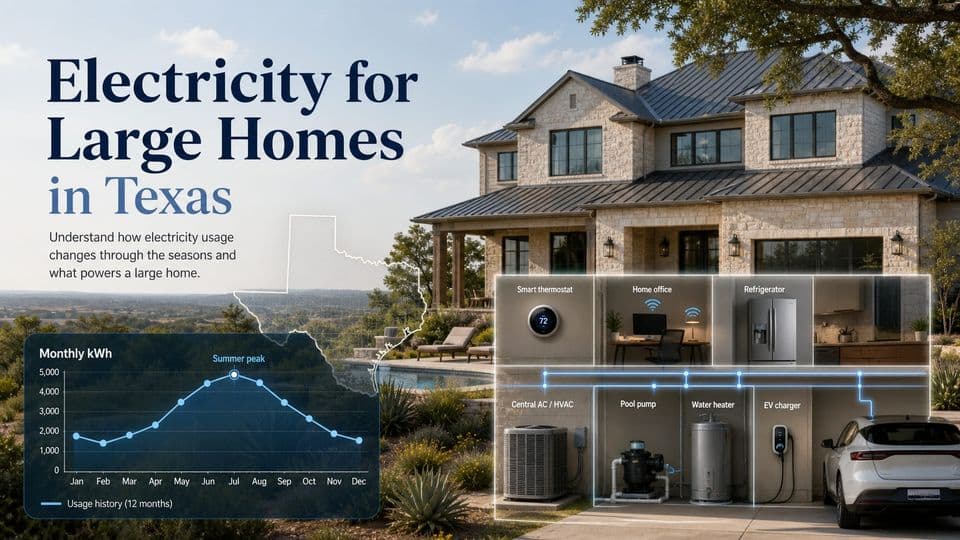
- 1Large-home electricity usage is best estimated in monthly kWh, not square footage alone.
- 2Main energy usage factors include climate/weather, home characteristics, equipment, efficiency, and household size.
- 3A home's own seasonal kWh history is more useful than a generic large-home estimate.
- 4A 2,000 kWh example is a reference point for context, not a monthly target for every large home.
Electricity for Large Homes in Texas
When you own or rent a large home in Texas, the monthly electric bill often becomes a bigger question. Square footage alone doesn't tell the full story. The number that matters most is monthly kilowatt-hours (kWh) - the actual electricity your household uses.
Large Homes Use More Electricity for More Than One Reason
A larger home usually means more space to heat, cool, and power. But the connection between square feet and kWh is not a straight line.
The U.S. Energy Information Administration (EIA) lists several factors that shape household energy use: climate, the home's construction and insulation, the number and efficiency of appliances and electronics, how often those devices run, and how many people live there.
In Texas, heating and cooling make up the largest chunk of residential electricity use. That means your monthly kWh can swing hard between a mild spring month and a scorching August.
A well-insulated large home with high-efficiency HVAC might use less electricity than an older, drafty small home. And a large home with a pool pump, home office, multiple refrigerators, and electric vehicle charging can push usage well above what you'd guess from the floor plan alone.
Edge cases matter too. A smaller home can still rack up high kWh if it has electric heat, an old air conditioner, or a family that runs electronics constantly. A larger home built with energy-efficient windows, LED lighting, and smart thermostats can come in lower than expected. The point is that home size is one variable, not the whole equation.
Home features that can raise monthly kWh
You can get a rough sense of what might drive usage by looking at high-draw features in your home. Central air conditioning, electric water heaters, electric ovens, clothes dryers, pool pumps, well pumps, and multiple refrigerators all add to the monthly total.
If you work from home or have teenagers, add more hours of computer and entertainment use. Texas summers mean the AC runs a lot, so the age and efficiency of your HVAC system matters.
Use Monthly kWh History Before Square-Footage Estimates
The most reliable way to estimate electricity use for a large home is to look at the home's own past billing history. If you already live there, dig up your last 12 months of electric bills. That gives you a seasonal pattern - summer peaks, winter dips, and shoulder months.
You can see exactly how your household's habits and the home's size translate into kWh.

If you are shopping for a new home or renting a place without past bills, you have a few imperfect options. Ask the seller or landlord for the previous year's usage history.
In Texas, electric bills are usually available from the current provider or the previous tenant. If that data isn't available, look at comparable homes in the same neighborhood with similar square footage, construction year, and number of occupants.
The EIA reports that the average U.S. residential electric customer bought about 899 kWh per month in 2022.
That number is useful as a national baseline, but it doesn't reflect Texas weather or the size of the home you are considering. A large Texas home can easily run above that average.
What to use when bills are not available
If you have no usage history and no comparable data, builder estimates or energy modeling tools can provide a ballpark figure.
Some home builders provide estimated annual energy costs based on the home's design and typical occupancy. Keep in mind these are best-case estimates and may not match real behavior.
A better approach is to plan your budget by assuming you'll land somewhere between the average and the peak usage you see in similar large homes in your area.
A 2,000 kWh Example Is a Reference Point, Not a Monthly Goal
You will see 2,000 kWh mentioned in Texas electricity plans, marketplace examples, and articles about high-usage homes. That number often appears because it sits above the typical residential average and represents a level where certain plan structures might apply. But it is not a rule that every large home needs to hit 2,000 kWh each month.
Your actual monthly usage could be higher or lower depending on the factors we already covered. A large home with moderate AC use, efficient appliances, and good insulation might land around 1,200-1,500 kWh in mild months.
The same home in July with the AC running nonstop and a pool pump going eight hours a day could easily top 2,500 kWh. The 2,000 kWh mark is just one data point on a wide range.
Why one usage point can miss the real pattern
Relying on a single usage level like 2,000 kWh ignores seasonal variation. In Texas, your air conditioner might run for six months straight, but the load changes with each month's temperatures. Even within the same house, monthly kWh can vary by 50% or more from winter to summer.
A one-size-fits-all reference point doesn't capture that reality. Use your own billing history or reasonable estimates for the specific home to get a more accurate picture.
Usage Credits Change the Math at the Threshold
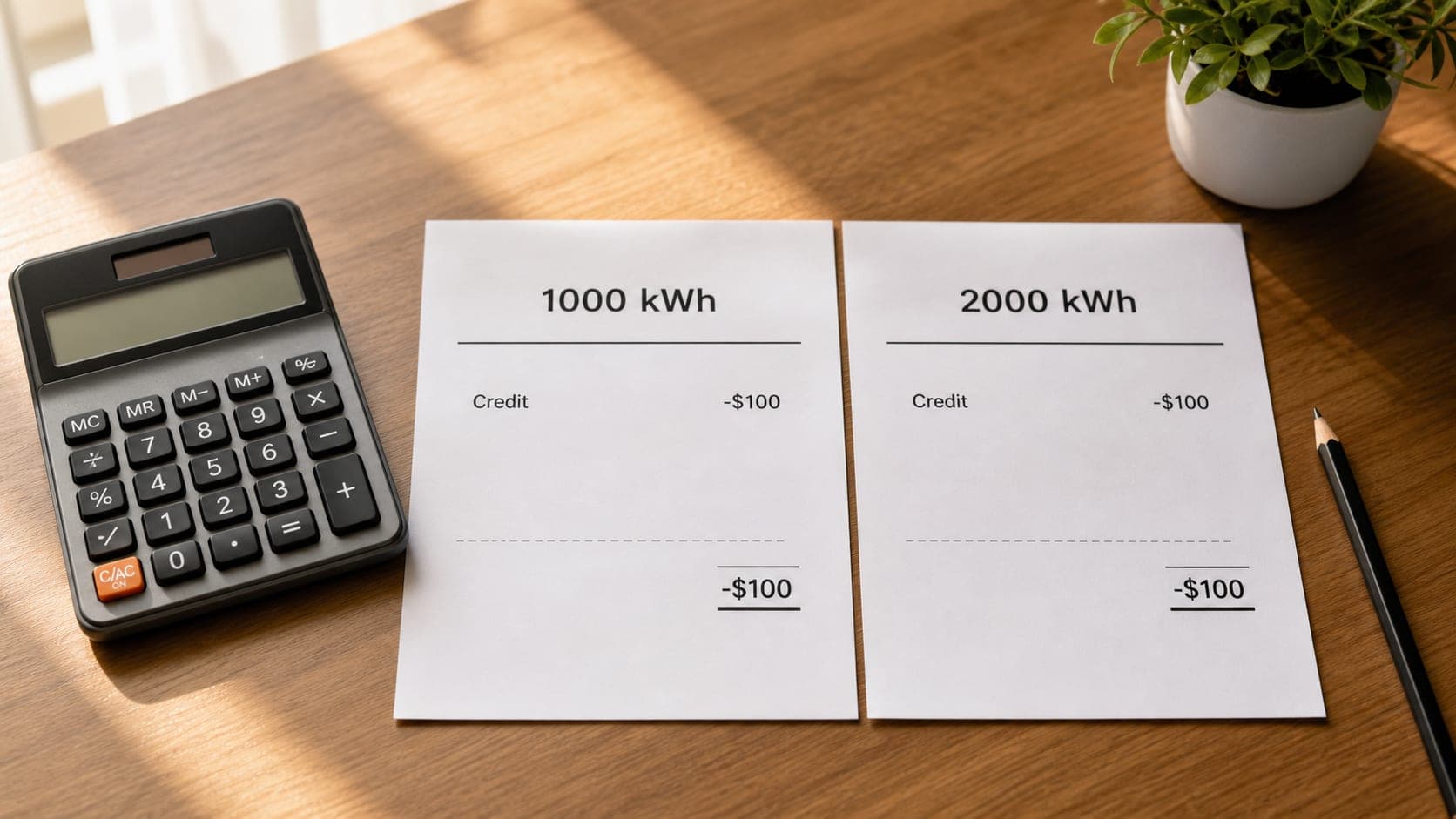
Some electricity plan examples include a usage credit that kicks in only when your monthly usage reaches a certain level. For instance, a plan might show a dollar credit applied if you use 2,000 kWh or more in a month. If you use less than the threshold, the credit does not apply, and the effective price per kWh changes.
The math is straightforward. A fixed dollar credit divided across the kWh you use. The higher your usage, the lower the cents-per-kWh effect of that credit. But if your usage varies month to month, the credit's impact fluctuates too.
In a month where you use 1,500 kWh and don't meet the threshold, you don't get the credit, and your effective rate is higher than in a month where you clear the threshold.
How a fixed credit changes per kWh
Imagine a plan with a $100 credit when you reach 2,000 kWh. If you use exactly 2,000 kWh, that credit knocks 5 cents per kWh off your bill.
If you use 2,500 kWh, the same $100 credit is worth only 4 cents per kWh.
If you use 1,900 kWh and miss the threshold, you get no credit at all. The same dollar amount matters less per kWh the more electricity you use, and it disappears entirely below the line.
Understanding this math helps you read examples clearly, but it is not a judgment on whether such a structure is good or bad for your situation.
Electricity for Large Homes FAQ
Editorial standards
SlashPlan publishes independent guidance to help Texans compare electricity plans. Our editorial team reviews each article without advertiser influence. See our editorial guidelines and monetization disclosure.
About the author
Roi CahanaEnergy advisor helping Texans better understand their electricity options and make more confident decisions. Focused on simplifying electricity plans, explaining confusing terms, and sharing practical guidance to help readers avoid common mistakes when comparing rates, contracts, and renewals.
Ready to compare plans?
Enter your ZIP code to see electricity plans available at your address.