Electricity Provider vs. Electric Utility in Texas
In competitive parts of Texas, the company that sells your electricity service is usually not the company that delivers power to your address. That difference affects who bills you, who restores outages, which charges appear on the bill, and what you can actually choose.
Key Takeaways
- 1A retail electric provider sells the electricity service and handles most customer account questions.
- 2An electric utility or TDU delivers power through local infrastructure and handles outages and delivery problems.
- 3In competitive Texas areas, customers can generally choose a provider, but the delivery utility is tied to the service area.
- 4Municipal utility and electric cooperative areas may not offer the same retail provider choice as competitive electric areas.
- 5A normal provider switch does not replace the local utility or the wires serving the property.
- 6One bill can reflect both retail supply service and local utility delivery service.
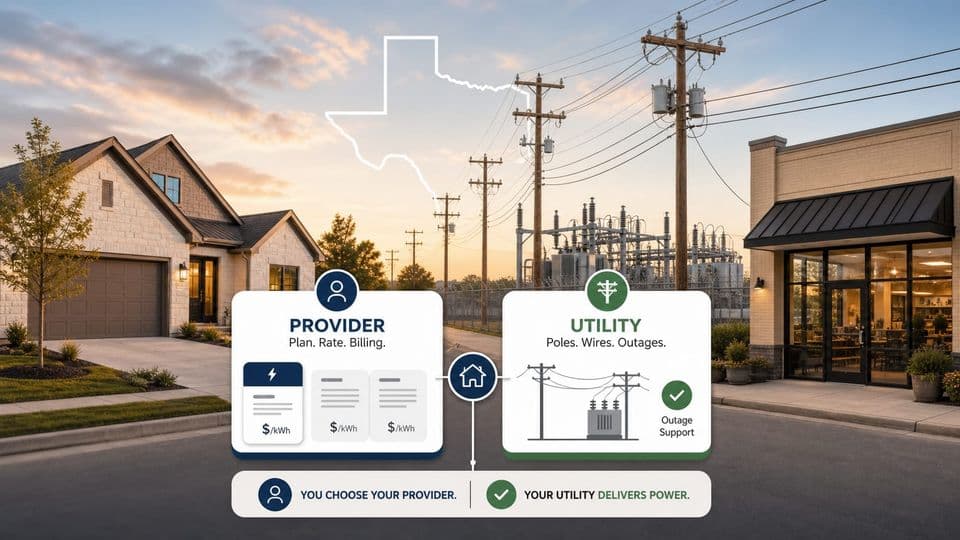
In Texas, the company that sends your electricity bill is usually not the company that restores your power during an outage. If you live in a competitive electric area, you choose a retail electric provider to supply your service, but a separate electric utility owns the poles and wires that deliver that power to your home or business. This split affects which company you call for specific problems, how your bill is structured, and what you can actually change when you shop for a new plan.
The Short Answer for Texas Customers
A retail electric provider sells the electricity plan and manages your account. This is the company you choose when you shop for service in a deregulated area. An electric utility, often called a Transmission and Distribution Utility (TDU) or Transmission, Distribution, and Retail Service Provider (TDSP), owns and maintains the physical infrastructure that delivers electricity to your address.
If you have a question about your bill, your plan's end date, or a payment arrangement, you usually start with your provider. If a tree falls on a power line or your neighborhood loses power, you need to contact your utility. In many parts of Texas, you will see both names on a single bill, but they perform two very different jobs.
Retail Electric Providers Sell the Plan
A retail electric provider (REP) is the company that markets, sells, and manages residential and commercial electricity plans. When you use a comparison tool to find a rate, you are looking at offers from different REPs. These companies handle the contractual side of your electric service.
Retail Service, Plan Terms, and Customer Account Support
Your provider is responsible for setting your energy rate, billing you for the electricity you use, and providing customer support for account-related issues. If you want to renew your contract, switch to a different plan, or dispute a charge related to your usage, the provider is your first point of contact.
REPs must be certified by the Public Utility Commission of Texas (PUCT) to operate in competitive areas. They do not own the power plants that generate the electricity, nor do they own the lines that carry it to your home. Instead, they purchase electricity from generators and sell it to you, the end-use consumer. Because the provider does not handle the physical delivery, they cannot fix a local line outage or inspect your meter hardware.
Electric Utilities Deliver the Power
The electric utility is the entity responsible for the "last mile" of electricity delivery. This includes the network of wires, poles, transformers, and substations that move power from the statewide grid to your light switch. In Texas, these companies are regulated monopolies, meaning you cannot choose which utility serves your address because it is determined by your physical location.
Poles, Wires, Meters, and Restoration Work
The utility's primary job is maintaining the physical grid. If you see a crew working on a power line in your neighborhood, they are almost certainly utility employees or contractors, not representatives from your retail provider. The utility is also responsible for installing and maintaining the electric meter that tracks your usage.
When the power goes out, the utility manages the restoration process. They use outage tracking systems to monitor which transformers are offline and dispatch repair crews. Because the utility owns the infrastructure, they are the only ones who can legally and safely perform repairs on the grid. Even if you have a "green energy" plan from a specific provider, the physical electrons are still delivered through the local utility's equipment.
REP, TDU, TDSP, and Utility: Plain-Language Terms
The Texas electricity market uses several acronyms that can be confusing for new residents. These terms generally refer to the same two roles: the seller and the deliverer.
- REP (Retail Electric Provider): The company you pay for the energy supply.
- TDU (Transmission and Distribution Utility): The company that owns the local wires and equipment.
- TDSP (Transmission, Distribution, and Retail Service Provider): This is often used interchangeably with TDU, though it technically includes some retail service functions for certain utilities.
- TDU Delivery Charges: The fees on your bill that go to the utility to cover the cost of maintaining the grid.
Understanding these terms helps you read your bill and identify the correct company when you have a service issue. If a document mentions "TDU charges," it is referring to the cost of delivery, not the cost of the electricity itself.
Customer Choice Depends on the Service Area
You can only choose your electricity provider if you live in a competitive area of Texas. Large cities like Houston, Dallas, Fort Worth, and much of Austin fall into this category. However, not every address in Texas has this option.
Competitive Areas Versus Non-Choice Areas
In competitive areas, the state government has deregulated the sale of electricity to encourage competition and lower prices. In these zones, you have the power to pick your REP. Your utility, however, remains the same regardless of which provider you choose.
If you live in an area that has not been deregulated, you typically have only one option for service. In these cases, a single company acts as both the provider and the utility. This is common in parts of Texas that are served by municipal utilities or electric cooperatives. Before you start shopping for a new plan, you should confirm that your address is located within a competitive service zone.
Municipal Utilities and Co-ops Can Work Differently
Some communities in Texas are served by municipally owned utilities (like Austin Energy or CPS Energy in San Antonio) or electric cooperatives. In these areas, the provider and the utility are often the same organization.
These entities are not subject to the same competitive market rules as the rest of the state. They do not offer a choice of retail electric providers because they handle both the sale of electricity and the delivery of it. If you live in one of these service areas, you will not see a separate TDU charge on your bill, and you cannot switch to a different retail provider.
Outages Go to the Local Utility
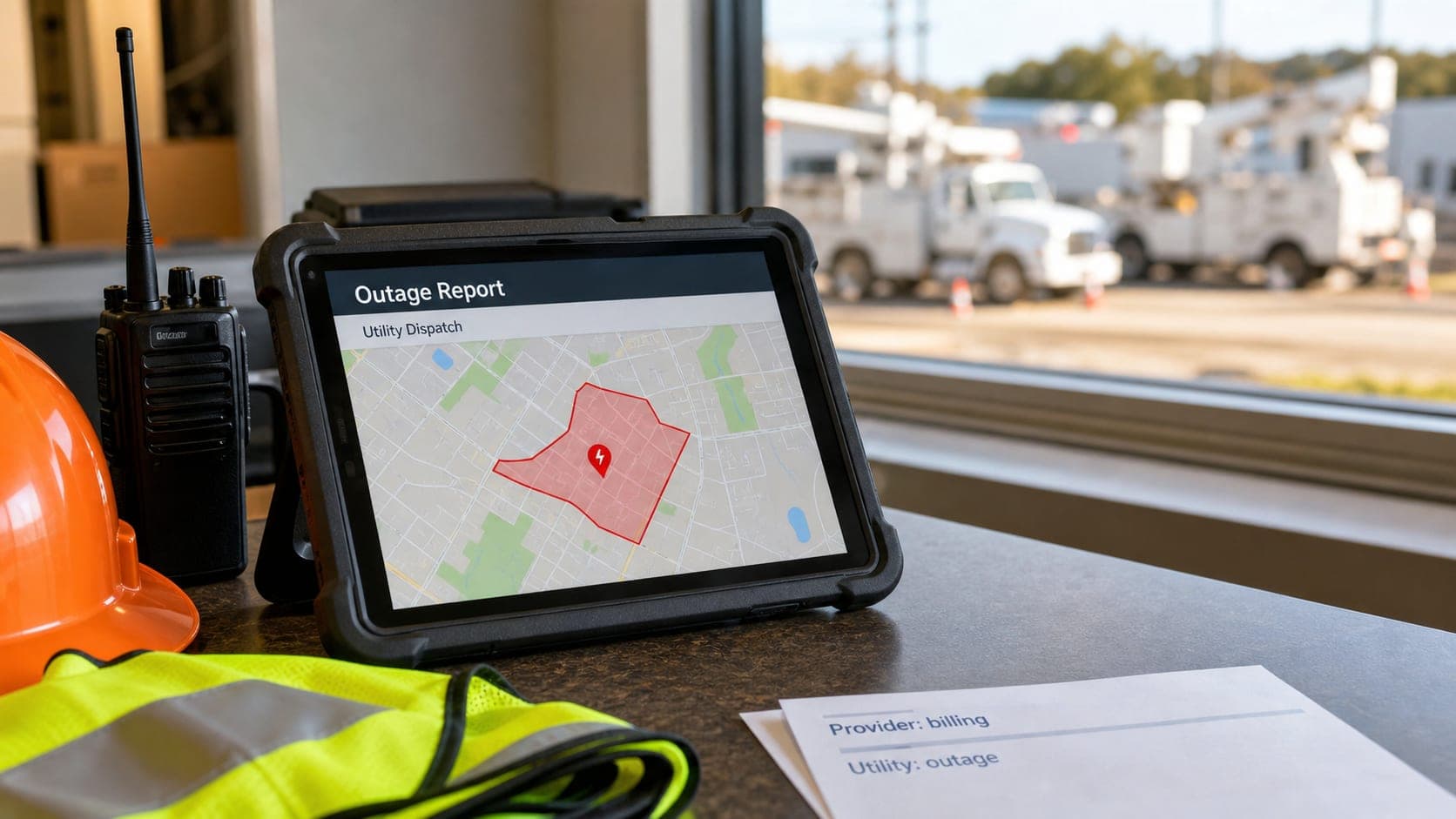
When the power goes out, your retail electric provider cannot help you restore it. The provider does not have access to the grid control systems or the physical work crews needed to fix downed lines. You must report outages directly to your utility.
Downed Lines, Emergencies, and Outage Trackers
If you see a downed power line or a sparking transformer, treat it as a life-threatening emergency. Call your utility's emergency line immediately. For non-emergency outages where the power is simply off, you can use the utility's online outage tracker or mobile app.
Each utility has its own system for reporting and tracking outages:
- Oncor: Serves the Dallas-Fort Worth area and others.
- CenterPoint Energy: Serves the Houston area.
- AEP Texas: Serves parts of West and South Texas.
- TNMP (Texas-New Mexico Power): Serves several specific communities across the state.
Your provider may have a link to your utility's outage page on their website, but the actual restoration work is entirely in the hands of the utility's field team.
Billing and Account Questions Usually Start with the Provider
Most of your day-to-day interactions regarding electricity will be with your retail electric provider. They are the ones who send the monthly statement, process your payments, and handle your personal information.
If you are having trouble paying your bill, want to change your autopay settings, or need a copy of your past bills, contact your provider. They also handle questions about your contract, such as whether you are on a fixed-rate or variable-rate plan.
If you have a dispute that your provider cannot or will not resolve, you can file a complaint with the PUCT. This is a last resort for unresolved issues, but it is an important protection for Texas electricity customers.
Delivery Charges Are Not the Same as Supply Charges
One of the most confusing parts of a Texas electricity bill is seeing charges from two different companies. Your bill includes "Supply Charges" (from your provider) and "Delivery Charges" (from your utility).
Supply Charges and Delivery Charges on One Bill
The supply charge is the part of your bill that pays for the actual electricity you used. This is the rate you agreed to when you signed up with your provider. The delivery charge, however, is a pass-through fee that your provider collects on behalf of the utility.
The utility sets these delivery rates, and they are approved by the PUCT. Your provider does not make a profit on these charges, nor can they lower them if you choose a cheaper plan. Every customer in a specific utility's service area pays the same TDU delivery rates, regardless of which retail provider they use. These charges cover the cost of maintaining the wires, reading your meter, and responding to outages.
Switching Providers Does Not Replace the Utility
Many people worry that if they switch their electricity provider, they might experience a service interruption or their power quality will change. In reality, the physical delivery of electricity remains exactly the same.
When you switch providers, you are only changing the company that sends you a bill and the company that buys the electricity on your behalf. The same utility trucks will still fix the lines in your neighborhood, and the same meter will still track your usage. The "switch" happens electronically at the meter level and usually does not require a service visit.
Common Texas Utility Names Shoppers May See
If you look at your electricity bill or your utility's website, you will likely see one of four major names. These are the investor-owned utilities that serve most of the competitive areas in Texas.
- Oncor Electric Delivery: The largest utility in Texas, serving North Texas.
- CenterPoint Energy: Serves the Houston metropolitan area.
- AEP Texas: Divided into North and South zones, serving various parts of the state.
- TNMP: Serves smaller, specific communities.
These companies are responsible for the reliability of your local grid. While your retail provider might offer "100% green energy," the physical infrastructure delivering that energy is owned by one of these utilities. You can find the name of your utility by looking at the "Delivery Charges" section of your bill or by checking a map of Texas utility service territories.
Commercial Accounts Follow the Same Role Split
The split between provider and utility also applies to businesses. A commercial property in a competitive area can choose its retail electric provider just like a residential customer can. However, the utility relationship remains tied to the building's location.
Business owners should be aware that while they can shop for better supply rates, they cannot negotiate lower delivery charges with the utility. Those rates are set by regulation. For large industrial customers, the utility may offer different rate classes, but the fundamental role of the utility as the grid operator remains constant.
How to Verify a Provider or Utility Claim
Because the Texas market is competitive, you may receive calls or mailers from companies claiming to be your provider or offering "special" utility rates. It is important to verify these claims using official sources.
Official Documents to Check Before Relying on a Claim
To confirm who your provider is, check your most recent electricity bill or log into your account portal. To confirm your utility, look at the delivery charges section of your bill or visit the PUCT website to look up your service address.
If a salesperson claims they are from the "utility company" and want to change your plan, be skeptical. Utilities do not sell electricity plans in competitive areas; they only deliver it. Always use the official Power to Choose website or a trusted comparison site to verify that a company is a legitimate, PUCT-certified retail electric provider.
Mistakes That Lead to the Wrong Call
The most common mistake Texas customers make is calling their provider about a downed power line. This wastes valuable time during an emergency. Conversely, calling the utility to ask about a high bill caused by a rate increase will only result in the utility directing you back to your provider.
Another frequent error is assuming that all delivery charges can be negotiated. Since these charges are set by the utility and passed through by the provider, they are the same for every provider. If a provider claims they can "eliminate" delivery charges, they are being misleading. The only way to change your delivery charges is if the utility changes its regulated rates or if you move to a different utility's service area.
Provider and Utility FAQs
Related Texas electricity guides
Sources & References
Editorial standards
SlashPlan publishes independent guidance to help Texans compare electricity plans. Our editorial team reviews each article without advertiser influence. See our editorial guidelines and monetization disclosure.
About the author
Roi CahanaEnergy advisor helping Texans better understand their electricity options and make more confident decisions. Focused on simplifying electricity plans, explaining confusing terms, and sharing practical guidance to help readers avoid common mistakes when comparing rates, contracts, and renewals.
Ready to compare plans?
Enter your ZIP code to see electricity plans available at your address.