Advertised Electricity Rates Explained for Texas Shoppers
A Texas electricity plan can look cheap until delivery charges, usage tiers, bill credits, or monthly fees change the actual bill. This guide explains how to read advertised rates before choosing a plan.
Key Takeaways
- 1Advertised electricity rates are sample prices at set usage levels, not a guarantee of what your monthly bill will be.
- 2In Texas, the Electricity Facts Label is the main document to check for energy charges, delivery charges, bill credits, fees, and contract terms.
- 3The 1,000 kWh rate can be misleading if your household usually uses much less or much more than 1,000 kWh.
- 4Bill credits, minimum-use fees, tiers, and base charges can change your effective rate when usage moves.
- 5A fixed-rate plan can make the energy charge more predictable, but it usually does not freeze every part of the bill.
- 6The best comparison uses your real usage history across high, low, and typical months.
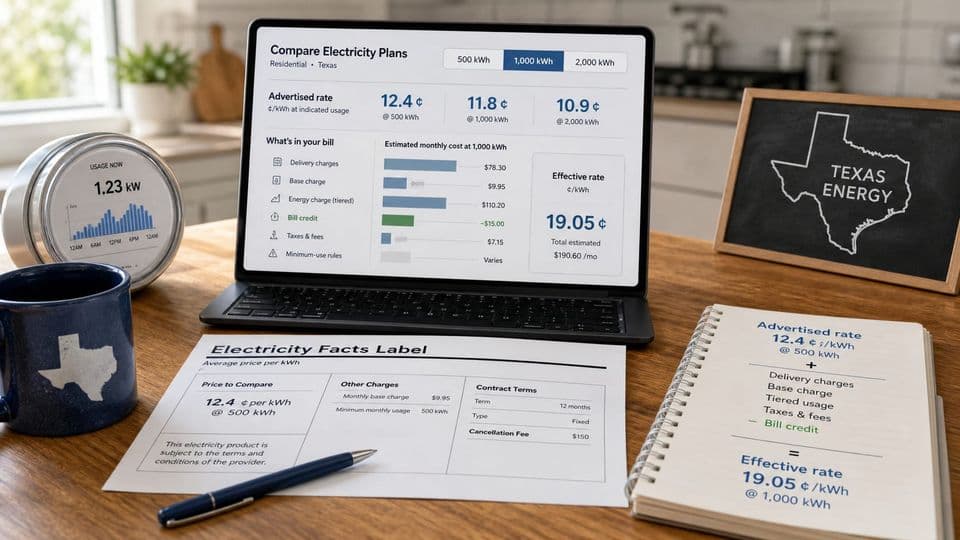
A Texas electricity plan can look cheap until delivery charges, usage tiers, bill credits, or monthly fees change the actual bill. Advertised electricity rates explained starts with recognizing that the promoted number is only a sample price at one usage level, not a fixed bill amount.
Advertised rates are sample prices, not a bill promise
Retail electric plans in Texas list a rate tied to a set monthly usage amount. That number comes from the plan's pricing at one specific kWh point and does not guarantee the same total on every bill.
A quick definition for Texas shoppers
The cents-per-kWh figure shown in search results or ads represents the energy charge at the listed usage. Actual charges also include delivery fees set by the local utility, any base charges, taxes, and applicable credits or penalties.
Where the 500, 1,000, and 2,000 kWh numbers come from
Texas plan listings and Electricity Facts Labels commonly show prices at 500 kWh, 1,000 kWh, and 2,000 kWh. These levels provide standard comparison points across providers.
How sample usage levels are displayed
Shoppers can locate their own recent monthly use and match it to the closest sample. Checking the other listed amounts still helps when usage shifts month to month.
Why the 1,000 kWh rate can mislead Texas shoppers
Many households use more or less than exactly 1,000 kWh in a typical month. A plan that ranks well at one advertised point can produce a higher effective rate at real usage levels.
The 999 and 1,001 kWh problem
Small changes around the advertised usage point can move a bill into a different pricing tier or away from a bill credit.
Why exact usage points matter
A household that averages 750 kWh or 1,300 kWh needs to review the plan's full pricing at those amounts, not just the 1,000 kWh column.
The bill math behind an advertised rate
The energy charge listed on the ad is only one part of the monthly total. Delivery charges, base charges, and credits alter the final amount paid.
Effective rate versus energy charge
Effective rate equals the full bill divided by actual kWh used. Tracking every component on the Electricity Facts Label shows the difference between the advertised line item and the amount due.
The documents to open before picking a plan
Review the Electricity Facts Label first. It lists the energy charge at each sample usage level along with delivery charges, recurring fees, contract length, and early termination rules. A plain-language guide to reading an Electricity Facts Label in Texas can help separate the advertised price from the full billing formula.
Electricity Facts Label
Open this document to see how the provider calculates the bill at the household's expected usage range.
Terms of Service
Confirm the exact early termination fee and any move-out exceptions listed in this document.
Your Rights as a Customer
Check this disclosure for required consumer protections and how the provider handles billing disputes.
Energy charges and delivery charges are different
The retail energy charge covers the electricity the provider supplies. Delivery charges cover the poles, wires, and local utility service that move power to the meter.
Retail energy charges
A fixed-rate plan can lock this portion for the contract term.
TDU delivery charges
These regulated amounts appear separately and can increase or decrease even while the energy rate stays fixed.
Base charges can make low-usage months expensive
A fixed monthly base charge spreads across fewer kWh when usage drops. Apartments or homes with mild usage often see a higher effective rate as a result.
Check the Electricity Facts Label for the base charge amount before comparing only the cents-per-kWh line.
Bill credits can create pricing cliffs
Some plans reduce the bill only when usage meets or exceeds a stated threshold. Missing the threshold removes the credit and raises the final amount due that month.
Effective rate after the credit
Calculate the bill both with and without the credit at the household's usual usage levels.
Minimum-use fees can punish conservation
Plans with a minimum-use rule add a fee or higher rate when consumption falls below a set level. Efficient homes or apartments can face unexpected charges even when usage drops.
Read the Electricity Facts Label for minimum-use language before enrolling.
Tiered rates change the effective price as usage moves
Some plans assign different prices to blocks of kWh. The first block may cost less while later blocks cost more, or the reverse.
Usage tiers on an EFL
Compare the plan at several monthly usage amounts to see where the household typically lands on the tier ladder.
Free nights and weekends need time-of-use behavior
Plans that offer free hours require the household to shift most use into those windows. Higher prices during the remaining hours can offset the savings if the schedule does not match daily routines.
Free-hour rules
Confirm which hours count as discounted and whether the benefit resets monthly.
Peak-hour tradeoffs
Test the plan against actual appliance and air-conditioning patterns before signing up.
Variable rates can change after the first bill
A variable-rate plan can adjust with wholesale market conditions. The advertised price at signup does not lock in place for the full term.
Market-linked price changes
Ask the provider how often and under what conditions the rate can increase.
Fixed rates still have moving parts
A fixed-rate plan usually holds the energy charge steady for the contract length. Delivery charges, taxes, and any usage-sensitive fees can still change the total bill. The tradeoff between fixed and variable electricity plans matters most when deciding how much bill movement a household can tolerate.
What a fixed rate usually locks
Only the energy charge portion stays fixed in most cases.
Early termination fees and move-out exceptions
Canceling a fixed-rate contract before the end date often triggers a fee. Providers are required to waive the fee when the customer moves outside the provider's service area.
Read the exact fee amount and conditions in the plan documents before enrolling.
Texas usage swings by season
Summer air conditioning can push monthly use well above spring or fall levels for the same home. A plan priced around 1,000 kWh year-round may perform differently during peak cooling months.
Summer cooling months
Compare the plan against the highest bills from recent summers.
Milder shoulder months
Review pricing at lower usage levels that occur in spring and fall.
ZIP code and utility territory change available rates
Plan offers and delivery charges depend on the local utility service area. Not every address has access to the same retail providers.
Service area differences
Enter the exact ZIP code during comparison to see only the options available at that location.
How to pull your usage history before shopping
Twelve months of data gives a clearer picture than a single bill. Start with the current provider's online portal or recent statements.
Provider portal data
Download monthly kWh totals directly from the account dashboard when available.
Smart Meter Texas and utility data
Check Smart Meter Texas or the local transmission and distribution utility site for additional usage records.
A simple way to estimate annual cost
Apply each month's actual kWh to the Electricity Facts Label pricing rules. Add the results across a full year rather than relying on one sample month.
Use 12 months, not one bill
Annual comparison reduces the chance that a single high or low month distorts the decision.
How apartments, small homes, and large homes should compare plans
Apartments often need to watch base charges and minimum-use rules. Larger homes benefit from testing high summer usage against bill-credit thresholds. Efficient homes may see little advantage from plans built around higher average consumption.
When a flat-looking rate is safer
Plans with fewer tiers, credits, or time restrictions reduce the chance of unexpected changes when usage varies. Safer structures do not always produce the lowest total cost.
When a low advertised rate might still work
A promoted rate can suit a household if its pricing rules align with normal usage patterns and any required credit or time-of-use conditions are easy to meet. The same plan may not fit a neighbor with different consumption.
Summer demand raises the stakes
Higher temperatures increase both household use and grid demand. Plans that look attractive at moderate usage can shift into higher tiers or lose credits during sustained heat waves.
High-usage months as a stress test
Run the household's largest recent summer bills through the Electricity Facts Label before enrolling.
Fuel and wholesale market costs sit in the background
Fuel prices affect generation costs that eventually reach retail plans. Natural gas remains a major input in the Texas market and can influence variable-rate movement.
Fuel costs and retail plan prices
Variable-rate offers react more quickly to these cost swings than fixed-rate contracts.
Power plant and grid costs feed into the price
Generation resources carry construction, operating, and maintenance expenses. Transmission and distribution systems also require ongoing investment that appears in delivery charges.
What clearer bill layouts can and cannot tell you
An easier-to-read bill shows how current charges break down. It does not predict how a different plan would perform at next month's usage level.
Bill clarity is not plan comparison
Use the bill to identify current charges, then compare new plans with the Electricity Facts Label.
How to read your current bill for plan clues
Note the rate name listed on the bill. Check whether charges stay consistent across all kWh or vary by time period. Confirm recurring base charges and average monthly usage. A guide to reading your electricity bill in Texas can help identify the charges that matter before comparing replacement plans.
How to spot a time-varying rate
Time-of-use or critical-peak plans change the price by hour, day, or grid event. Savings depend on shifting usage into lower-price windows.
Time-of-use windows
Verify the exact peak and off-peak hours listed on the Electricity Facts Label.
Critical peak and rebate structures
Confirm whether event pricing or rebates apply on top of regular time-of-use rules.
What to check on renewal offers
Compare the renewal Electricity Facts Label against current marketplace options for the same address. Verify any changes to term length, base charges, or credit rules before accepting.
Questions to ask before enrollment
Ask how the plan prices at the household's low, typical, and high monthly usage. Confirm whether any credit, minimum-use, tier, or time-of-use rule affects the advertised rate. Verify the early termination fee and conditions.
Usage questions
Request estimated totals at three different monthly kWh levels that match the home's actual history.
Fee and contract questions
Read the exact early termination fee and move-out exception language in the plan documents.
The final shopping check before you choose
Use the advertised rate as an initial clue, then verify the full formula on the Electricity Facts Label. Compare total estimated cost across a full year of real usage months. Select the plan whose complete rules align with the home rather than the single most attractive usage-point number.
Advertised electricity rates FAQ
Topics
Editorial standards
SlashPlan publishes independent guidance to help Texans compare electricity plans. Our editorial team reviews each article without advertiser influence. See our editorial guidelines and monetization disclosure.
About the author
Roi CahanaEnergy advisor helping Texans better understand their electricity options and make more confident decisions. Focused on simplifying electricity plans, explaining confusing terms, and sharing practical guidance to help readers avoid common mistakes when comparing rates, contracts, and renewals.
Ready to compare plans?
Enter your ZIP code to see electricity plans available at your address.