Bill Credit Electricity Plans in Texas
A practical guide to usage credits, breakpoints, and when advertised rates can mislead Texas shoppers.
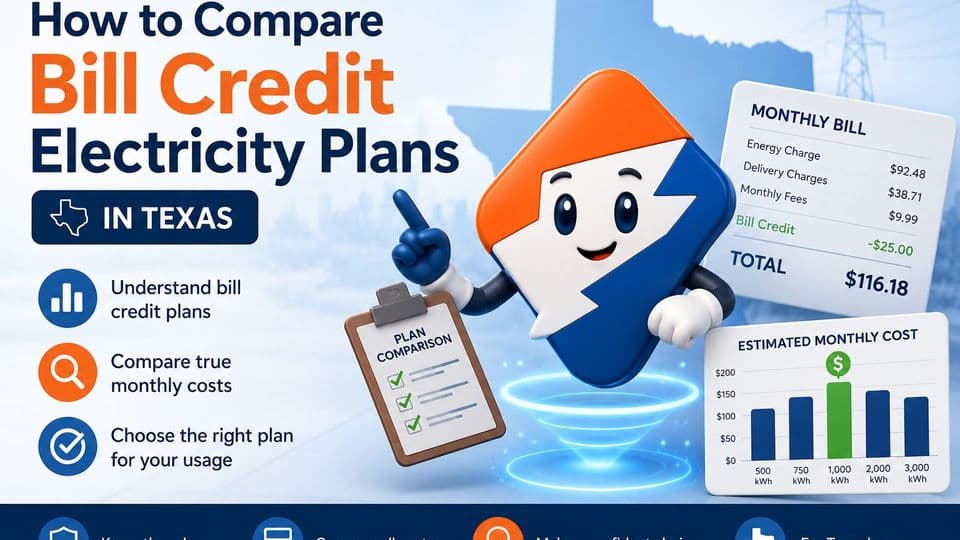
Key Takeaways
- 1Bill credits are discounts that usually apply only when usage meets a stated condition.
- 2A plan can be attractive at 1,000 kWh and still be expensive at 750 or 3,000 kWh.
- 3Compare estimated monthly bills across multiple usage levels before enrolling.
- 4Always read the Electricity Facts Label, Terms of Service, and Your Rights as a Customer documents.
How to Compare Bill Credit Electricity Plans in Texas
Bill credit electricity plans can be useful, but they are also one of the easiest plan types to misunderstand. The advertised average rate often assumes a specific usage point. If your home lands below or above that point, the credit may shrink, disappear, or stop offsetting other charges.
The safest way to compare a bill credit plan is to model the whole estimated monthly bill, not just the displayed cents-per-kWh number. That means looking at the energy charge, recurring fees, delivery charges, and the exact usage rule that earns or loses the credit. This page belongs with the broader Texas electricity plans guidance because it explains a plan structure, not just one provider offer.
What a bill credit usually means
A bill credit is a discount that appears when the account meets the plan's stated condition. In Texas electricity plans, that condition is commonly tied to usage in a billing cycle.
For example, a plan may offer a credit when usage reaches a threshold such as 1,000 kWh. Another plan may apply a credit only within a usage band. The exact rule is plan-specific, so the Electricity Facts Label and Terms of Service matter.
Some credits are simple. Others interact with base charges, energy charges, minimum usage language, or delivery charges. A shopper should never assume that a credit lowers every bill by the same amount.
Why advertised rates can be misleading
Many shoppers compare the sample average prices at 500, 1,000, and 2,000 kWh. Those examples are useful, but they can hide what happens between.
That is why SlashPlan compares monthly costs at a range of usage levels when evaluating plans. These checks help reveal plans that are narrowly optimized around the standard benchmarks.
A plan can look inexpensive at exactly 1,000 kWh and look very different at 925 or 1,125 kWh. The problem is not that bill credits are automatically bad. The problem is that the plan has to fit the way the home actually uses electricity.
What to compare before enrolling
Start with your real usage history if you have it. Look at the last twelve months and note how often you fall below 1,000 kWh, around 1,000 kWh, above 2,000 kWh, or near seasonal highs. If your bills swing widely, compare the plan across every important usage level before enrolling.
Then compare each plan at several usage levels. Include the energy charge, recurring monthly fees, TDSP delivery charges, and the bill credit rule. If a credit only applies at one threshold, make sure the comparison shows the bill just below and just above that threshold.
When a bill credit plan can fit
A bill credit plan can make sense when your usage is predictable and usually lands inside the credit range. It may also fit homes with stable occupancy, stable HVAC patterns, and no expected additions such as an EV, pool, or major appliance.
The plan is riskier when usage changes month to month. A renter moving into a new home, a household adding an EV, or a home with large seasonal swings should compare more carefully. Bill smoothing tools such as average billing can reduce payment swings, but they do not fix a plan that is mispriced for the home's usage.
Documents to check
Before enrolling, review the Electricity Facts Label, Terms of Service, and Your Rights as a Customer disclosure. The EFL should show the pricing components and the average price examples. The Terms of Service should explain contract rules, fees, and other conditions.
If the bill credit rule is unclear, ask the provider how the credit is applied, whether taxes or delivery charges affect the calculation, and what happens if usage misses the threshold by a small amount.
A practical rule
Choose a bill credit plan only if it still looks competitive when your usage is lower and higher than the advertised sweet spot. If the savings depend on hitting one narrow target every month, treat the plan as a fit question, not a simple low-rate plan.
Check the plan against your usage
Bill credit plan FAQs
Editorial standards
SlashPlan publishes independent guidance to help Texans compare electricity plans. Our editorial team reviews each article without advertiser influence. See our editorial guidelines and monetization disclosure.
About the author
Roi CahanaEnergy advisor helping Texans better understand their electricity options and make more confident decisions. Focused on simplifying electricity plans, explaining confusing terms, and sharing practical guidance to help readers avoid common mistakes when comparing rates, contracts, and renewals.