What Is an Energy Broker Under Texas Rules?
Texas rules define an energy broker by the brokerage services a person provides. This guide explains the official definition, registration triggers, application timing, expiration rules, and common role mix-ups without turning the topic into electricity shopping advice.
Key Takeaways
- 1Texas rules define a broker as a person that provides brokerage services.
- 2Brokerage services include advice or procurement services to, or acting on behalf of, a retail electric customer regarding the selection of a REP or a REP product or service.
- 3A person must be registered with the commission before providing compensated brokerage services in Texas, including online brokerage services.
- 4A retail electric provider is not permitted to register as a broker under the Texas broker registration rule.
- 5Broker registration has official timing rules for application review, deficiency cure periods, updates, amendments, expiration, and enforcement action.
Texas rules treat an energy broker as a defined market role rather than a vague industry label. The Public Utility Commission of Texas oversees that role through a specific registration process tied to certain activities performed for retail electric customers.
Texas definition of an energy broker
The controlling source is 16 TAC Section 25.112. Under that rule, a broker is simply a person that provides brokerage services. The definition focuses on the activity rather than on job titles, marketing claims, or business models.
Brokerage services in plain language
The rule describes brokerage services as providing advice or procurement services to, or acting on behalf of, a retail electric customer regarding the selection of a retail electric provider or a provider's product or service. The focus stays on the interaction with the customer and the specific type of assistance offered.
Advice, procurement, and acting for a customer
The activity can take several forms. It includes giving recommendations about which provider or plan meets a customer's needs. It also includes handling paperwork or negotiations on the customer's behalf. The rule centers on the service being provided to the retail customer.
Role boundaries in the Texas electricity market
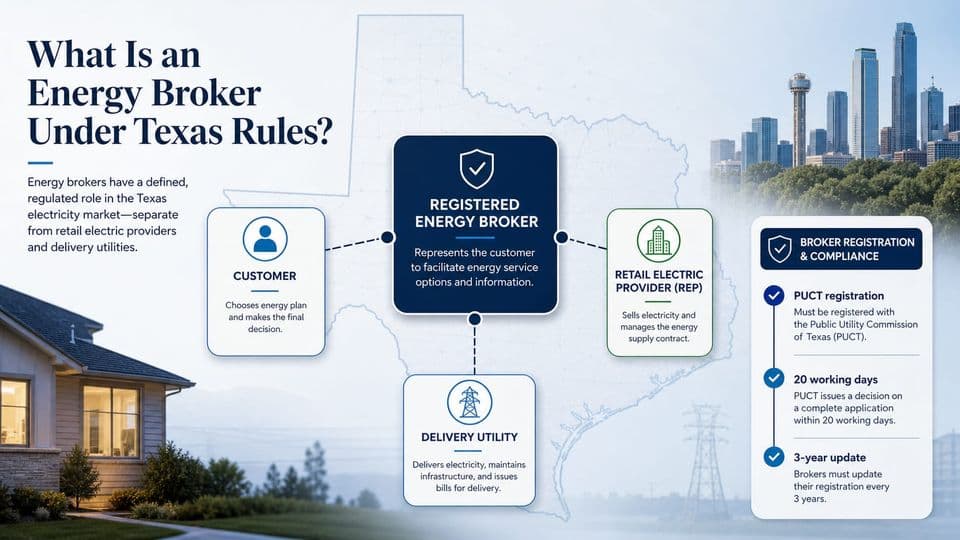
A broker occupies one position in the market structure. Other roles include the customer, the retail electric provider that sells electric service, and the delivery utility that owns the wires and poles.
Customer, broker, REP, and delivery utility roles
These positions remain distinct under the rule. A broker does not sell electricity itself. A delivery utility does not register as a broker. The separation keeps each entity responsible for its own part of the transaction.

Registration requirement for compensated brokerage services
A person must not provide brokerage services in Texas for compensation or other consideration unless registered with the commission as a broker. The requirement attaches to the compensated activity rather than to casual conversations or general information sharing.
Compensation or other consideration
The rule uses the phrase "compensation or other consideration." This language covers payment arrangements that may not look like a traditional fee. Once the service meets the definition and involves consideration, registration becomes mandatory.
Online brokerage services under the rule
The registration requirement applies when brokerage services are offered online and provided in Texas for compensation or other consideration. The same standard used for in-person services applies to digital channels.
The rule does not treat every website that discusses electricity topics as a brokerage service. The activity must meet the specific criteria in the definition before registration is required.
Information a broker registration must identify
The registration form collects business names, principal business contact information, commission contact information, customer service contact information, complaint contact information, the form of the business, and an affidavit signed by an owner, partner, or officer.
This information creates identifiable points of contact for customers and for the commission. Registration therefore links the broker role to traceable channels for questions and complaints.
Application review, deficiencies, and acceptance timing
Commission staff review each submitted form for completeness. They notify the applicant of any deficiencies within 20 working days of receipt.
Completeness review and cure periods
The applicant then has ten working days from the notice to correct the deficiencies. Once the application is complete, staff decide whether to accept or reject it within 60 days of receipt.
Registration updates, amendments, and expiration
Broker registration carries ongoing timing duties. Unless updated, a registration expires three years after the broker registration number is assigned or after the most recent update.
Three-year expiration and 90-day updates
A registrant must submit updated information no less than 90 days before the current registration expires. In addition, a broker must amend its registration within 30 calendar days when certain previously submitted information changes.

Conduct that can trigger penalties or registration action
The commission may impose administrative penalties for violations of the Public Utility Regulatory Act or commission rules. It may also suspend or revoke a broker registration for significant violations.
The rule lists examples of conduct that can lead to enforcement action: false or misleading information, fraudulent or deceptive practices, failure to respond to commission inquiries or customer complaints, unauthorized switching, and unauthorized charges.
How broker, consultant, and supplier labels differ
Brokers are often presented as handling procurement or customer representation, while consultants are described as concentrating on usage audits or efficiency recommendations.
These distinctions appear in industry writing but are not part of the Texas legal definition of a broker. The rule itself controls what counts as brokerage services regardless of the label used in marketing materials. A retail electric provider remains separate from the broker role under the same rule.
Energy Broker FAQs
Editorial standards
SlashPlan publishes independent guidance to help Texans compare electricity plans. Our editorial team reviews each article without advertiser influence. See our editorial guidelines and monetization disclosure.
About the author
Roi CahanaEnergy advisor helping Texans better understand their electricity options and make more confident decisions. Focused on simplifying electricity plans, explaining confusing terms, and sharing practical guidance to help readers avoid common mistakes when comparing rates, contracts, and renewals.
Ready to compare plans?
Enter your ZIP code to see electricity plans available at your address.