Usage-Based Electricity Pricing Explained
Usage-based electricity pricing ties at least part of an electricity cost to how much power is used, and some structures also account for when that use happens.
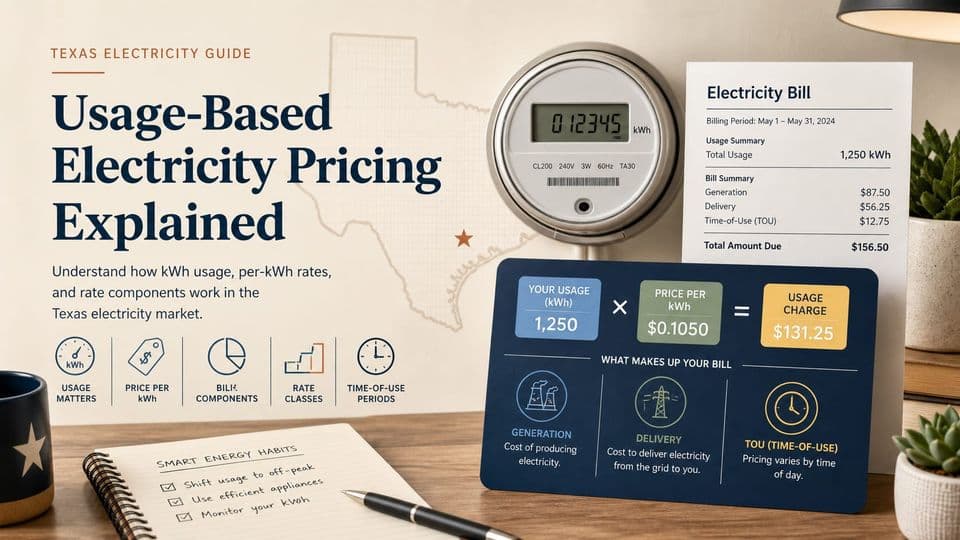
Key Takeaways
- 1Usage-based electricity pricing ties at least part of the cost to how many kilowatt-hours are used.
- 2A per-kWh figure may describe one part of electric service, not the full bill.
- 3Rate classes and tariffs can change which usage price applies.
- 4Time-of-use pricing adds timing to the calculation, so both kWh and the clock can matter.
Most electricity bills are not a single flat fee. Instead, they are built on a mix of fixed charges and charges that change based on how much power a home or business actually uses. This approach is called usage-based electricity pricing. At its core, it means that at least part of the cost you pay is tied to the number of kilowatt-hours (kWh) you consume over a billing cycle.
For Texas electricity shoppers, understanding how these charges work is the first step toward reading a bill or a plan document with confidence.
Whether you are looking at a basic flat rate or a more complex time-of-use structure, the common thread is that the "usage" part of the bill responds to your actions. This guide explains the mechanics of these pricing models, how to interpret per-kWh figures, and why the specific details of a tariff or rate class matter so much.
What usage-based electricity pricing means
Usage-based pricing is a broad term for any electric rate structure where the total cost is not the same every month regardless of consumption. If a utility or provider charges you for the electricity you use by multiplying your kWh by a specific rate, you are looking at usage-based pricing.
This is the most common way electricity is sold. Even in "flat rate" plans, the price per unit of energy usually stays the same, but the total dollar amount changes because the amount of energy used changes.
kWh as the basic billing unit
To understand usage-based pricing, you have to start with the kilowatt-hour. A kWh is the standard unit of measurement for electricity use. If you turn on a 1,000-watt (1 kilowatt) space heater for one hour, you have used one kWh of electricity. Because usage-based pricing is built around this unit, any change in your monthly consumption will change that portion of your bill.
How kWh becomes a measurable charge
In a typical usage-based model, the math is straightforward: the utility or provider establishes a price for each unit of electricity, and that price is applied to your total measured usage. This is often referred to as per kWh electricity pricing.
For example, if a pricing document shows a rate of 10 cents per kWh and you use 1,000 kWh in a month, the usage-based portion of that charge would be $100. However, this simple multiplication only tells part of the story. The final bill usually includes other components, such as delivery charges or fixed monthly fees, which may not be included in that initial per-kWh figure.
It is important to look at where that per-kWh number comes from. In some markets, it represents the total cost of service. In others, it represents only the "generation" or "supply" portion of the bill, while the "delivery" or "transmission" portion is calculated using different rules or separate tariffs.
Why one per-kWh figure may not equal the whole bill
One of the most common points of confusion for electricity users is seeing a "price to compare" or a per-kWh benchmark and assuming it represents the final bill. In many regulated and deregulated markets, a per-kWh figure may only apply to one specific part of the electric service.
Generation-only examples from Price to Compare
To see how this works, look at how some states present a "Price to Compare." For instance, in New Jersey, the "Price to Compare" is a per-kWh benchmark that specifically reflects the generation portion of the electric service. It does not include the costs of delivering that electricity over the local utility's wires, nor does it include various taxes or state-mandated surcharges.
When you are reading any electricity pricing document, you should always ask: "What does this number actually cover?" If it only covers the energy supply, you must add the utility's delivery charges to get a true picture of the total cost.
Failing to make this distinction can lead to inaccurate budgeting and unrealistic expectations about what a plan actually costs.
Tariffs, rate classes, and service categories
Electricity pricing is not random. It is governed by formal documents called tariffs. A tariff is essentially the rulebook for how a utility or provider charges its customers. Within these tariffs, you will find different rate classes.
A rate class is a category of customer. Common classes include residential, commercial, and industrial. Each class has its own set of rules, pricing structures, and fees. Your electricity rate class determines which specific rows of the tariff apply to you.
Rate class labels and source limits
The rate class you fall into can completely change how usage-based pricing applies to your account.
For example, a commercial rate class might have a demand charge based on the highest amount of power used at any single moment, whereas a residential class might only charge for total monthly kWh.
Because these definitions are source-specific, a commercial rate in one city might look very different from a commercial rate in another.
When researching utility rate structures, always confirm that the data you are looking at applies to your specific customer class and geographic area.
Flat, tiered, and block-based pricing
While all these models are usage-based, they calculate the final bill in different ways. Understanding these variations helps you see why two bills with the same total kWh can look very different.
Flat per-kWh pricing
This is the simplest form of usage-based pricing. One price applies to every kilowatt-hour you use. If the rate is 12 cents per kWh, you pay 12 cents for the first kWh, the 500th kWh, and the 1,000th kWh.
It is easy to calculate and easy to predict, provided you can estimate your total monthly usage.
Tiers and blocks in tariff databases
Some utility rate structures use tiers or blocks. In these models, the price per kWh changes as you use more electricity.
- Block pricing: The first 500 kWh might be charged at one rate (Block 1), and any usage above 500 kWh might be charged at a different rate (Block 2).
- Inclining block rates: This is a specific type of tiered pricing where the price per kWh actually increases as you use more electricity. The goal is often to encourage conservation by making high usage more expensive.
These structures are common in municipal utilities and some regulated markets. You can often find the specific thresholds and prices for these blocks in public utility rate databases, such as the OpenEI Utility Rate Database, which provides context for how different utility rate structures are built.
Time-of-use pricing adds a clock to electricity use
Time-of-use (TOU) pricing is a more advanced form of usage-based pricing. Instead of just looking at how much electricity you used, it also looks at when you used it. Under time-of-use electricity rates, the price per kWh is higher during peak hours (usually hot afternoons when everyone is running air conditioning) and lower during off-peak hours (like late at night).
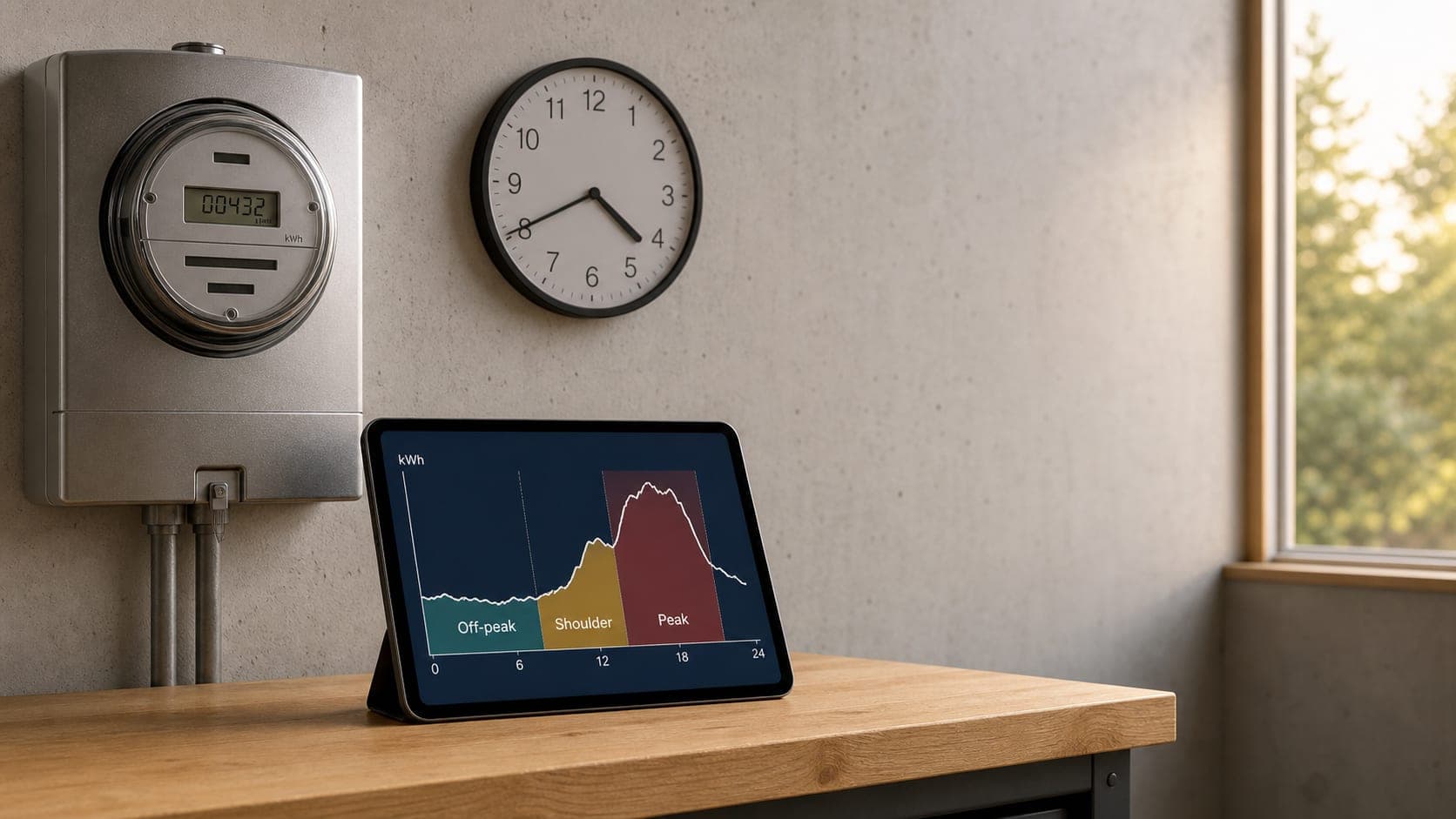
This model is designed to reflect the actual cost of producing electricity. It is more expensive for utilities to generate power during peak demand, so they pass those higher costs on to customers who use electricity during those times.
TOU periods require tariff-specific hours
It is important to remember that there is no single time-of-use schedule. The exact hours that count as peak, off-peak, and shoulder are determined by the specific tariff or utility program. One provider might define peak hours as 2:00 PM to 6:00 PM, while another might use 4:00 PM to 8:00 PM.
If you are considering a TOU plan, you must look at the specific schedule in the plan's tariff to understand when the pricing shifts.
Load shifting and demand response
When people talk about time-of-use pricing, they often mention load shifting or demand response. These are related concepts, but they mean different things.
Load shifting is the practice of moving your electricity use to a different time of day. For example, if you run your dishwasher at 10:00 PM instead of 2:00 PM, you are load shifting. In a time-of-use plan, this can help manage your bill because you are using power when the rate is lower.
Demand response is a broader grid concept. It usually refers to programs where utilities or grid operators ask customers to reduce their power use during emergencies or peak periods.
While these programs can sometimes offer bill credits or other incentives, they are separate from the basic usage-based pricing on your monthly bill. Reliable information on these programs can often be found through official sources like the Federal Energy Regulatory Commission (FERC).
Residential and commercial averages are dataset labels
When you look at broad state or national electricity rate pages, you will often see data separated into residential and commercial averages. These numbers are useful for understanding general market trends, but they are not a guarantee of what you will pay.
Why averages don't tell the whole story
A residential average price might include everyone from a small apartment in a warm climate to a large house in a cold climate. Because usage-based pricing responds to how much power you use, your personal bill depends heavily on your specific home and habits. Similarly, commercial rates can vary wildly depending on the size of the business and the specific rate class they occupy.
Some broad rate pages, like those found on sites that track electricity prices by state, separate these residential and commercial averages to provide a clearer picture of the market. However, these figures should be treated as context, not as a quote for your specific service address.
State-rate pages are context
Publicly available state-rate pages are excellent resources for seeing how electric utility rates are organized across the country. They can show you which states have high or low average prices and how those prices have changed over time.
However, these pages cannot prove what a specific local customer will pay. Electricity prices are hyper-local. They depend on your local utility's infrastructure costs, your state's regulatory environment, and the specific rate class you are in.
If you see a state-wide average, remember that it is a compilation of many different utility rate structures, some of which may be very different from the one serving your home.
Usage-Based Electricity Pricing FAQ
Sources & References
Editorial standards
SlashPlan publishes independent guidance to help Texans compare electricity plans. Our editorial team reviews each article without advertiser influence. See our editorial guidelines and monetization disclosure.
About the author
Roi CahanaEnergy advisor helping Texans better understand their electricity options and make more confident decisions. Focused on simplifying electricity plans, explaining confusing terms, and sharing practical guidance to help readers avoid common mistakes when comparing rates, contracts, and renewals.
Ready to compare plans?
Enter your ZIP code to see electricity plans available at your address.