Why Advertised Electricity Rates Can Mislead Texas Shoppers
A cheap Texas electricity rate can stop looking cheap once usage assumptions, delivery charges, bill credits, and plan fees hit the monthly bill.
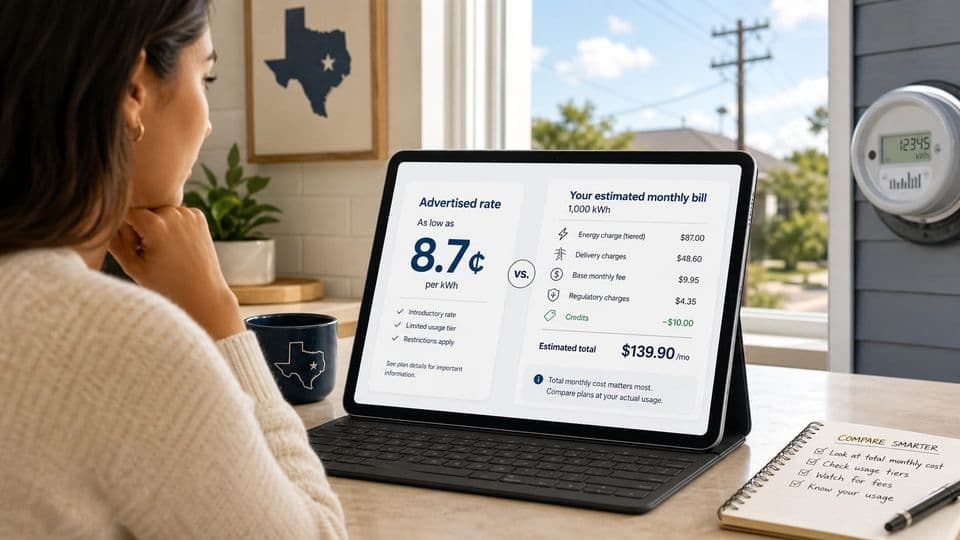
Key Takeaways
- 1The advertised cents-per-kWh rate is not the same as the monthly bill.
- 2Texas shoppers should compare total estimated bills at their own usage levels, not only the 1,000 kWh example.
- 3Bill credits, base charges, tiered pricing, and free-period plans can make a low advertised rate expensive outside a narrow usage range.
- 4A fixed-rate plan can lock the retail energy charge, but it usually does not freeze usage, taxes, or regulated delivery-related charges.
- 5Electricity market claims need context, including date, geography, market rules, and whether the claim reflects total customer cost.
- 6Before enrolling, review the Electricity Facts Label, Terms of Service, and Your Rights as a Customer disclosure.
A Texas electricity plan can look cheap until delivery charges, usage tiers, or monthly fees change the actual bill. The number shown in ads or shopping results usually reflects a simplified average at one usage level.
The advertised rate is not the bill
An advertised electricity rate is the headline cents-per-kWh number shown in plan marketing or shopping results. That figure assumes specific conditions. Usage levels, base charges, delivery charges, bill credits, taxes, contract length, and rate structure all affect the final amount due.
Shoppers reach better decisions by comparing full estimated monthly bills at their real usage rather than chasing the lowest displayed rate. If the bill details are hard to separate, start with where to find usage, delivery charges, plan fees, and credits before comparing plans.
What the cents-per-kWh number usually assumes
The displayed average often blends an energy charge with other items or assumes a particular monthly kWh total. When actual use falls outside that point, the effective cost shifts.
Why estimated monthly cost is the better comparison
Total bill estimates at several usage points reveal the real expense. One plan may show the lowest cents-per-kWh figure yet produce a higher bill once base fees or credits are applied.
Where the rate comes from on a Texas plan
The Electricity Facts Label lists 500, 1,000, and 2,000 kWh examples that show how charges combine. Review the document to separate the energy charge from the base charge, delivery charges, bill credits, term length, and early termination fee.
The single average rate on a comparison site can hide the individual pieces that determine the monthly total.
How EFL usage examples can help and mislead
The three sample usage points on the Electricity Facts Label give quick reference points, but they may not match a household's actual pattern across seasons.
Energy charges, base charges, and delivery charges
Energy charges cover the power supplied. Base charges appear as fixed monthly amounts. Delivery charges cover transmission and distribution and often include both fixed and per-kWh elements.
The pricing moves that make cheap plans look cheap
Bill credits, tiered pricing, minimum usage requirements, and free-period structures can produce a low advertised rate while raising the cost outside a narrow usage range.
A plan that performs well for one apartment or season may cost more for a larger home or during peak air-conditioning months.
Bill credits tied to usage thresholds
Some plans apply a credit only after a customer exceeds a stated kWh level. Usage below that threshold removes the credit and can leave the bill higher than competing offers.
Base charges that matter more in low-usage months
A plan with a low energy rate but a sizable monthly base charge can become expensive when consumption drops in milder weather.
Tiered rates and minimum-use plans
Tiered pricing raises the rate once usage crosses certain bands. Minimum-use plans add fees when monthly kWh falls below a set floor.
Free nights and weekends still need a usage check
Plans that offer free hours on specific days can reduce cost only when a household's consumption pattern aligns with those hours.
Your usage can move you out of the sweet spot

Households should compare plans against their own 12-month usage history rather than a single sample point. Texas summer air-conditioning loads and changes in household size often shift consumption well above or below the 1,000 kWh reference point.
Why 1,000 kWh can be the wrong anchor
A plan optimized for exactly 1,000 kWh can become costly at half that amount or at twice that amount once tier thresholds or credits no longer apply.
The months that expose a bad rate structure
Spring and fall bills often fall into low-usage ranges where base charges dominate. Summer bills test high-usage tiers and credit thresholds.
Delivery charges are part of the real cost
Delivery charges appear on every Texas electricity bill separate from the retail energy charge. They may include both a fixed customer charge and a usage-based component.
Where delivery charges show up
The line items labeled TDU, TDSP, or delivery appear below the energy charge and are set by regulated utilities rather than the retail provider.
Why fixed-rate does not mean every charge is fixed
A fixed-rate plan locks only the retail energy charge for the contract term. Delivery charges, taxes, and certain riders can still change.
How to stress-test a plan before you enroll
Pull the most recent 12 months of kWh data. Run each plan through low, average, and high monthly usage figures to see which produces the lowest total bill.
Use your own low, normal, and high months
Compare bills at the lowest and highest months in the past year as well as an average month. This shows the range of outcomes.
Check what happens just below a bill-credit threshold
Test usage one or two hundred kWh below any advertised credit trigger to measure the impact if consumption falls short.
Compare total dollars before effective rate
Focus on the projected monthly dollar amount first. The resulting cents-per-kWh figure matters only after the dollar total is confirmed.
The plan documents to read before you switch
Review the Electricity Facts Label, Terms of Service, and Your Rights as a Customer disclosure in full before enrollment.
EFL, Terms of Service, and customer rights disclosure
These three documents list the energy rate, base charge, delivery details, contract length, early termination fee, and renewal rules.
Renewal terms and early termination fees
Note what happens at the end of the contract and the cost to leave early. A low first-month bill does not protect against unfavorable renewal terms.
When a low advertised rate is still a good deal
A low advertised rate works when the plan's usage assumptions line up with actual household consumption. Simple fixed-rate plans without credits or tiers are often easier to evaluate across multiple usage levels.
Signs the advertised rate matches your usage
The plan shows consistent total bill estimates at low, average, and high usage points that match the household's history.
When simpler pricing is worth a slightly higher headline rate
Plans without usage thresholds or credits reduce the chance that seasonal changes will push the bill higher than expected.
Rising bills make the rate trap more expensive
When overall electricity bills are becoming more expensive, differences in base charges, credits, and usage assumptions matter more. Gain more clarity by focusing on your own bill estimates rather than market-wide headlines or advertisements.
Why affordability context belongs in a shopping guide
A single plan's structure can add or subtract meaningful dollars each month even when broader market conditions remain unchanged.
What not to assume from broad market headlines
Headlines about load growth or transmission projects do not replace checking the Electricity Facts Label for the specific plan under consideration.
A practical final check before choosing a plan
Reject any plan whose total cost cannot be explained after reading the Electricity Facts Label. Compare at least three plans using identical usage numbers and save the enrollment documents.
Three questions to answer before enrollment
Does the plan produce the lowest total bill at my actual usage range? What fees apply if usage drops? What rate applies after the contract ends?
The red flags that should send you back to comparison shopping
Large base charges, credits that require exact usage targets, or renewal language that is unclear all increase the risk that the advertised rate will not match the eventual bill.
If a payment demand or bill notice pressures immediate action, treat that as a separate safety issue. CenterPoint's guide to common energy bill scams explains that imposters may pose as utility representatives.
Advertised electricity rate FAQs
Editorial standards
SlashPlan publishes independent guidance to help Texans compare electricity plans. Our editorial team reviews each article without advertiser influence. See our editorial guidelines and monetization disclosure.
About the author
Roi CahanaEnergy advisor helping Texans better understand their electricity options and make more confident decisions. Focused on simplifying electricity plans, explaining confusing terms, and sharing practical guidance to help readers avoid common mistakes when comparing rates, contracts, and renewals.
Ready to compare plans?
Enter your ZIP code to see electricity plans available at your address.