How to Spot Teaser Electricity Rates in Texas
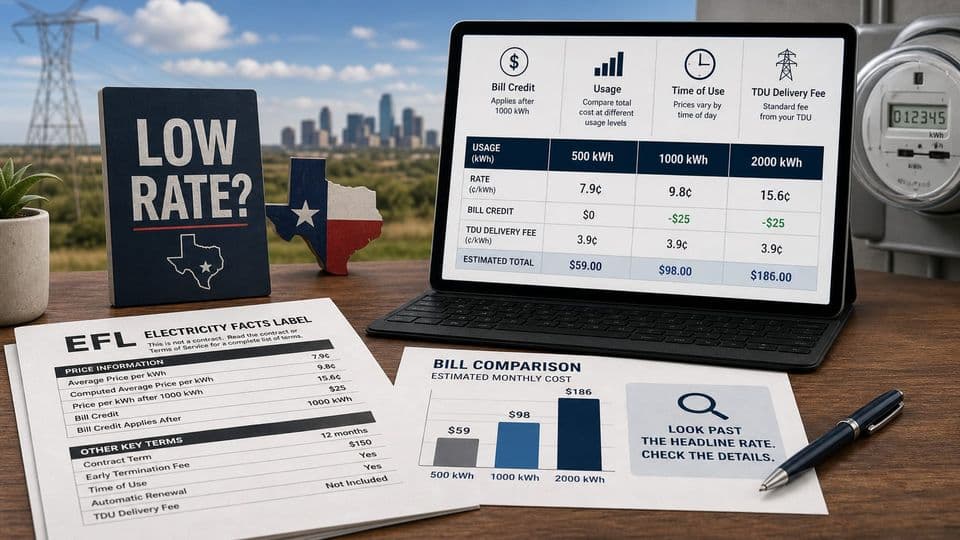
A low electricity rate can look simple until the plan documents show usage tiers, bill credits, time windows, or recurring charges. The useful question is whether the cost formula still works at the customer's real usage.
Key Takeaways
- 1A teaser electricity rate is a low-looking price whose real cost depends on disclosed billing conditions.
- 2The Electricity Facts Label, Terms of Service, and related customer disclosures show the conditions behind the rate.
- 3Average price per kWh can change by usage level when recurring charges, credits, or other terms affect the calculation.
- 4Bill credits and tiered pricing can make one usage range look cheaper than nearby usage levels.
- 5Time-based pricing must be read by its stated hours, not assumed from the lowest number shown.
- 6The practical test is to estimate the cost at low, typical, and high usage before relying on the low-looking number.
A low electricity advertisement can catch your eye, but the number you see is not always the number you pay. In Texas, providers are required to disclose pricing details, yet the way those details are presented can make a rate look much cheaper than it actually is for your specific home. This is often called a "teaser" rate-a low-looking price that depends on specific conditions hidden in the fine print.
To protect your budget, you have to look past the big bold number and check the actual plan documents. This guide explains how to read those documents, what conditions to look for, and how to calculate whether a "great deal" actually fits your usage patterns.
What Makes a Rate a "Teaser"
"Teaser electricity rates" is not an official term used by the Public Utility Commission of Texas (PUCT). Instead, it is a plain-language way to describe a low-looking price that only stays low when certain conditions are met. If those conditions don't match your real-world energy use, the rate effectively disappears, leaving you with a much higher bill than you expected.
These conditional rates usually rely on one or more of the following:
- Usage Levels: The low price only applies if you use exactly 500, 1,000, or 2,000 kWh.
- Bill Credits: A large credit lowers the bill, but only if your usage hits a specific threshold.
- Time-Based Pricing: The cheap rate only applies during certain hours of the day.
- Contract Length: The introductory price expires after a few months, then jumps to a much higher "contract" rate.
- Recurring Fees: A low energy charge is offset by a high monthly base fee.
The most important thing to remember is that the advertised price is a calculation based on assumptions. Your goal is to find out what those assumptions are before you sign up.
Use the Official Disclosures as the Source of Truth
In Texas, every retail electric provider (REP) must provide specific documents that explain the true cost of the plan. Advertising materials or comparison shopping sites are just summaries. The legal source of truth for your pricing is found in three specific documents.
Electricity Facts Label (EFL)
The Electricity Facts Label is the most important document for spotting a teaser rate. By law, it must show the average price per kWh at three specific usage levels: 500 kWh, 1,000 kWh, and 2,000 kWh. It also lists the contract term, the type of price (fixed or variable), and any recurring or non-recurring fees. If the average price at 500 kWh is much higher than at 1,000 kWh, the plan likely relies on a usage-based bill credit.
Terms of Service (TOS)
The Terms of Service document contains the legal details of the contract. This is where you find out about early termination fees, the "contract expiration" date, and how the provider handles auto-renewals. Sometimes, a plan will show a low rate for the first six months, but the TOS will reveal a much higher rate for the remaining months of the contract.
Your Rights as a Customer
This document explains the rules for deposits, disconnection, and how to switch providers. While it is less about the "teaser" price itself, it confirms whether the plan has a "minimum usage fee" if you use too little electricity, which is another common way teaser rates fail to deliver savings.
Average Price Per kWh Changes When Usage Changes
The "average price per kWh" is a calculated figure. It is not a fixed unit price like you might see on a grocery store tag. It is the result of taking the total bill (energy charges + fixed fees - bill credits) and dividing it by the total kWh used.
Because of this math, a plan's average price can swing wildly depending on how much power you use.
For example, a plan might show an average price of 10 cents per kWh at 1,000 kWh of usage. However, if you only use 500 kWh, the fixed monthly charges and the loss of a bill credit might push that average price up to 14 cents per kWh. Conversely, if you use 2,500 kWh, the math might change again.
To spot a teaser rate, always look at the average price at 500 kWh and 2,000 kWh in addition to the 1,000 kWh mark. If the price at 500 kWh is significantly higher, the plan is designed to penalize low usage. If the price at 2,000 kWh is higher, the plan is likely designed to give a "teaser" discount only at the exact midpoint.
Test the Usage Levels Shown on the Label
Do not trust a plan that only advertises the 1,000 kWh price. Look at the EFL and compare the three rows.
- The 500 kWh Row: This tells you how the plan treats "light" users.
- The 1,000 kWh Row: This is the most common advertising number.
- The 2,000 kWh Row: This tells you how the plan treats "heavy" users, like those with electric vehicles or large homes.
If the price at 500 kWh is high but the price at 1,000 kWh is low, the plan is using a bill credit to create a "teaser" effect.
Bill Credits Can Hide a Narrow Sweet Spot
A bill credit is a specific dollar amount subtracted from your bill. For example, a plan might offer a $50 bill credit if you use between 1,000 and 2,000 kWh. This sounds great, but it creates a "cliff."
If the credit only applies at exactly 1,000 kWh, and you use 999 kWh, you miss the credit entirely. In that case, you pay the full energy charge plus any base fees, which makes your effective rate much higher than the advertised "teaser" price.
How to Check the Credit Condition
Look at the EFL for the "Bill Credit" line item. Note two things:
- The Threshold: At what kWh level does the credit appear?
- The Range: Does the credit disappear if you use too much (e.g., over 2,000 kWh)?
If your monthly usage is inconsistent, a bill credit plan can be risky. You might hit the sweet spot one month and miss it the next, leading to an average cost that is higher than a simpler, slightly more expensive plan with no credit.
Tiered Pricing Can Reward One Range and Punish Another
Some Texas electricity plans use tiered pricing. This means the price you pay per kWh changes once you cross a certain usage threshold. Unlike a bill credit (which is a lump sum off the total), tiered pricing changes the actual "per unit" cost of the electricity.
For instance, a plan might charge 5 cents per kWh for the first 1,000 kWh, but then charge 12 cents per kWh for every kWh after that. If you are a high-usage customer, the cheap "teaser" rate at the bottom of the tier won't help you much because most of your electricity will be billed at the higher tier.
Look for the "Tier" in the EFL
The EFL must disclose if the price is "Tiered." If it is, the document will show a "Price to Compare" that changes based on usage. To spot this teaser, you have to estimate your highest usage months. If the tiered price jumps up right where your usage typically starts, the plan is not a good fit.
Fixed Rates Still Need a Fee Check
Many people assume that a "Fixed Rate" plan means there are no surprises. While a fixed rate does lock in the "energy charge" (the price per kWh for the electricity itself), it does not lock in everything else.
Even on a fixed-rate plan, you may still see:
- Monthly Base Fees: A recurring charge just for being a customer (e.g., $9.95/month).
- TDU Delivery Charges: These are regulated by the local utility (Oncor, CenterPoint, etc.) and can change every March and September. They are passed through to you even on a fixed-rate plan.
- Cancellation Fees: A fixed-rate plan often has a penalty for leaving early.
If a plan has a very low energy charge but a very high monthly base fee, it is a teaser. It looks cheap on a per-kWh basis, but the high fixed fee will eat up your savings if you are a low-usage customer.
Variable and Indexed Terms Need Extra Caution
Unlike fixed-rate plans, Variable or Indexed plans can change their price at any time. A variable plan might start with a very low "teaser" rate to get you to sign up. However, because there is no long-term price guarantee, the provider can raise the rate the very next month.
Indexed plans are even more complex. The price is tied to a public index (like natural gas prices). If the market price goes up, your electricity price goes up. These plans often use the "teaser" of a low initial index price, but they rarely show you the "worst-case scenario" math. If you are looking at a variable or indexed plan, check the "History of Price Changes" section in the Terms of Service to see how much the price has moved in the past.
Free-Time and Time-of-Use Offers Depend on the Clock
Time-of-use pricing (sometimes called "Free Nights" or "Free Weekends") offers a low or zero price for electricity used during specific hours. The "teaser" here is the idea that you can get free power.
However, these plans often have a much higher price for electricity used during "on-peak" hours (usually weekdays from 3 PM to 8 PM). To make these plans work, you have to be extremely disciplined about when you run your dishwasher, laundry, and air conditioning.
Match Low-Price Hours to Actual Use
Before signing up for a time-of-use plan, look at your past bills. Do you use most of your power in the morning or late at night? If your family is home and using AC during the expensive peak hours, a "free nights" plan will likely cost you more than a standard fixed-rate plan. The "teaser" is the free hours; the "catch" is the expensive daytime rate.
Delivery Charges and Recurring Fees Can Move the Bill
When you look at your Texas electricity bill, you will see two main parts: the "Energy Charge" and the "TDU Delivery Charge."
The Energy Charge is what you negotiate with your provider. The TDU Delivery Charge is set by the local utility company to maintain the poles and wires. While you can't shop for a different TDU, the way your provider handles these charges in their math can create a teaser effect.
Some providers "bundle" the TDU pass-through charges into their advertised rate, while others list them separately. If a plan looks unusually cheap, check to see if they are "unbundled." This means the price you see doesn't include the TDU delivery fees, which will be added to your bill later. Always use the Average Price per kWh on the EFL as your true comparison point, because that number includes both the energy charge and the estimated delivery fees.
Commercial Accounts May Have Different Billing Drivers
If you are shopping for a small business or commercial location, the "teaser rate" check works a bit differently. Residential plans are standardized by the PUCT, but commercial plans can have more complex pricing structures.
Commercial customers should verify:
- Demand Charges: Many commercial bills include a charge for your "peak" power draw during the month, not just your total kWh. A low kWh rate won't save you if the demand charge is high.
- Account-Specific Tariffs: Some plans are negotiated contracts rather than standard "products."
For a small commercial account, always ask for the Tariff Sheet or the specific Contract Pricing Schedule rather than relying on a generic advertisement.
A Three-Scenario Check Before Relying on the Rate
The best way to spot a teaser rate is to do a quick "Three-Scenario Check" using your own past usage and the plan's EFL.
- The Low Month: Find a month where you used very little electricity (e.g., a mild spring month). Look at the 500 kWh price on the EFL. Is it still low, or does it jump up because of fees or lost credits?
- The Typical Month: Look at your average usage. Does it match the "sweet spot" of the plan's bill credit or tiered pricing?
- The High Month: Find your highest usage month (usually summer). Look at the 2,000 kWh price. If the plan has "tiered" pricing, the price at 2,000 kWh might be much higher than the advertised rate.
If the plan only looks good in one of these three scenarios, it is likely a teaser rate. A "non-teaser" plan will have a consistent average price across all three usage levels, or at least a price that doesn't jump by more than a cent or two.
Questions About Teaser Electricity Rates
Editorial standards
SlashPlan publishes independent guidance to help Texans compare electricity plans. Our editorial team reviews each article without advertiser influence. See our editorial guidelines and monetization disclosure.
About the author
Roi CahanaEnergy advisor helping Texans better understand their electricity options and make more confident decisions. Focused on simplifying electricity plans, explaining confusing terms, and sharing practical guidance to help readers avoid common mistakes when comparing rates, contracts, and renewals.
Ready to compare plans?
Enter your ZIP code to see electricity plans available at your address.