Commercial Electricity Contract Changes Explained
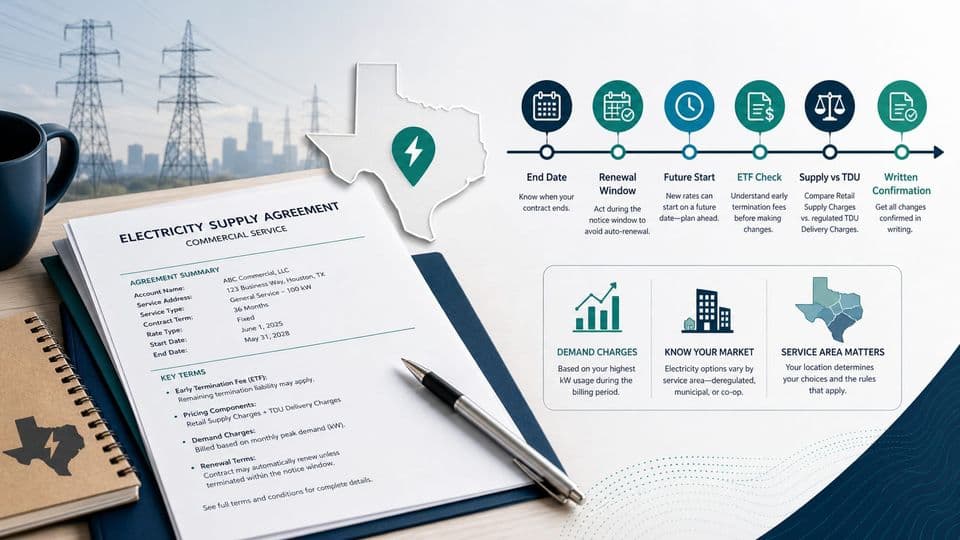
Commercial electricity contract changes often come down to contract dates, fee language, supply and delivery charges, demand terms, service area, and written confirmation.
Key Takeaways
- 1A commercial electricity contract change can involve renewal, expiration, a future start date, fee language, fixed or variable terms, delivery charges, demand terms, or service-area limits.
- 2The signed agreement is the first document to check because it controls dates, renewal terms, cancellation language, and fee details.
- 3Early termination fees depend on the contract.
- 4Retail supply charges and TDU delivery charges come from different roles and different documents.
- 5Demand charges may matter for some commercial accounts, but they require account-specific review.
- 6Texas service territory can affect which contract-change options are available.
Managing a business means keeping the lights on and the bills predictable. In Texas, that often involves navigating commercial electricity contracts that are longer, more detailed, and more specific than residential plans. When it comes time to make a change-whether that is a renewal, an expiration, or a mid-term adjustment-the details in your paperwork matter more than any general advice you might find online.
A commercial electricity contract change can involve contract timing, renewal language, fee terms, charge categories, or service-area constraints. Because every agreement is different, the most reliable way to understand your options is to look at the signed documents, the renewal notices, and the official rules that apply to your service area.
What a commercial electricity contract change can mean
In Texas, most business electricity customers buy power from a retail electric provider (REP) that sells the energy, while a transmission and distribution utility (TDU) or local utility delivers it. A contract change can happen for several reasons: the term is ending, the business is moving, the ownership is changing, or the account usage has shifted enough to trigger a review.
These changes are not just about picking a new rate. They involve specific dates, specific fee language, and specific documents. For example, changing a contract might mean moving from a fixed-rate term to a variable one, or it might mean adjusting how delivery charges are passed through to the account.
Contract changes that affect dates and terms
The most common change involves the contract end date. Businesses often plan a switch or a renewal to happen right as the old term ends. However, "change" can also mean modifying the length of a new term, shifting the start date of a future agreement, or updating the legal terms that govern how the account handles disputes or outages.
Charge changes that need separate documents
Some changes affect only the supply charge, which is the part of the bill tied to the retail contract. Others affect delivery charges, which are set by the TDU and governed by tariffs. A business might see a "change" because the TDU updated its delivery rates, even if the retail contract stayed the same.
Documents to gather before reviewing new terms
Before you sign anything or agree to a renewal, gather the documents that actually control your account. In a dispute or a confusion, the signed agreement and the official tariff usually outweigh a verbal promise or a marketing email.
Signed agreement and renewal notices
Your current signed agreement is the first place to look. It lists the contract term, the rate type, the early termination fee language, and the renewal process. If you received a renewal notice, keep it. These notices often explain what happens if you do nothing, but they can be easy to miss if they arrive during a busy season.
Written confirmations and account records
Keep any written confirmations of your contract start and end dates. If you have emails or letters from your provider confirming a future start date or a specific fee waiver, save those. Account records, including past bills and usage reports, also help you see if your business profile has changed enough to warrant a different kind of contract.
Contract expiration and renewal language
One of the most stressful moments for a business owner is the contract expiration date. Unlike some services that automatically cancel, commercial electricity contracts often have specific "renewal" or "rollover" language that determines what happens the day after the term ends.
Expiration and renewal outcomes depend on the signed agreement, renewal language, applicable notices, and written confirmations. Some contracts move the account to a month-to-month status at a higher rate. Others automatically renew into a new fixed term unless the customer gives written notice by a certain deadline.
End date and renewal deadline
Look for the "Term" or "Contract Period" section of your agreement. It should list a start date and an end date. Near that section, look for "Renewal" or "Automatic Renewal" language. Some contracts require a 30-day or 60-day notice before the end date if you want to leave without a fee. If you miss that window, you might be locked in for another year or moved to a variable rate that fluctuates with the market.
Post-term language and rollover wording
If the contract ends and you haven't signed a new one, check the "Post-Term" or "Holdover" section. This part of the contract explains the rate and terms that apply after the end date. In many cases, the post-term rate is much higher than the rate you paid during the fixed term.
End-date timing for a retail service change
Timing is critical when you want to change retail electric providers. You want the new service to start the day the old service ends to avoid a gap or an overlap.
Near-end retail service changes should be treated as timing and documentation issues tied to end date, effective date, fee language, account status, and confirmation. If you try to start a new contract before the old one ends, you could trigger an early termination fee. If you wait too long, you might end up on a expensive month-to-month rate.
Effective date and current term overlap
When you are close to the end of your term, ask for a "future start date" that matches your current contract end date. This is sometimes called a "future-dated electricity contract." It allows you to lock in a rate weeks or months in advance without overlapping your current term.
Confirmation before the old term ends
Always get written confirmation of the new start date. Verbal assurances are difficult to enforce. The confirmation should show the new contract start date and the new rate. Check that date against your current contract end date to ensure they align.
Early termination fee caveats
Early termination fees (ETFs) are one of the most misunderstood parts of commercial electricity contracts. An ETF is a charge some providers use to recover costs if a customer leaves before the contract end date.

Early termination fee treatment depends on the signed contract and any applicable official rule or written confirmation. Some contracts have no ETF, some have a flat fee, and some have a fee that decreases the closer you get to the end of the term.
Fee clauses in the signed agreement
To understand your ETF risk, read the "Early Termination" or "Cancellation" section of your contract. It will explain how the fee is calculated. For example, some providers charge a set dollar amount per remaining month, while others charge a flat fee regardless of when you cancel.
Waiver claims that need primary support
Be careful with "waived fee" claims. Some providers offer to waive the ETF if you renew with them or if you are moving to a new location they serve. These waivers are not automatic. They usually require a specific written offer or a signed addendum. Do not assume the fee will be waived just because a salesperson mentioned it.
Future start dates and written confirmation
A future-dated contract is a useful tool for businesses that want to plan ahead. It allows you to secure a rate for a start date that is weeks or months away.
A future start date can help align new terms with the current contract end date when the effective date is documented. This prevents the "gap" where a business is paying a high month-to-month rate because the new contract has not started yet.
Future-dated start language
When reviewing a future-dated contract, check the "Effective Date" or "Start Date" field. It should match your current end date or the date you need the service to begin. If the contract says "upon enrollment" or "as soon as 1 business day," it might not give you the timing protection you need for a planned change.
Rate-lock wording in writing
If you are signing a future-dated contract to "lock in" a rate, make sure the rate is fixed in the document. Some future-dated products are variable, meaning the rate you see today might not be the rate you pay when the contract actually starts.
Fixed-rate and variable-rate contract wording
The type of rate you choose affects how you handle contract changes. Fixed-rate and variable-rate terms can affect what contract language a business should review.
Fixed-rate term language
A fixed-rate contract means the price per kilowatt-hour (kWh) stays the same for the length of the term. If you are changing contracts and want stability, you will likely look for a new fixed-rate term. However, "fixed" only applies to the supply portion of the bill. It does not stop the TDU from changing its delivery charges.
Variable-rate change language
Variable-rate contracts do not have a set end date or a set price. They often go month-to-month. These are easier to change or cancel because they usually do not have early termination fees. However, the price can change with the market, which makes budgeting difficult for some businesses.
Retail supply charges and TDU delivery charges
A common source of confusion during a contract change is the difference between what you pay for the energy itself and what you pay to have it delivered.
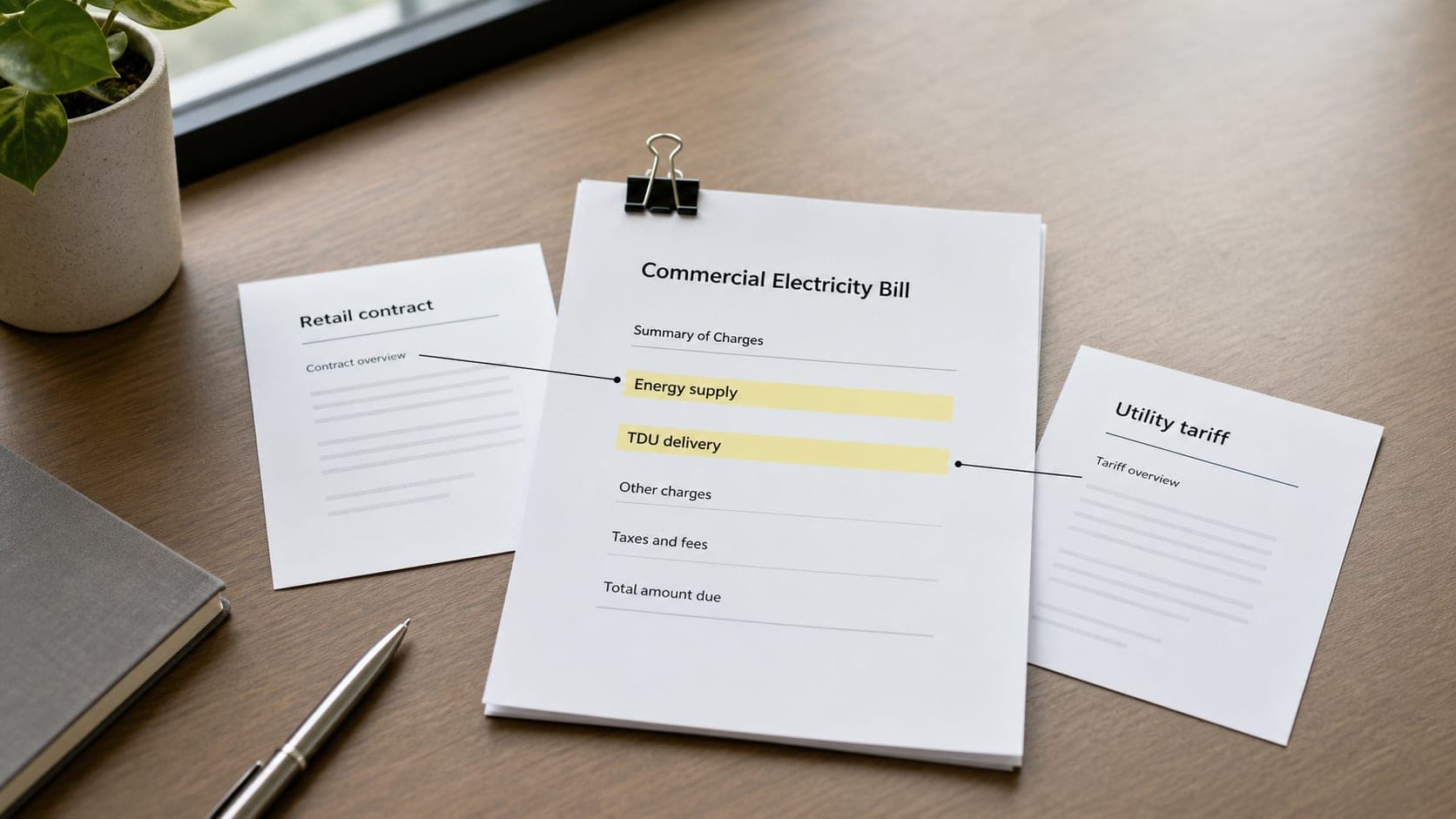
Retail supply charges and TDU or utility delivery charges come from different roles and should be checked against the retail contract and official tariff or utility materials. The retail supply charge is what you negotiate with your provider. The TDU delivery charge is set by the utility (like Oncor, CenterPoint, or AEP) and is passed through to your bill.
Retail energy supply charges
When you change retail electric providers, you are primarily changing the supply charge. This is the part of the bill that pays for the generation and sale of the electricity. It is the part you can shop for and compare.
Regulated delivery charge documents
TDU delivery charges are different. They are regulated by the Public Utility Commission of Texas (PUCT). These charges pay for the poles, wires, and meters. Even if you change your retail provider, you cannot change your TDU. When reviewing a contract change, check if the new provider is "passing through" the TDU charges at cost or if they are bundling them into a higher fixed rate.
Demand charges and usage profile changes
For many commercial customers, the bill is not just about how much energy they use, but when they use it. This is where demand charges come in.
Some commercial accounts may have demand-related terms or charges that require contract, tariff, utility, provider, or account-specific documentation. Demand charges apply to the highest amount of power used in a short period (usually 15 minutes). If your business has large, sudden power needs, your demand charge could be a significant part of your bill.
Demand language in commercial contracts
If your business is changing its operations-for example, adding new machinery or changing shift hours-you should review the demand language in your contract. Some contracts have "ratchet" clauses or specific demand billing methods that might not fit your new usage profile.
Usage changes before renewal
If your usage has gone up or down significantly, a contract change is a good time to look for a plan that fits your new "load profile." A provider might offer a different rate structure if your business uses power more steadily or more efficiently than before.
Service area limits in Texas
Not every business in Texas has the same options for contract changes. Retail choice and contract-change options can depend on the service address and utility territory.
Deregulated retail choice areas
Most of Texas is deregulated, meaning businesses can choose their retail electric provider. In these areas, you have the most freedom to change contracts and shop for new rates. However, even in deregulated areas, the specific TDU that serves your address affects the delivery charges you will see on any new contract.
Municipal utility and cooperative areas
Some parts of Texas are served by municipal utilities (like Austin Energy or CPS Energy) or rural electric cooperatives. In these areas, you may not have a choice of retail providers. Your contract change options might be limited to the rate plans offered by the local utility. Always check the service address against the official PUCT maps or the Power to Choose website to see if your business is in a competitive area.
Commercial Electricity Contract Changes FAQ
Editorial standards
SlashPlan publishes independent guidance to help Texans compare electricity plans. Our editorial team reviews each article without advertiser influence. See our editorial guidelines and monetization disclosure.
About the author
Roi CahanaEnergy advisor helping Texans better understand their electricity options and make more confident decisions. Focused on simplifying electricity plans, explaining confusing terms, and sharing practical guidance to help readers avoid common mistakes when comparing rates, contracts, and renewals.
Ready to compare plans?
Enter your ZIP code to see electricity plans available at your address.