Top 5 Texas Business Electricity Mistakes to Avoid
A Texas business electricity plan can look cheap until demand, delivery charges, renewal language, or usage assumptions change the real bill.
Key Takeaways
- 1A Texas business should compare electricity offers using actual usage, demand, and operating patterns instead of rough estimates.
- 2Demand, peak demand, load factor, and 4CP exposure can change commercial electricity costs in ways a simple kWh rate does not show.
- 3Renewal offers deserve a market check because convenience can hide higher pricing or weaker terms.
- 4Shopping before the contract expires helps avoid default, holdover, month-to-month, or variable pricing surprises.
- 5Business owners should read the contract terms before signing, especially pass-through charges, early termination rules, renewal language, and change-in-law provisions.
A Texas business electricity plan can look cheap until demand, delivery charges, renewal language, or usage assumptions change the real bill.
Start With the Five Costliest Mistakes
Most expensive surprises on a commercial electricity bill stem from mismatched assumptions rather than headline rates alone. The five issues that drive the biggest dollar impact are shopping without accurate usage data, overlooking demand and load factor, accepting a renewal offer without comparing the market, waiting until the contract is nearly expired, and judging offers only by the lowest advertised rate per kWh.
Each of these choices can turn an apparently competitive contract into an unplanned expense once the first few invoices arrive. The goal is not to find one perfect provider, but to match contract terms to the actual operating pattern of the business.
Texas Business Electricity Works Differently From Home Plans
Retail electric providers sell the energy portion of the bill. Transmission and distribution utilities, called TDSPs or TDUs, handle delivery and infrastructure charges in their service territories. Small commercial accounts often receive standard customer disclosures, while larger accounts with higher demand or multiple meters face more customized pricing and fewer regulatory protections.
Meter count and credit history can also influence available offers. A single-location office and a multi-site warehouse may see different contract structures even when total monthly kWh looks similar.
Mistake 1: Shopping Without Real Usage Data
Accurate comparison starts with at least twelve months of actual bills when they are available. One recent statement rarely captures seasonal swings, equipment cycles, or changes in operating hours. Restaurants, retail stores, offices, warehouses, and multi-location businesses each carry distinct patterns that affect how providers model future costs.
Monthly kWh totals, peak demand values, and seasonal swings help providers build quotes that reflect reality instead of averages. Using estimates instead of meter data often produces offers that look favorable on paper but diverge once real usage hits the bill.
Use Interval Data When Your Load Is Spiky
Fifteen-minute interval data shows whether usage stays steady or spikes during short windows. Restaurants, manufacturers, cold-storage facilities, gyms, medical offices, and sites with large HVAC loads often benefit from reviewing this level of detail before locking in terms.
For smaller accounts the extra step may be unnecessary. For accounts with noticeable peaks, the data helps owners ask targeted questions about how a provider will treat demand in the contract.
Mistake 2: Ignoring Demand, Peak Demand, and Load Factor
Demand measures the highest level of power drawn at one time. Two businesses that use roughly the same monthly kWh can receive different pricing when one runs continuous loads and the other creates sharp peaks. Load factor compares average demand to peak demand and gives providers a quick way to assess usage steadiness.
Commercial quotes often adjust for these factors even when the energy rate appears identical. Reviewing both historical demand and load factor helps owners anticipate why one provider's offer differs from another.
4CP: The Summer Peak Detail Some Businesses Miss
4CP ties certain charges to a business's usage during the four highest grid-wide peak periods, typically occurring in June, July, August, and September. Not every account experiences the same exposure, so the impact depends on account type, tariff, and contract language.
Businesses that operate cooling, manufacturing, or other high-load equipment during summer should ask how 4CP costs are calculated and whether the provider includes or excludes them from the quoted price.
Mistake 3: Accepting the Renewal Offer Without Shopping
Current providers often send renewal offers weeks or months before the contract ends. These offers can contain higher rates or less favorable terms because the provider knows the customer values convenience over price comparison.
Collecting competing offers before the renewal deadline creates leverage and reveals whether the current provider's numbers remain competitive. Staying with the existing provider can still work when the final terms match the market and simplify operations.
Mistake 4: Waiting Until the Contract Is Almost Over
Contract end dates and notice requirements should be recorded as soon as the agreement is signed. When a contract expires without action, the account can move to default, holdover, month-to-month, or variable pricing that costs more than a negotiated renewal.
Shopping several months ahead allows the business to select a future start date and avoid urgent decisions. Summer expirations deserve extra attention because market volatility can limit available options during peak months.
Mistake 5: Choosing the Lowest Headline Rate
Energy charges represent only part of the total bill. Delivery charges from the local TDSP, demand charges, base fees, usage tiers, minimums, bill credits, and pass-through language can all alter the final amount.
Comparing projected monthly cost under the business's actual usage pattern gives a clearer picture than any single rate number. The offer that appears cheapest at average usage may cost more when demand spikes or seasonal patterns shift.
The Contract Terms That Can Change Your Bill After Signing
Pass-through charges, change-in-law provisions, ancillary service fees, bandwidth limits, material usage changes, early termination fees, and credit requirements appear in many commercial contracts. Larger accounts often require closer review of these clauses than small commercial customers who rely on standard disclosure documents.
Reviewing the full contract language before signing reduces the chance that an unexpected adjustment appears on later invoices.
Fixed, Variable, and Indexed Plans Change Your Risk
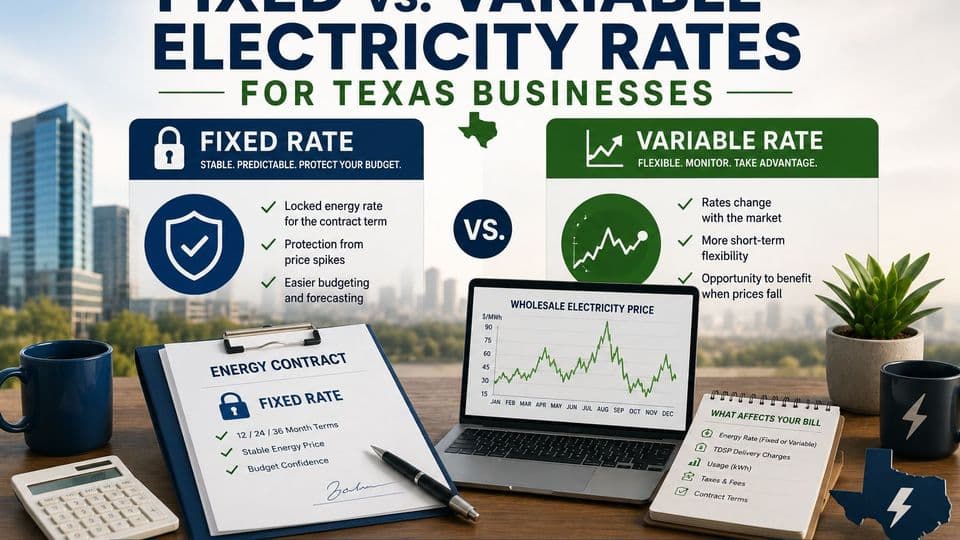
Fixed-rate contracts support budgeting because the energy charge stays constant for the term, although regulated delivery charges can still adjust. Variable or indexed plans can track market movement and may require more active oversight by the business owner.
The better structure depends on usage stability, tolerance for bill variation, and willingness to monitor market conditions. No single plan type suits every Texas business.
Provider Familiarity Is Not the Same as Plan Fit
A well-known provider name does not guarantee the lowest total cost or the best contract terms. Comparing multiple offers using identical usage and demand assumptions helps isolate differences in price, risk, and service.
Brokers may add value for multi-meter or high-demand accounts that need more specialized negotiation. The decision should rest on the specific offer rather than brand recognition alone.
A Cleaner Way to Compare Business Electricity Quotes
Place every quote on identical assumptions: service address, meter count, start date, contract length, historical usage, demand profile, and included versus excluded charges. Ask each provider to state clearly what is covered and what can change later.
Compare total projected cost, contract flexibility, and risk exposure rather than focusing solely on cents per kWh. This approach reveals which offer truly fits the business's operating pattern.
Market Events Are a Contract Risk Reminder
ERCOT market operations and regulatory decisions influence wholesale prices and can flow into certain commercial contracts through pass-through language.
Reviewing contract language for change-in-law or pass-through provisions are important to review regardless of market conditions.
Decision Checklist Before You Sign
Review the Electricity Facts Label, Terms of Service, Your Rights as a Customer disclosure, and the full commercial contract. Confirm usage assumptions, demand treatment, delivery charges, start and end dates, early termination fees, pass-through language, and renewal terms all align with the business's needs.
Sign only when the offer matches actual usage patterns, risk tolerance, and timeline requirements.
Texas Business Electricity Mistakes FAQ
Sources & References
Editorial standards
SlashPlan publishes independent guidance to help Texans compare electricity plans. Our editorial team reviews each article without advertiser influence. See our editorial guidelines and monetization disclosure.
About the author
Roi CahanaEnergy advisor helping Texans better understand their electricity options and make more confident decisions. Focused on simplifying electricity plans, explaining confusing terms, and sharing practical guidance to help readers avoid common mistakes when comparing rates, contracts, and renewals.
Ready to compare plans?
Enter your ZIP code to see electricity plans available at your address.