Electricity for Multiple Meters in Texas
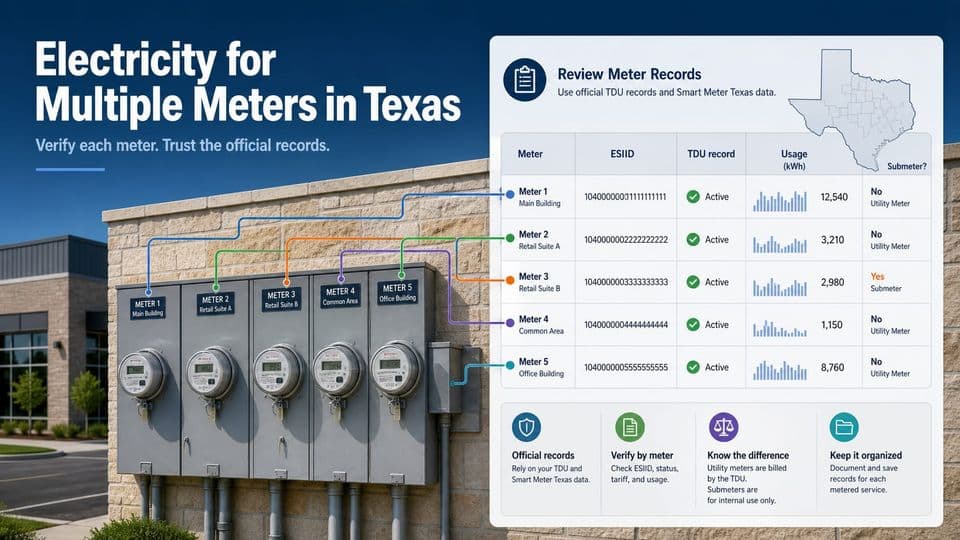
A Texas property with more than one electric meter should be reviewed meter by meter. The key details are what each meter serves, whether it has its own ESI ID, whether it is a utility meter or submeter, which rules apply, and how usage and delivery charges are recorded.
Key Takeaways
- 1A property with more than one electric meter should be organized meter by meter, not only by street address.
- 2An ESI ID helps tie a Texas meter or service location to the right account record and usage history.
- 3Utility meters and private submeters are not the same, and different rules can apply depending on the property type.
- 4A second meter can create separate usage records, charges, due dates, and enrollment steps.
- 5New or changed meter work usually starts with the local TDU, service standards, permits, and electrical design.
- 6TDU tariff schedules are the right place to verify delivery and metering charges for a specific service territory.
A single Texas property can have more than one electric meter. A main house might have its own meter, while a detached garage, guest house, or accessory building has a separate one. In multifamily or commercial properties, multiple meters can serve different units, tenants, or types of equipment.
When a property has more than one meter, the most important details are what each meter serves, whether it has its own ESI ID, whether it is a utility meter or a private submeter, which rules apply, and how usage and delivery charges are recorded. Approaching the situation meter by meter, rather than relying only on a street address, helps you avoid confusion about accounts, bills, and service responsibilities.
Start by listing every meter and what it serves
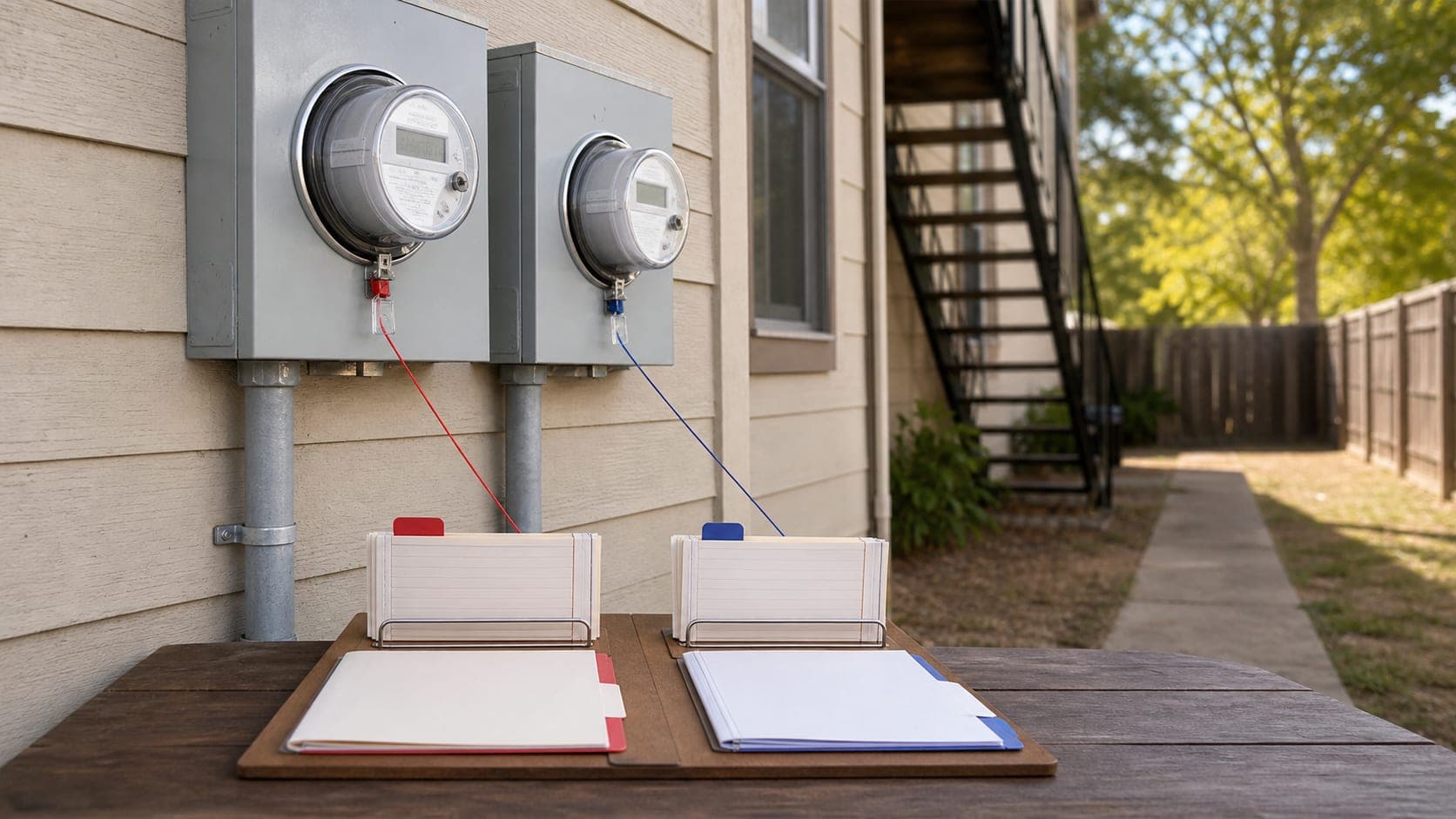
Begin with a physical inventory. Walk the property and identify every meter that belongs to the site. Note what each meter powers. One meter might serve the main dwelling, while another serves a detached workshop, an irrigation pump, a duplex unit, or a common-area hallway.
If you are a tenant, check whether the meter serving your space is a utility meter in your own name or a private submeter read by the landlord or a third-party billing company.
A street address alone does not tell the full story. Each meter can have its own service record, usage profile, and account details. Treating the property as a single electric service when it actually has multiple meters can lead to missed bills, incorrect payments, and confusion about which usage belongs to which building or tenant.
For each meter, record the following details:
- The physical meter number printed on the face of the meter or the smart meter housing.
- The service address tied to that meter, which may differ from the mailing address used for bills.
- The ESI ID, if you have it, which is the unique service identifier for that Texas service location.
- The TDU (Transmission and Distribution Utility) territory, such as Oncor, CenterPoint, AEP Texas, or TNMP.
- Whether the meter appears to be a standard utility meter or a private submeter.
If you cannot access a meter because it is behind a locked panel or located on a neighboring pole, note that as well. Some meters serve multiple buildings or shared equipment, and the labeling is not always obvious from the street.
Meter labels, service addresses, and ESI IDs
In Texas, electricity for multiple meters is not a single account product. It is a collection of individual service records that may or may not be bundled in the same billing system. The ESI ID (Electric Service Identifier) is the key piece of data that ties a specific meter at a specific location to the Texas retail electricity market and to your TDU's records.
If you have paperwork from a past enrollment, a move-in packet, or a utility bill, look for the ESI ID on those documents. If you are not sure which ESI ID belongs to which meter, you can contact your TDU or use the ESI ID lookup tools provided by the TDU to match a service address and meter to the correct identifier.
Utility meter, private submeter, and panel monitor
Not every device that measures electricity is a utility meter. A utility meter is owned and maintained by the TDU and is the official record used for billing by a retail electricity provider (REP).
A private submeter is owned by a landlord, property manager, or building owner and is not part of the official TDU or REP billing system. A panel monitor or energy display is a device that shows usage information but does not create an official service record on its own.
Knowing which type of meter you are dealing with changes which rules apply. PUCT submetering rules apply to private submeters in certain property types, while TDU tariffs and REP contracts apply to utility meters. Mixing up the two can lead to incorrect assumptions about your rights, your charges, and who to contact when something goes wrong.
Use the ESI ID to connect a meter to official records
An ESI ID connects a Texas electric service location to market and utility records. When a property has multiple meters, the ESI ID helps keep one meter's service record and usage separate from another. If two meters are physically close to each other, or if they serve buildings that share a roofline or a driveway, the ESI ID is the most reliable way to confirm which account belongs to which service point.
You may encounter ESI IDs in several places:
- On a Texas electricity bill, usually near the service address or account summary section.
- In enrollment documents when you sign up for service with a REP.
- In TDU lookup tools provided by Oncor, CenterPoint, AEP Texas, or TNMP.
- In Smart Meter Texas account details, if you have access to the usage data for that service point.
If a property has two meters but only one ESI ID appears in your records, that may indicate a master-metered setup or a submetering arrangement where only one official service record exists for the entire property. If you believe there should be a separate ESI ID for a second meter but you cannot find it, contact the TDU that serves the area to confirm whether the second meter is a utility meter or a private submeter.
Where an ESI ID appears
In ERCOT market guides and TDU tariff documents, the ESI ID is used to route usage data, billing determinants, and service requests to the correct meter and account. For a property with multiple electric meters on one property, each utility meter should have its own ESI ID. If you are trying to enroll in service, change a REP, or dispute a bill, having the correct ESI ID for each meter prevents delays and misrouted requests.
Inactive or missing ESI IDs
If a meter has been disconnected, removed, or never officially enrolled, it may not have an active ESI ID in public lookup tools. That does not necessarily mean the meter is a submeter. It may mean the meter was installed for future service, was discontinued, or was never properly activated with the TDU.
In those cases, ask the TDU to inspect the meter and confirm its status before making assumptions about how to enroll or how to bill for the usage.
Check whether the setup is utility metering or submetering
Utility metering and private submetering are different concepts, and different rules apply to each. A utility meter is part of the official electric delivery system.
The TDU owns the meter, the REP uses the meter data to calculate your bill, and the PUCT's retail rules apply to the enrollment, the billing, and the service protections.
A private submeter is owned by the property owner or a third-party submetering company. The landlord or property manager reads the submeter and issues a bill to the tenant or building occupant. In those cases, the tenant may not have a direct contract with a REP, and the PUCT's submetering rules-not the standard retail electricity rules-govern how the charges are calculated and disclosed.
If you are unsure which type you have, ask these questions:
- Is the bill you receive from a REP with a TDU delivery charge, or is it from a landlord, property manager, or private billing company?
- Does the meter have a TDU logo or official TDU labeling, or is it a small, standalone dial or digital display inside a panel?
- Is there a single master meter for the property that supplies power to multiple submeters downstream?
Master-metered properties are common in older apartment buildings, some condominium complexes, mobile home parks, and RV parks.
In those setups, the property owner receives the official utility bill and then passes the cost through to tenants using submeters or a ratio-based allocation.
Texas electricity submetering rules apply to these situations, but the rules are specific to certain property types and billing methods.
Utility-metered service versus owner submetering
With utility metering, each meter has its own ESI ID, its own REP account (if the occupant is responsible for enrollment), and its own usage record. With owner submetering, there may be only one ESI ID for the entire property, and the owner uses submeters to divide the usage among tenants or buildings.
The distinction matters because it determines who you call with a problem. If a utility meter is broken or recording incorrectly, you call the TDU. If a private submeter is broken or reading incorrectly, you may need to work with the property owner or the submetering company, and the PUCT submetering rules will determine what the owner must do to fix the issue or credit you for an error.
Master-metered property records
If you live or work in a master-metered property, ask the property owner for a copy of the submetering disclosure required by the PUCT. For covered property types, the owner must provide information about how the submeter charges are calculated, how the submeter readings are taken, and what rights the tenant has to dispute a bill. Keeping your own notes about your meter readings and your monthly charges can help you spot patterns or errors over time.
Texas submetering rules depend on property type
PUCT electric submetering rules cover apartments, condominiums, mobile home parks, and RV parks in specific circumstances.
These rules are not a one-size-fits-all permission slip for any property owner to charge for electricity however they want.
The rules are detailed, and they specify when submetering is allowed, how the charges must be calculated, what disclosures must be provided to tenants, and how often the submeters must be tested or calibrated.
The two main PUCT rules that address electric submetering are Rule 25.142 and Rule 25.143. Rule 25.142 generally covers apartments and condominiums, while Rule 25.143 covers mobile home parks and RV parks.
If your property falls into one of these categories and the owner uses submetering, the owner must follow the requirements in the rule that matches the property type.
This can include limits on administrative fees, requirements for separate submeter testing, rules about how to handle master-meter adjustments, and specific language that must appear in the lease or in a separate submetering notice.
If you are a tenant and you believe your submetering bill does not follow these rules, you can file a complaint with the PUCT or ask the property owner to show you the submetering disclosure and the calculation method.
Apartment, condominium, and mobile home park rules
In apartments and condominiums, submetering often involves a master meter that serves the entire complex and individual submeters for each unit.
The PUCT rules require the property owner to use an approved method for allocating common-area usage and for handling master-meter losses or adjustments.
Tenants should not be charged for more electricity than the master meter recorded, and the submeter bill should show how the charges were calculated.
In mobile home parks and RV parks, the setup may be similar, but the rules recognize the different ways these parks are laid out and billed.
Some parks use submetering, while others use a flat fee or a base rent that includes electricity.
If you are unsure which system your park uses, ask for a written statement of how the electric charges are determined and whether the park is subject to PUCT submetering rules.
RV park submetering rules
RV parks present unique challenges because the occupants may be short-term or seasonal, and the electrical connections may not always match standard residential service.
PUCT Rule 25.143 includes specific provisions for RV parks to ensure that tenants are billed fairly and that the submetering equipment meets accuracy standards.
If you operate or stay in an RV park, check whether the park has filed the required documentation with the PUCT and whether the submeters are tested according to the rule's schedule.
TDU service guides control new or changed meter work
Adding or changing a utility meter is usually a service-design question that should be checked against the local TDU service standards, permits, and electrical design. You cannot simply install a second meter because it would be convenient.
The TDU must approve the service design, the local permit office must approve the electrical work, and a licensed electrician must complete the installation to code.
Each TDU like Oncor, CenterPoint, AEP Texas, and TNMP-publishes service standards that explain how new meters are added, how existing services are upgraded, and what the TDU requires for detached structures, accessory buildings, and multi-unit properties.
These standards cover wire sizes, service drop locations, meter socket specifications, and coordination with the TDU's engineering team.
If you are planning to add a second meter for a guest house, a workshop, or a rental unit, start by contacting the TDU that serves the property. Ask them to explain the service options for your specific situation. In some cases, the TDU may require a separate service drop for the new meter. In other cases, a single service drop with a duplex meter socket may be allowed.
The answer depends on the TDU's engineering rules and the local electrical code.
Detached structures need a service-route check
A detached structure such as a guest house, a barn, or a separate garage may or may not require its own utility meter. Some TDUs allow a single meter to serve a main house and a detached structure if the electrical design meets certain conditions and the usage is not separately metered for a different occupant. Other TDUs may require a separate meter if the detached structure has a kitchen, a bathroom, or a separate living space that could be occupied by a different person.
Because these rules vary by TDU and by local permitting authority, there is no universal answer. If you are building or renovating a detached structure, include the electric meter question in your early planning. Making the wrong assumption can lead to expensive rewiring or a failed inspection later in the project.
Tariff schedules explain delivery charges and metering fees
TDU tariff schedules are the source to check for delivery service, metering-related charges, and tariff terms in a specific utility territory. If a property has multiple meters, each meter may be subject to its own delivery charges, metering charges, or base fees depending on how the TDU's tariff is written and how the service is classified.
In Texas, the delivery portion of your electricity bill is regulated by the PUCT and is set by the TDU.
The REP passes these charges through to you, but the REP does not set them. If you have two meters, you may see two sets of delivery charges on your bills, or you may see a single delivery charge that covers both meters if they are billed under a special tariff arrangement.
To understand what you should be paying, look up the TDU's tariff schedule for your service territory. The tariff will list the standard delivery charges, any metering-related fees, and any special rules for multi-meter properties, master-metered properties, or properties with detached structures. If you see a delivery charge on your bill that you do not understand, compare it to the tariff schedule or contact the TDU for an explanation.
Base charges and metering charges belong in tariff
Some TDUs charge a monthly base fee for each meter, while others bundle metering costs into the delivery rate. If you are comparing the cost of running one meter versus two meters, do not guess. Check the tariff. A second meter can create separate delivery or metering charge treatment on a bill, but the exact amount depends on the TDU, the rate class, and the service design.
If you are a commercial customer, the tariff may also include demand charges, time-of-use delivery rates, or power factor adjustments that apply at the meter level.
These charges can be significant, and they are calculated based on the usage and the load profile of each individual meter. Reviewing the tariff with a qualified electrician or energy professional can help you avoid surprises when the bills arrive.

Multiple electric meters FAQ
Editorial standards
SlashPlan publishes independent guidance to help Texans compare electricity plans. Our editorial team reviews each article without advertiser influence. See our editorial guidelines and monetization disclosure.
About the author
Roi CahanaEnergy advisor helping Texans better understand their electricity options and make more confident decisions. Focused on simplifying electricity plans, explaining confusing terms, and sharing practical guidance to help readers avoid common mistakes when comparing rates, contracts, and renewals.
Ready to compare plans?
Enter your ZIP code to see electricity plans available at your address.