Texas Electricity Move-In Checklist
What to gather before choosing an electricity plan for a new Texas address.
Key Takeaways
- 1Start electricity setup before move-in day so the requested service date is available.
- 2Use the exact service address and ESI ID when possible.
- 3Compare plans with expected usage, not only the advertised average rate.
- 4Keep confirmation emails and plan documents after enrollment.
Texas Electricity Move-In Checklist
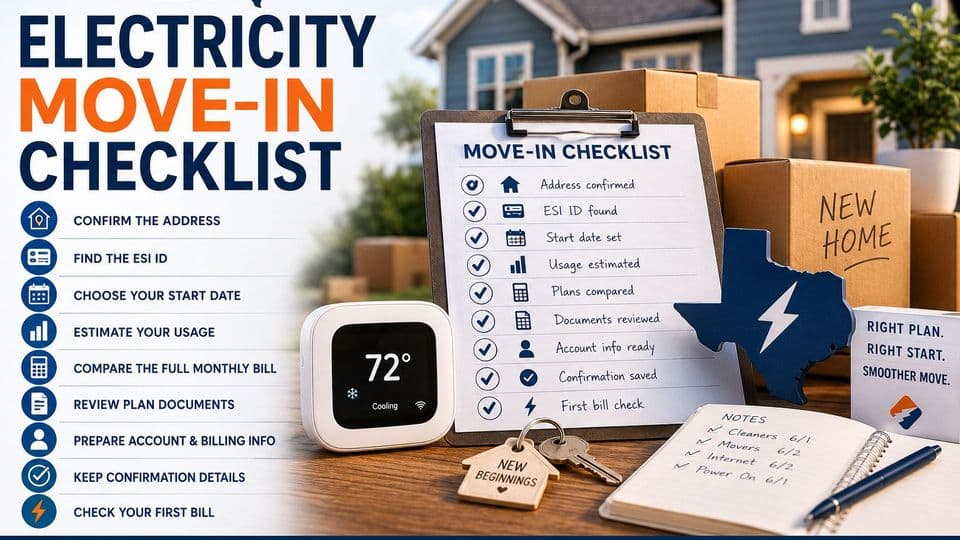
Moving into a Texas home is easier when the electricity setup is handled before move-in day. The goal is to match the right plan to the right meter, request the right service start date, and keep the documents you may need later.
This checklist is written for renters, homeowners, and anyone coordinating service for a new address in a deregulated Texas market. It supports the broader electricity guides library and connects naturally to the plan comparison flow once the address is ready.
1. Confirm the exact service address
Use the full service address, including unit number when applicable. A mailing address is not always enough. Apartments, townhomes, duplexes, and new construction addresses can have similar names but different meters.
If the address is new construction, ask the builder, landlord, or property manager whether the meter is active and whether the final service address has been registered. A small address mismatch can create enrollment delays. If the property has a gate code, building name, suite number, or separate garage meter, collect those details before contacting a provider.
2. Find the ESI ID if you can
The ESI ID identifies the electric meter for the address. If you have a prior bill, the ESI ID is usually on it. If not, use a provider or comparison flow that can look up the service address.
An ESI ID is especially helpful when a property has multiple meters or multiple units. It reduces the chance that service gets assigned to the wrong meter. If a landlord or seller can share an old bill with account details removed, the ESI ID can still be useful.
3. Pick a realistic start date
Choose the day you need power active, not just the lease or closing date. Some move-ins can be scheduled quickly, but availability depends on the meter, provider, TDSP, and whether the account needs special handling.
A same-day request may not always be available. If power must be active before movers, cleaners, contractors, internet installers, or appliance deliveries arrive, plan for that operational date rather than the first night you sleep in the home.
4. Estimate monthly usage
If you have prior bills from the same home, use them. If not, estimate based on home size, HVAC type, occupancy, pool pumps, EV charging, and work-from-home patterns. A plan that is cheap at 1,000 kWh may not be cheap at 750 or 3,000 kWh.
For homes with smart-meter access, the Smart Meter Texas guide can help explain how interval usage data supports better plan shopping. For a new home without history, compare multiple usage scenarios and avoid plans that only work at one narrow threshold.
If the prior occupant used far less electricity than you expect to use, do not rely on that history alone. A family with remote work, pets, electric heat, or EV charging can have a very different usage profile than the previous resident.
5. Compare the full monthly bill
Look beyond the advertised rate. Compare energy charges, base charges, TDSP delivery charges, usage credits, contract length, early termination fees, and renewable content.
The full bill matters more than the headline rate. Delivery charges are tied to the local utility territory, so the same provider plan can show different monthly costs in different service areas. If the home is in a territory with higher fixed delivery charges, a plan with a low energy charge may not be the cheapest total bill.
6. Review plan documents
Before enrolling, save or download the Electricity Facts Label, Terms of Service, and Your Rights as a Customer disclosure. These documents explain pricing, fees, contract rules, and customer rights.
If a plan includes bill credits, minimum usage, free nights, or other special terms, read the details carefully. The bill credit plan guide explains why usage thresholds can change the final bill.
7. Prepare account and billing details
Have the account holder's legal name, phone number, email, date of birth or identification details if requested, billing address, and payment method ready. Some providers may require a deposit or credit check. Others may offer prepaid or no-deposit options with different tradeoffs.
If a roommate or spouse will manage the account later, confirm whether they need to be listed as an authorized user. This avoids service problems when someone else needs to ask billing or move-in questions.
8. Keep confirmation details
After enrollment, save the confirmation number, start date, provider name, plan name, and customer service contact. If there is a move-in delay, these details make follow-up easier.
Keep the plan documents in the same folder as the lease, closing documents, or moving checklist. That makes renewal and dispute questions easier to resolve later.
9. Check your first bill
The first bill may cover a partial cycle. Confirm the plan name, meter, start date, rate structure, TDSP charges, and any deposit or one-time fees. If something looks wrong, contact the provider quickly.
If the first bill is much higher than expected, separate usage from pricing. A short or long billing cycle, deposit, connection fee, or unusual move-in usage can distort the first statement.
Common move-in mistakes
Do not wait until move-in morning if power is needed for cleaning, repairs, or deliveries. Do not choose a plan only because the 1,000 kWh average price looks low. Do not ignore the contract length if you expect to move again soon. Do not assume the retail provider repairs outages; the local utility handles wires and restoration.
Also avoid enrolling with an address guess. If the address lookup returns multiple meters or units, pause and confirm the correct one. Fixing a wrong-meter enrollment can take longer than getting the address right upfront.
Practical move-in rule
Set up electricity as soon as the address, expected start date, and account holder are known. Then compare plans by expected usage, save the documents, and check the first bill against the plan you selected.
Compare plans for your new ZIP code
Move-in electricity FAQs
Related pages
Sources & References
Editorial standards
SlashPlan publishes independent guidance to help Texans compare electricity plans. Our editorial team reviews each article without advertiser influence. See our editorial guidelines and monetization disclosure.
About the author
Roi CahanaEnergy advisor helping Texans better understand their electricity options and make more confident decisions. Focused on simplifying electricity plans, explaining confusing terms, and sharing practical guidance to help readers avoid common mistakes when comparing rates, contracts, and renewals.