Mistakes to Avoid When Choosing a Texas Electricity Provider
A practical guide to choosing a Texas electricity provider without getting tripped up by low advertised rates, plan-document fine print, renewal terms, outage confusion, or business-account contract issues.
Key Takeaways
- 1The cheapest-looking Texas electricity plan can be a poor fit if the price depends on usage assumptions, bill credits, tiers, fees, or time-based rates.
- 2The Electricity Facts Label and Terms of Service are the first places to verify fees, contract length, average price assumptions, renewable content, and provider information.
- 3Renewal offers, rollover language, and cancellation rules should be checked before a contract ends.
- 4Provider choice affects billing, notices, account support, and retail service issues, while outage reporting and restoration belong to the local delivery utility.
- 5Business accounts need an extra review for usage history, renewal timing, written contract terms, and any demand-related language in the applicable contract or tariff.
Choosing an electricity provider in Texas involves more than finding the lowest number on a comparison site. Many residents and business owners focus on the advertised rate, only to find their actual bills are higher than expected because of usage thresholds, hidden fees, or plan structures that don't match their lifestyle.
These common pitfalls when choosing an electricity provider in Texas can lead to bill shock and frustrating contract lock-ins. By understanding where these mistakes happen, you can shop with a critical eye and select a plan that actually fits your home or business.
A Cheap-Looking Plan Can Be a Bad Fit
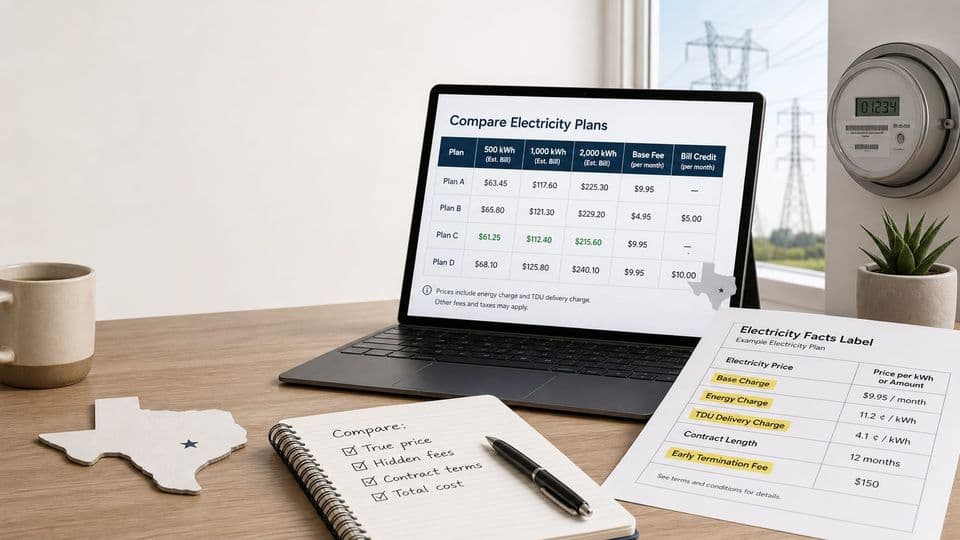
The most common mistake is assuming the plan with the lowest average price is the cheapest option for you. In the Texas retail market, providers use specific usage levels (like 500 kWh, 1,000 kWh, or 2,000 kWh) to calculate those advertised rates.
If your household uses significantly more or less electricity than the number used in the advertisement, your actual price per kilowatt-hour (kWh) will be different.
Before you sign up, look at your past 12 months of usage. If you are a low-usage consumer, a plan with a high base charge might cost you more than a slightly higher-rate plan with no base fee. Similarly, a cheap plan might include a bill credit that only applies if you hit a specific, high usage threshold every month. If you miss that threshold by even 1 kWh, you lose the credit and pay a much higher effective rate.
Your Usage Pattern Changes the Price
Texas electricity plans are designed with specific behaviors in mind. A plan that works for a family of five in a large home may be a disaster for a single person in an apartment.
You need to match the plan's structure to your actual consumption habits.
For example, "Free Nights and Weekends" plans sound appealing, but they often carry a much higher rate during the daytime hours. If you work from home and run your AC, computer, and appliances during the day, you will likely pay more overall. Conversely, if you are rarely home during the day, this structure could save you money.
Bill credits and usage tiers need your real kWh
Bill credits are one of the most misunderstood parts of Texas electricity plans. A provider might advertise a $50 credit on your bill if you use between 1,000 and 2,000 kWh. However, if you use 999 kWh, you get nothing. This creates a cliff effect where your effective rate spikes right before the credit kicks in.
Always check the Electricity Facts Label (EFL) to see exactly how these tiers and credits are applied across different usage levels.
The Advertised Average Price Has Assumptions Behind It
Every electricity plan in Texas must provide an average price per kWh based on specific usage levels, as required by state regulations. This number is a standardized metric, but it is not a guarantee of what you will pay.
The calculation includes the energy charge, the Transmission and Distribution Utility (TDU) delivery charges, and any fees or credits listed in the plan.
The mistake happens when shoppers treat this average price as the final word. You must look at the Price to Compare at the usage level that matches your home. If a plan's average price looks great at 2,000 kWh but you only use 800 kWh, that advertised number is irrelevant to your budget.
The Electricity Facts Label Is the First Document to Read
The Electricity Facts Label (EFL) is the most important document in the Texas energy market. It is a standardized disclosure that allows you to compare apples to apples between different Retail Electric Providers (REPs). Ignoring the EFL is like buying a car without checking the fuel efficiency or the warranty.

In the EFL, you will find:
- The exact energy charge (the rate you pay for electricity).
- The contract term length.
- The percentage of renewable energy fuel mix.
- The type of product (fixed, variable, or indexed).
- Any fees for early termination.
Terms of Service and customer rights are not optional reading
While the EFL covers the "what," the Terms of Service (TOS) covers the "how." The TOS explains the rules for billing, payment, and what happens when your contract is about to expire. Under Texas law, providers must also make available a "Your Rights as a Customer" document. Reading these documents helps you avoid surprises regarding deposit requirements, late fees, and how the provider handles disputes.
Early Termination Fees Can Change the Switching Decision
Many Texas electricity plans include an Early Termination Fee (ETF) if you cancel your service before the contract ends. These fees can range from $50 to $395, depending on the provider and the length of the plan.
A common mistake is signing a long-term contract (e.g., 36 months) for a slightly lower rate, without considering that prices may drop and you'll want to switch within that time. If you are unsure about your long-term housing plans, a 12-month plan might be a better choice, even if the average price is slightly higher. Always check the ETF amount in the Terms of Service before you commit.
Cancellation rules need the exact plan terms
Not all cancellation rules are the same. Providers in Texas offer a grace period of 14 days before the end of a contract where you can cancel without a fee. Others may waive the fee if you provide proof that you are moving out of their service area. These details are plan-specific, so you must read the fine print or call the provider to confirm their specific cancellation policy.
Renewal Offers
When your fixed-rate contract is nearing its end, your provider will usually send a renewal offer. A major pitfall is simply clicking accept on the renewal notice without checking the market. Often, the default renewal offer is a higher rate than what a new customer would receive.
In Texas, if you don't renew or switch before your contract ends, you may be moved to a month-to-month or holdover rate. These rates are often much higher than the market average. To avoid this, mark your calendar for 30 to 45 days before your contract expires. This gives you time to shop for a new plan or negotiate a better rate with your current provider.
Rollover language should come from the notice or contract
Check your contract for automatic renewal clauses. Some plans will automatically roll you into a new term at the current market rate if you don't give notice.
This might be convenient, but it could also lock you into a rate that is no longer competitive. Ensure you know the exact date your right to cancel without a penalty begins.
Fixed, Variable, and Time-Based Plans Create Different Risks
Choosing the wrong type of plan is a frequent mistake.
- Fixed-Rate: Your rate stays the same for the length of the contract. This offers stability but might mean you pay more if market prices drop.
- Variable-Rate: Your rate can change every month based on market conditions. This is risky during Texas summers when high demand can cause prices to spike.
- Time-of-Use (TOU): These plans charge different rates depending on the time of day. They require you to be very active in managing your energy usage (like doing laundry at 2:00 AM) to see savings.
If you prefer predictable bills, a variable-rate plan is likely a mistake. If you want the absolute lowest price and are willing to monitor the market, a fixed-rate plan might feel too restrictive.
Green Energy Claims
Many Texans want to support renewable energy. While Texas is a leader in wind and solar, green plans vary significantly. Some plans purchase Renewable Energy Credits (RECs) to offset your usage, while others might have a lower percentage of green energy than you assume.
The mistake here is assuming that a green label means 100% renewable. Check the EFL for the Fuel Mix disclosure. This will tell you exactly what percentage of your electricity comes from wind, solar, and other sources. Also, verify if there is an extra green premium added to your rate that isn't immediately obvious.
Provider Ratings Do Not Tell the Whole Service Story
It is easy to get caught up in online reviews or star ratings for electricity providers. While customer service is important, a 5-star rating doesn't mean much if the plan's math doesn't work for your home. Conversely, a provider with average reviews might offer a rock-solid fixed rate that saves you hundreds of dollars.
Focus on the plan first and the provider second. However, you should check if a provider has a history of billing errors or unexplained fees. The Texas Public Utility Commission (PUC) maintains complaint data that can give you a more objective look at a company's reliability than a curated review site.
Outages Belong to the Delivery Utility, Not the Energy Company
A major point of confusion for Texas shoppers is who to call when the power goes out. Choosing a new Retail Electric Provider (REP) does not change who maintains the poles and wires. That job belongs to your local Transmission and Distribution Utility (TDU), also known as a TDSP.
In Texas, the main TDUs are:
- Oncor: Serves Dallas, Fort Worth, and parts of West Texas.
- CenterPoint Energy: Serves the Houston area.
- AEP Texas: Serves parts of South and West Texas.
- TNMP (Texas-New Mexico Power): Serves specific communities across the state.
If your power goes out, you must call your TDU, not your retail provider. Your retail provider manages your bill and customer service, but they cannot restore your power.
REP support and TDU restoration
When you have an issue, knowing who to contact saves time. If your bill is wrong or you want to change your plan, contact your REP.
If your lights are out or you see a downed wire, contact your TDU.
Mistaking one for the other is a common frustration for new Texas residents.
Business Accounts Need More Than Residential Plan Math
For business owners, the stakes are higher. Commercial electricity plans in Texas are more complex than residential ones. A common mistake is using a residential mindset (focusing only on the lowest rate) for a business account.
Businesses often have demand charges, which are based on the highest amount of power used at any single moment during the billing cycle. A plan with a low energy rate but high demand charges can be very expensive for a business with high-powered equipment. Business owners should always review their interval data (hourly usage) and consult the specific tariff sheets for their TDU before signing a contract.
4CP For Commercial Energy Plans
For larger commercial users, the "Four Coincident Peaks" (4CP) can significantly impact transmission charges. This refers to the four peak-demand hours during the year when the entire ERCOT grid is under the most stress. If your business uses a lot of power during those specific hours, your transmission costs for the following year will be higher.
This is an advanced topic that requires a deep dive into ERCOT market mechanics and your specific TDU tariff. If you are a small business or a residential customer, you generally do not need to worry about 4CP. However, if you are a large industrial user, failing to account for 4CP in your energy budget is a costly mistake.
The Safest Move Is a Short Pre-Sign Review
Avoiding these mistakes doesn't require a degree in energy economics. It just requires a 15-minute review before you enroll. Use this checklist to ensure you aren't making a decision you'll regret:
- Check your usage: Look at your last 12 months of bills. Do you use 500, 1,000, or 2,000+ kWh per month?
- Read the EFL: Find the rate at your specific usage level, not the advertised average.
- Check for base fees: Does the plan charge a monthly "base charge" even if you use zero electricity?
- Understand the contract length: Are you comfortable with a 3-year lock-in?
- Know your TDU: Make sure you know who to call if the power goes out.
- Set a renewal reminder: Put a note in your phone for 60 days before your contract ends.
Texas Electricity Provider Mistakes FAQs
Helpful Texas Electricity Guides
Sources & References
Editorial standards
SlashPlan publishes independent guidance to help Texans compare electricity plans. Our editorial team reviews each article without advertiser influence. See our editorial guidelines and monetization disclosure.
About the author
Roi CahanaEnergy advisor helping Texans better understand their electricity options and make more confident decisions. Focused on simplifying electricity plans, explaining confusing terms, and sharing practical guidance to help readers avoid common mistakes when comparing rates, contracts, and renewals.
Ready to compare plans?
Enter your ZIP code to see electricity plans available at your address.