Electricity for Texas Homebuyers: Move-In Service Guide
A practical explainer for Texas homebuyers and residential movers who need to set up or transfer electricity service, understand provider and utility roles, and avoid move-in service confusion.
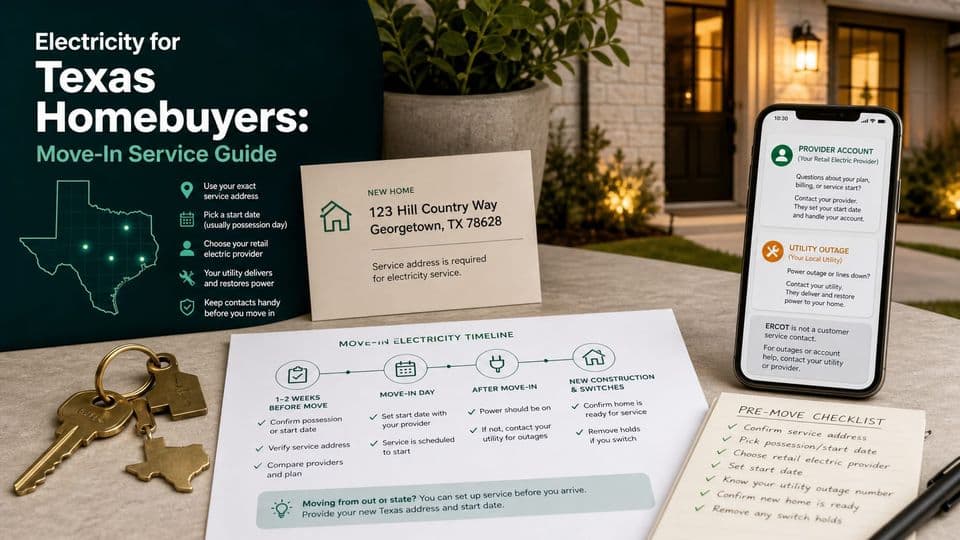
Key Takeaways
- 1Texas homebuyers should confirm the exact service address, possession or move-in date, and account responsibility before assuming electricity will be ready.
- 2A retail electric provider and a local utility can have different responsibilities in competitive Texas electricity areas.
- 3Outage and delivery emergencies usually go to the local utility, while billing and account questions go to the retail electric provider.
- 4Moving from another state, moving within Texas, new construction, and second homes can each change what needs to be confirmed.
- 5Before move-in, the buyer should save both the provider account contact and the local utility outage contact for the service address.
Electricity for Texas Homebuyers: Move-In Service Guide
When you buy a home in Texas, one of the first practical steps is making sure the lights turn on the day you move in.
That sounds simple enough, but a few things about how electricity works in Texas can trip up even experienced homebuyers.
The system separates the company you pay from the company that fixes a downed line. The start date depends on when you actually take responsibility for the property, not just when you close. And everything starts with one detail, your the exact service address.
This guide walks through the steps you need to get electricity running at your new Texas home, explains who to call for different problems, and covers the edge cases that can catch new homeowners off guard.
Start with the exact service address
The exact residential service address for the property is the single most important piece of information for setting up electricity. The address on the deed, the address on the mailbox, and the address the electric system uses can sometimes differ, especially in newer subdivisions, condos, or properties with unit numbers.
Before you call anyone about service, make sure you have the address as the local electric grid recognizes it.
City name is not enough
A city name by itself can be misleading in Texas. Two homes on opposite sides of the same street might fall into different utility service areas, and that changes who handles delivery and outage response. ZIP codes can overlap service territories too. The only reliable way to check is to use the exact street address with unit or lot numbers if they apply.
Confirm unit numbers and new subdivision addresses
If the property is part of a multi-unit building, a duplex, or a new subdivision where street names were recently assigned, double check that the address a provider would use matches what the local utility has on file. A missing unit number or an outdated address can delay service and lead to confusion about which utility handles delivery for the property.
Match electricity timing to possession and move-in
The date you close on the house and the date you are responsible for electricity might not be the same. The key is to know when you actually take possession of the property.
Closing date and move-in date can differ
Many buyers close on one day, take possession on another day, and physically move in later. The electricity start date should align with the date you become responsible for the property, not the date you sign papers.
If the seller still has active service at closing, they may need to cancel it, and you need to start your own service in time for possession.
Ask who controls service before the start date
It is common for a seller, builder, landlord, or prior occupant to still have an active account at the address. You cannot assume the power will be on unless you confirm that the previous account is disconnected and your service is scheduled.
Check with the current account holder or the provider about when control changes. The right timing depends on the actual address and account situation, not a universal rule.
Retail providers and local utilities do different jobs
If you are new to Texas, the split between retail electric providers and local utilities can be confusing. In most of the state, these are two different organizations with separate responsibilities.
The provider handles the account
In competitive areas, the retail electric provider is the company you sign a contract with, pay your bill to, and contact for account questions. You can choose among many providers in these areas. The provider manages the customer side of your electricity service.
The utility handles local delivery
The local utility owns and maintains the poles, wires, transformers, and meters that deliver electricity to your home. You do not choose the utility. It is tied to the physical service address. When the power goes out or a line falls, the utility is the right contact, not your provider.
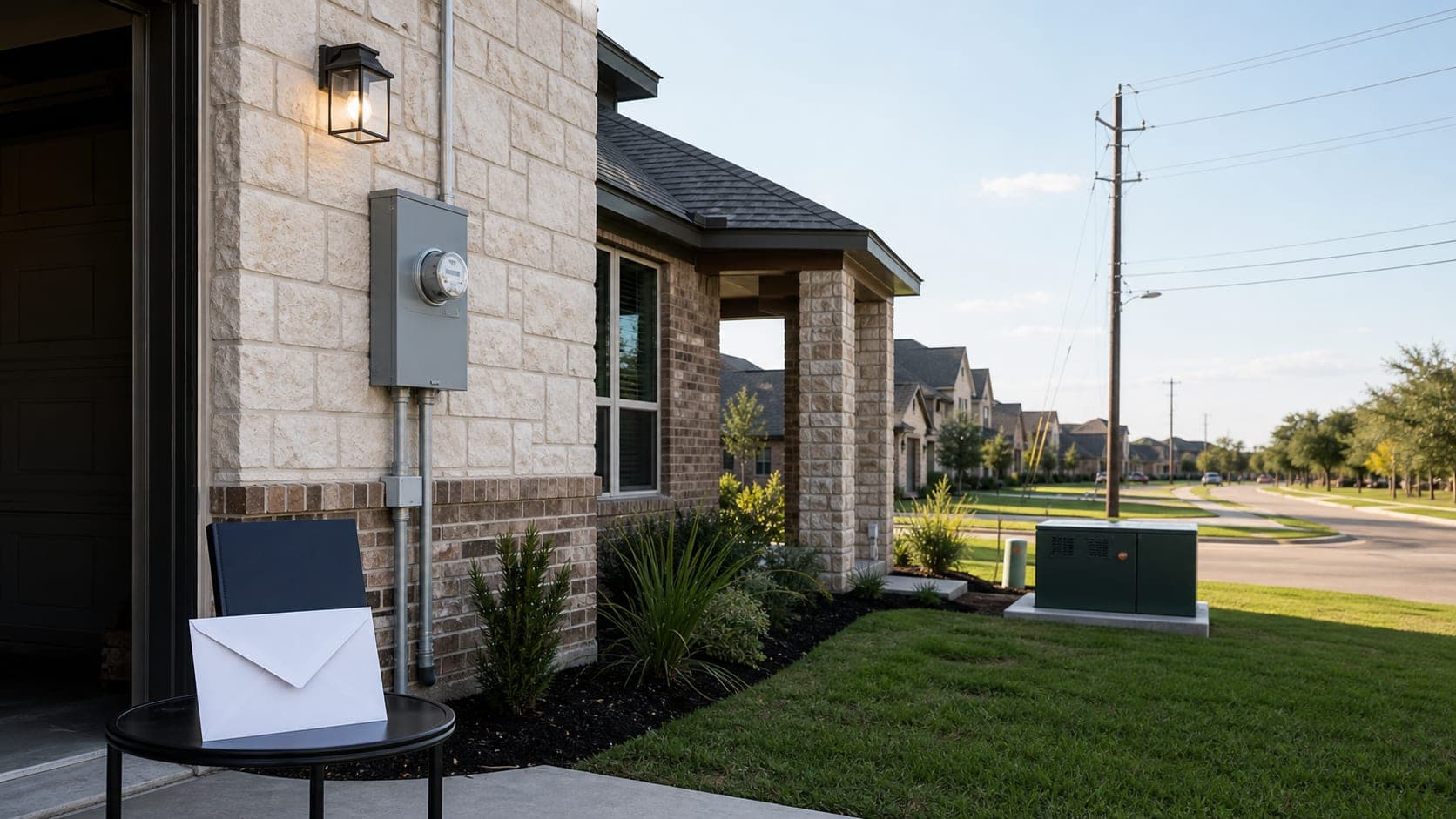
Knowing this split matters most after move-in. If your power goes out after a storm, calling your provider can waste time. The provider cannot fix a broken power line, only the local utility can.
Outage questions go to the utility after move-in
Once you are in the house, the most important phone number is the one for your local utility, not your provider.
Outages, downed lines, sparks, and other delivery emergencies belong to the utility for that address.
Save the utility outage contact
Before move-in day, look up the outage reporting number for the utility that serves your property. Keep it in your phone and in a visible spot. That contact will change if you move to a different utility area, so confirm it for every new address.
ERCOT is not the billing or outage contact
You may hear about ERCOT because it operates most of the Texas power grid. But ERCOT does not handle customer accounts, billing, or neighborhood outages. If you call ERCOT about a downed line or a bill, they will redirect you to your utility or provider. Save ERCOT for grid-level news, not for daily service needs.
Moving from another state can feel different in Texas
Buyers coming from other states often find the Texas system surprising.
In many parts of the country, one utility company handles everything from the bill to the outage. In Texas, that single-company model exists only in areas that are not part of the competitive electricity market.
Some addresses have customer choice and some do not
Most of the state is in the competitive market where you choose a retail provider. But some areas, particularly those served by certain municipal utilities or electric cooperatives, do not offer customer choice.
In those areas, you get electricity from the local utility and cannot pick a different company. Your service address tells you which system applies.
The first practical step remains the same: confirm the exact service address to know which utility handles delivery and whether you have provider choice.
An in-state move may still change the service process
Even if you already live in Texas, moving to a new address can change how your electricity service works.
A new utility area can change the next step
Moving from one part of town to another might seem minor, but if the new address falls under a different local utility, you will need to learn a new outage contact and possibly a new set of service procedures. Your old provider may not serve the new area.
Service transfer depends on the new address
Some providers allow you to transfer service from one address to another, but eligibility depends on the new address and the terms of your current account.
Do not assume a transfer is automatic. Confirm the process with your provider before the move and make sure the new address is within their service area. If it is not, you will need to choose a new provider.
Check basic service documents without turning this into plan shopping
You do not need to become an expert in electricity plan documents just to get the lights on. But a quick review of the account terms before service starts can prevent surprises.
Focus on the account holder name, service address, service start date, customer service contact for your provider, and the utility outage contact for the address.
The first bill after service starts is a good time to verify that everything matches. If the address or start date is wrong, catch it early.

Keep account contacts separate from outage contacts
Put the provider contact and the utility outage contact in different places if that helps. But the key point is to have both numbers easily reachable. When the power goes out at 11 PM, you do not want to search for the right number.
Switch holds and account issues can affect a move-in
Sometimes a previous occupant or a past account issue can make it harder to start new service. This is known as a switch hold, and it can delay your move-in if you do not know about it ahead of time.
A switch hold typically means the account at that address has an unresolved balance, meter issue, or other problem that prevents a new provider from taking over. You may need to contact the local utility or the provider to resolve it before service can begin.
Do not assume the prior occupant's issue is yours
If a hold appears, it does not automatically mean the debt is yours. But it can still cause a delay. The fastest way to handle it is to confirm the exact nature of the hold with the utility or provider and follow their instructions. For detailed guidance on this topic, look for dedicated resources that cover switch holds in Texas specifically.
New construction needs builder and utility confirmation
A brand new home adds another layer of verification. Because the address might be new, the electric service records may not yet be set up for residential use.
Ask whether the address is ready for residential service
Before you contact a provider, confirm with the builder or the local utility that the address is ready for a residential electricity account. Sometimes a new construction home still has temporary construction power, and the meter needs to be set for permanent service. The builder should have the instructions or a contact at the utility. Do not assume the meter is active or that the utility already has the address in their system.
Before move-in, save a short electricity checklist
Here is what you should have written down or saved in your phone before the first night in your new home.
- The exact service address as the utility recognizes it, including unit numbers or lot designations.
- The possession date or move-in date that determines when you need service to start.
- The name and contact number of the retail electric provider that will handle your account.
- The outage and emergency contact number for the local utility that serves your address.
- Confirmation that the previous occupant's account is disconnected and your service is scheduled.
- For new construction, confirmation from the builder or utility that the address is ready for residential electric service.
- For a second home or occasional-use property, confirmation of the service start date and any occupancy requirements the provider may have.
Save both the provider account number and the utility outage number. You will need the provider number for billing questions and the utility number for power problems.
Having both ready before move-in day means one less thing to worry about when you are unloading boxes and checking that the air conditioning works.
Electricity for Texas homebuyers FAQ
Topics
Editorial standards
SlashPlan publishes independent guidance to help Texans compare electricity plans. Our editorial team reviews each article without advertiser influence. See our editorial guidelines and monetization disclosure.
About the author
Roi CahanaEnergy advisor helping Texans better understand their electricity options and make more confident decisions. Focused on simplifying electricity plans, explaining confusing terms, and sharing practical guidance to help readers avoid common mistakes when comparing rates, contracts, and renewals.
Ready to compare plans?
Enter your ZIP code to see electricity plans available at your address.