Electricity for College Students in Texas
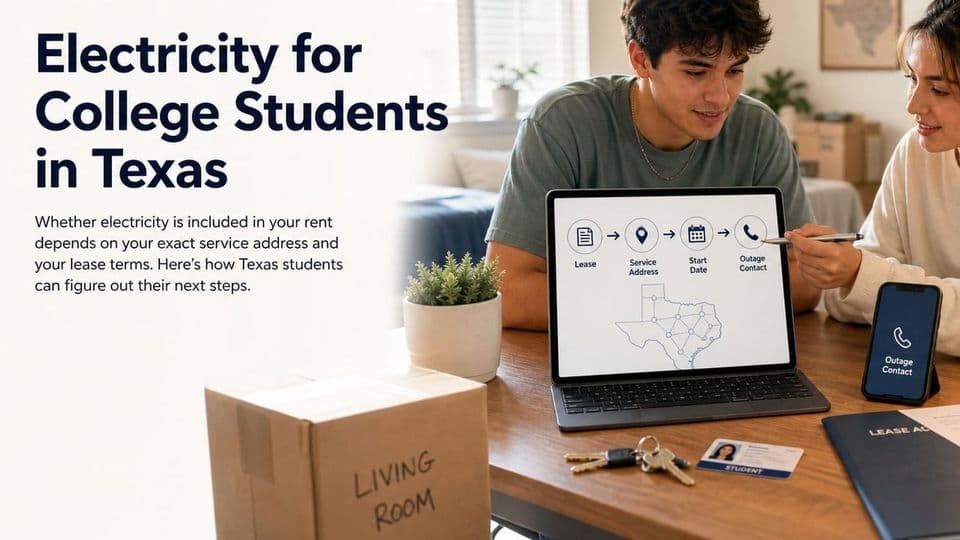
Electricity responsibility depends on the housing setup. A dorm, an all-bills-paid student apartment, and a standard off-campus rental can each handle electricity differently, so students should confirm the details before move-in day.
Key Takeaways
- 1College students should first check whether electricity is included in housing, billed through the apartment, or required in their own name.
- 2Dorms, all-bills-paid student apartments, and standard off-campus rentals can handle electricity differently.
- 3In some Texas areas, the account company and the local utility may handle different parts of service.
- 4The exact service address matters because a campus ZIP code, family home, and apartment unit may not follow the same electricity setup.
- 5Before move-in, students should confirm the start date, proof-of-service requirement, leasing-office instructions, and shared-housing responsibilities.
- 6No-deposit, no-credit-check, and average-bill claims can depend on the address, provider, timing, and account terms.
Most Texas college students do not automatically need to set up their own electricity account. The actual responsibility depends on where you live, what your housing contract says, and which entity handles billing at your address. A dorm room, an all-bills-paid student apartment, and a standard off-campus rental can each handle electricity differently, so the first step is to confirm the details before move-in day.
First check who controls electricity in the housing agreement
Your housing agreement decides who is responsible for electricity. This can be a school housing contract, a lease with a private property management company, or a month-to-month rental agreement. The document itself tells you whether the electricity is included, billed separately through the property, or set up in the tenant's name.
Campus housing and residence hall contracts
Most on-campus residence halls include electricity in the housing charge. The university or college handles the utility billing on the back end, and the student does not set up a separate account. The official housing contract or residence life portal usually states this clearly. If you live in a campus apartment managed by the school, check the same contract because some campus apartments still include utilities while others may not.
Student apartments, rentals, and utility add-ons
Student apartments vary. Some buildings include electricity in the rent. Others bill electricity through the apartment's own utility system, where the property charges you each month for what the unit used. Other off-campus rentals require the tenant to open an account with a retail electric provider and pay the provider directly.
The leasing office or lease language is the only reliable source. If the lease says "all utilities included," ask the office to confirm exactly which ones. If the lease says the tenant is responsible for electricity, ask whether the apartment has a preferred provider list or a required sign-up process.
Texas electricity service can involve an account company and a local utility
In many parts of Texas, the company that sends your bill is not the same company that maintains the poles, wires, and meters. The retail electric provider handles the account and billing. The local utility, sometimes called the transmission and distribution utility, handles outages, meter reads, and physical infrastructure.
Retail electric provider, local utility, and outage contacts
If your apartment requires you to set up electricity, you may have an account with a retail electric provider. That provider sends bills and handles account questions. If the power goes out across the area, you usually contact the local utility, not the retail provider. The utility's contact information depends on the service address, not on which retail provider you choose.
Address-dependent service in deregulated and non-deregulated areas
Not every Texas address works the same way. Some parts of the state are deregulated, which means the customer can choose a retail electric provider. Other parts are served by a municipal utility or an electric cooperative, and the customer does not choose a separate provider. The service structure depends on the exact address, so students should not assume their hometown process applies to their college address.
Use the exact service address before assuming anything

Always use the exact apartment address and unit number when you check electricity responsibility. A campus building name, a general ZIP code, or a nearby intersection can point you to the wrong information. The actual unit determines which utility serves the building and whether the electricity is included.
Apartment number, service address, and requested start date
When you contact the leasing office or a utility, have the full service address ready. This means the building number, the street address, and the apartment number. Also ask for the move-in date that should appear on the account. If the lease starts on the first of the month, ask whether the electricity needs to be active on that date or whether the apartment handles a transition period.
Proof of service if the lease asks for it
Some leases ask the tenant to provide proof of electricity service before move-in. This usually means a confirmation email, an account number, or a service start letter. If the apartment includes electricity, the leasing office may instead give you a document that says utilities are included. Keep a copy of whatever proof the office requires because some buildings will not release keys until the paperwork is complete.
Ask the school or leasing office these questions before move-in
You can avoid most move-in electricity problems by asking a short list of questions before you sign the lease or arrive on campus.
Electricity included, capped, or billed separately
Ask the school or the leasing office whether electricity is included in the rent, capped at a certain allowance, billed back by the apartment based on usage, or set up separately in the tenant's name. Each option changes what you need to do before move-in.
Move-in desk documents and deadlines
Ask what documents the move-in desk needs on the day you pick up your keys. If the office needs proof of electricity service, ask what format the proof should take and who should be listed as the account holder. Also ask whether the building requires the electricity to be in the student's name only or whether a parent or guardian can be the account holder.
Roommates need a simple responsibility plan
When several students share an apartment, only one person may be the named account holder for the electricity. That arrangement works as long as everyone understands how costs and notices are handled.
One account holder and several roommates
If the apartment requires a separate electricity account, the provider usually names one person as the account holder. That person receives bills, disconnection notices, and deposit requests. Roommates should decide in advance how they will split the cost and how they will share account notices so that one person does not miss an important email.
Move-out timing when one person leaves early
Roommate arrangements can change mid-lease. If one person moves out before the lease ends, decide what happens to the electricity account. Some roommates keep the account in the same person's name and settle costs informally. Others change the account holder through the provider. The lease and the provider's rules decide what is allowed, so check both before making changes.
No-deposit and no-credit-check claims need careful sourcing
You may see advertising that mentions no-deposit or no-credit-check electricity. These claims appear in commercial electricity pages, but they do not apply the same way to every student or every address.
Deposit and credit claims need to be checked
If you think you may qualify for a no-deposit or no-credit-check arrangement, verify the details with official documents, not with an advertisement. Deposit rules can depend on the provider, the applicant's credit history, the address, and the type of lease. The only reliable answer comes from the provider's current account terms or from the leasing office if the apartment handles electricity through its own system.
Low usage matters, but average bill can mislead students
Student apartments often use less electricity than larger homes, but that does not mean every student apartment has a low bill. Usage depends on the unit size, the number of roommates, the HVAC settings, the appliances, and how much time you spend inside the apartment.
Student routines that change electricity use
A student who takes most classes in person and studies at the library may use very little electricity during the day. A student who takes online classes at home and runs the air conditioning every afternoon may use more. Laundry in the unit, an electric stove, and a gaming computer also change usage. Because routines vary, a general average bill number may not match your actual costs.
Average-bill numbers need fresh source data
Average bill and usage numbers change over time. They also differ by city, by building type, and by meter-read period. If you see an average bill claim on a website or an advertisement, treat it as a very rough estimate rather than a guaranteed result. Your lease terms, your unit's efficiency, and your daily habits matter more than a statewide average.
College towns can have different electricity setups
Texas college towns do not all handle student electricity the same way. A student in Austin may face a different setup than a student in College Station, Lubbock, or El Paso. The difference comes from local utility boundaries, municipal utilities, electric cooperatives, and deregulated areas.
The only way to know your next step is to check the service address and the housing documents. Do not assume that a process used by a friend at another school applies to your building. The leasing office, the school housing portal, or the local utility website can give you address-specific instructions.
Power outages should go to the right contact
If the power goes out, the correct contact depends on where you live and which utility serves the address.
If you live in a dorm or an all-bills-paid building, contact the front desk or the maintenance office first. The problem may be a tripped breaker inside the building rather than a widespread outage.
If you live in an off-campus rental and you have an account with a retail electric provider, check the local utility's outage map or call the utility's outage number. The utility handles the poles, wires, and meters, so the utility restores power after a storm or a local equipment problem.
Save the correct outage contact before you need it. Write down the local utility name, the outage phone number, and the online outage reporting link. Store them with your other move-in papers so you are not searching for the information in the dark.
A move-in electricity checklist catches the loose ends
Use this short checklist during the week before you move in:
- Confirm whether electricity is included, billed through the apartment, or set up in your name.
- Write down the exact service address, the apartment number, and the move-in date.
- Ask the leasing office or the school housing office what proof of electricity they need before move-in.
- Decide with your roommates who will be the account holder if the apartment requires a separate account.
- Save the account contact, the leasing office number, and the local utility outage contact in your phone.
- Check the lease or the housing contract one more time so you know who to call for electrical problems inside the unit.
The goal is not to become an electricity expert. The goal is to know who handles the power at your address, what your housing contract requires, and which phone number to call when something stops working.
If you confirm those three things before move-in, you can spend less time on paperwork and more time on classes, work, and campus life.
Editorial standards
SlashPlan publishes independent guidance to help Texans compare electricity plans. Our editorial team reviews each article without advertiser influence. See our editorial guidelines and monetization disclosure.
About the author
Roi CahanaEnergy advisor helping Texans better understand their electricity options and make more confident decisions. Focused on simplifying electricity plans, explaining confusing terms, and sharing practical guidance to help readers avoid common mistakes when comparing rates, contracts, and renewals.
Ready to compare plans?
Enter your ZIP code to see electricity plans available at your address.